Is your brand stuck on the performance plateau?

What is it, why are you stuck on it, how are you going to get off it?

It’s become common for brands with a performance mindset, to hit a growth plateau. Let’s call it the ‘performance plateau’. If you think you may have hit it, you’re far from alone. From the number of companies I’ve seen grappling with the issue in recent years (and long before talk of recession), it seems to be endemic in marketing today. And it’s not just SMEs and scaleups, even big names can be affected.

It’s a problem that seems to have its roots in the performance-oriented mindset of the millions of SMEs who make up the bulk of today’s advertisers, and the continuation of that mindset well past the point when their scale suggests they should have adopted a more balanced marketing approach.

TL;DR: what got you where you are now, won’t get you where you want to go.

What is it?

It’s about brands getting to a point where the success of their traditional mix of search, social and display advertising levels off, leaving them looking around for new ways to grow.

The story often goes a bit like this…

A brand’s initial growth has stalled. Customer acquisition costs are higher than ever, previously good return on ad spend (ROAS) has fallen. Everything’s become inefficient and more efficient ad buys are harder to come by. You’re not sure where new customers are going to come from. Everything you thought worked doesn’t seem to work so well any more. A previously direct link between advertising and growth seems to have been weakened. All the low-hanging fruit seems to have been picked.

Within the marketing team nervousness is setting in, and beyond it founders and investors are starting to question everything.

“We used to be able to put £1 in and get £1.70 back. That’s just not happening any more. At best we have to put £1.50 in for the same return but investors are starting to ask tough questions about where growth is going to come from,” an anonymous founder told me.

The performance plateau seems to be something you have to go through these days to make the transition to maturity as a marketing organisation. It’s like working through the gears on a bike: you’re no longer able to pedal faster in a lower gear so you’re going to need to invest more effort in higher gears to start accelerating.

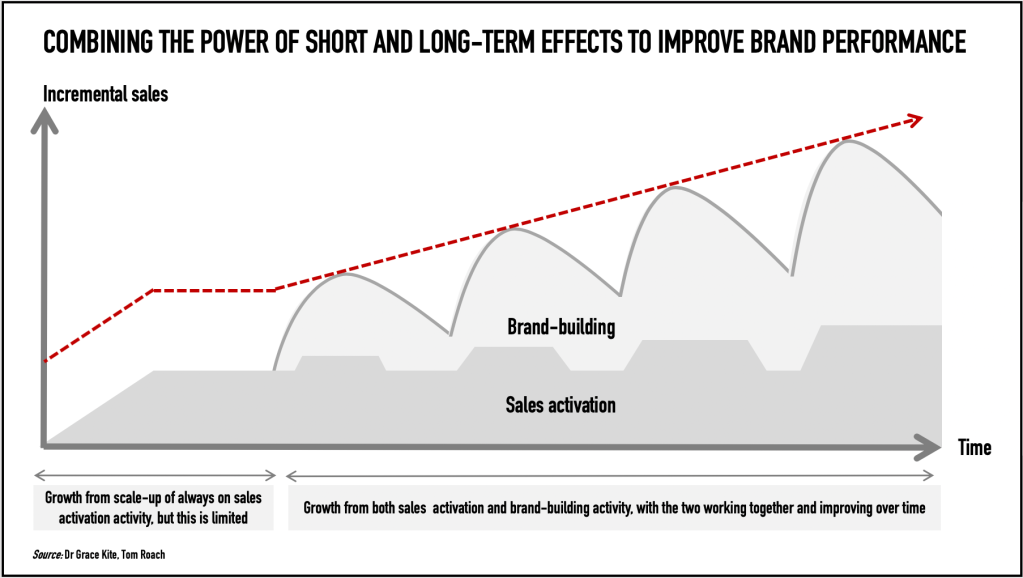
Econometrician Dr Grace Kite’s work had been pointing to this as an issue for performance-driven brands, and the chart below, based on her econometric modelling for a wide range of digital-first brands, was created by us to capture this moment and describe the benefits that can come later once a more balanced approach is deployed.

When presenting this chart we’ve both seen just how much the plateau resonates with marketers. On the chart it looks placid, but in reality it can feel existential.

Who’s affected?

Over the last year I’ve spoken to around a dozen brands in this situation. Businesses of different sizes, both B2C and B2B. They include a weight loss app, a B2B data viz platform, a buy now, pay later payment brand, a major US D2C mattress brand, and a mobile gaming platform. At a conference for FMCG brands recently, who Grace and I were presenting to, when Grace asked if they’d experienced this, around 80% of people’s arms shot up. So if you’re experiencing it too you’re not alone.

And it’s not just small- and medium-sized brands who can find themselves on the performance plateau. Even huge brands who’ve taken some wrong turns can also find themselves on it.

Recently we’ve seen Airbnb and Asos admit to a chronic over-reliance on performance and a subsequent shift in balance towards brand-building activity as they look to put an era of sluggish growth behind them. Of course, this won’t have been the only cause of their problems, but it doesn’t invalidate the point.

I know from personal experience there were many people who tried to persuade Asos of the dangers of their approach. Many others will have similar cautionary tales from other businesses.

Regardless of the economic environment right now, there’s definitely a common thread: a brand has success with performance marketing, doubles down on it, but later realises it wasn’t helping them achieve long-term growth, and belatedly course-corrects to a more balanced approach.

Why it happens

What happens is that the platforms are great at helping brands optimise their direct response advertising, but once spend is maxed out on them, brands are far from ready to make the transition to taking a more balanced ‘full-funnel’ approach.

Performance-oriented brands can lack the skills, experience, people and partners needed to take them to the next level. Essentially there’s friction in the system that creates massive delays in brands’ ability to recognise they have an issue, and get themselves geared up to kickstart their growth again.

Getting beyond the plateau

Every brand of course needs its own bespoke growth strategy. No article can tell you how to develop one, but it can point to what connects brands that have successfully navigated this moment.

It often includes developing a new philosophy about how marketing and advertising work to grow brands; a new growth model defining how it will work for your brand; new people and maybe new partners; new measurement and metrics.

That’s a lot of new stuff to learn and do, which may explain why the plateau can last a long time. So here are some key things for brands to think about as they plot their new path.

1. Unlearn what you know

The first major thing that connects the brands that get off the plateau is that they go through a period of introspection and analysis, unlearning and learning, about how brands grow and how marketing and communications work. This has to be something the whole team goes through together with a brand’s leadership: this will all be pointless if your leadership isn’t on the journey.

This is probably the hardest step as it will involve challenging people’s existing views. There’s a considerable body of knowledge out there on this, built up over decades, that can help. Mark Ritson’s Mini MBA covers much of it. Here’s an article from the reading list on the topic of ‘bothism’ that seems to help brands at this point: The wrong and the short of it. And this is Grace Kite’s typically practical, real-world take on the topic.

Performance-oriented people can tend to be quite left-brained in their worldview. Theirs is a world where you put X in knowing you will get Y out. A world where everything can be tested and the correct answer is known instantly. But where you’re going things don’t quite work like that. You’ll need to get comfortable with a greater level of ambiguity, with irrational consumers, qualitative research, the huge variation of effects from different creative campaigns. Where you’re going you’ll need balance: of data and judgement, technology and creativity, art and science, long and short. You won’t get off the performance plateau armed with spreadsheets alone.

2. Know your (growth) audience

Digital-first brands, and D2C brands in particular, often believe they know their audiences inside out. But owning the data on what existing customers do on your digital real estate isn’t going to be enough. You’re going to need to really understand all category buyers, and especially non-users and very light users of your brand who are going to be disproportionately important to you now.

Get to know the people who couldn’t care less about you just as well as those who love you, and work out what you need to do to attract them. Chances are you’ll discover it’s got a lot to do with not being known by them, not being thought of in the right moments, your brand not being associated with the right things. Understanding your growth audience inside out is fundamental to your positioning, and will be essential to unlocking your next phase of growth.

3. The importance of reach

One of the most common data-points that helps brands off the performance plateau is the LinkedIn B2B Institute’s ‘95:5 rule’, which suggests roughly 95% of category buyers are not in-market at a given time (this is an average for B2B brands; B2C brands will likely have a similar but less stark ratio). Working this out for your brand can help you learn how important the ‘upper funnel’ is to your brand, and just how little most people will be thinking about a category or brand at any point. It’s a simple but powerful tool in helping brands understand the need to achieve much broader reach.

Meta has been preaching reach over tight targeting for some time now, and has good evidence that achieving greater reach among category buyers drives growth. In a meta-analysis by Meta of 40 ‘conversion lift studies’ it saw an 87% correlation between the size of the audience reached and the volume of incremental purchases.

But reach is expensive right? Not necessarily. New data from Meta aimed at performance advertisers shows the impact of adding ‘reach’ campaigns to the mix: it claims you can double reach for only 36% greater spend, and that adding reach as an objective can drive an 84% organic search lift versus performance campaigns alone. And most importantly that adding reach to Meta performance campaigns can deliver 18% more incremental sales than performance campaigns alone.

4. Build a growth model

At the IPA Effworks conference recently, Gousto CMO Tom Wallis presented their ‘journey from performance to brand’. Gousto never got stuck on the performance plateau in the first place: it made the leap before that could happen.

They’d seen some classic signs that the time was right to transition from performance to brand, including low brand awareness, low share of voice and low market share in a competitive mass market category, and a maximised performance spend versus a major growth opportunity.

The tipping point for them came in 2017, when 100% of adspend was on performance and 0% was on brand, and 80% of their customer acquisition was from paid ads, but only 20% was organic. Gousto was too reliant on ads: switch them off and sales would mostly stop.

Gousto developed a simple performance model illustrating how brand activity would create a ‘demand pool’ of future potential customers.
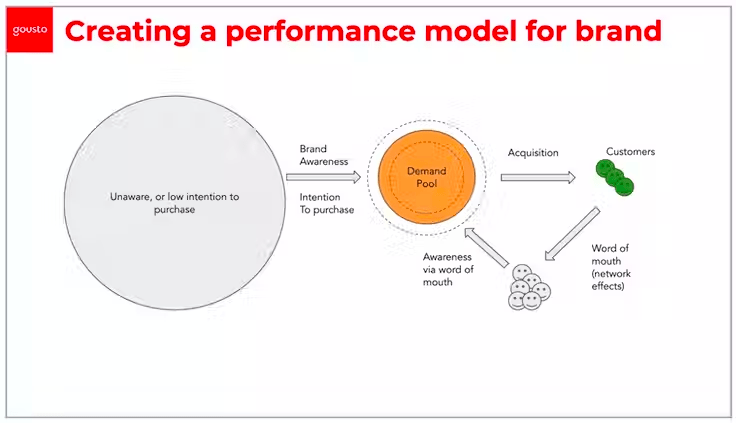
They ended up optimising their plan to a balance of 60% brand and 40% performance (the data took them there, they weren’t aiming to mirror Binet & Field’s rule of thumb), and by 2020 75% of Gousto’s customer acquisition was organic and only 25% was from paid ads. Layering in brand advertising had created a large reservoir of future customers and a more reliable source of future revenue.

If you’re too reliant on paid ads, then you need to develop your base sales. To do that you’re going to need to build a stronger brand. A stronger brand will mean stronger residual awareness, familiarity and understanding of what you offer that can generate future cashflow. A brand isn’t a luxury, it’s future cashflow.

5. Get the best of both

At this point many brands think that adding upper funnel activity just means adding TV (or CTV) to their digital media. TV has always been the long and short channel par excellence so it’s not a terrible assumption to make.

But some excellent new research exploring the power of digital channels to drive both short- and long-term ROI suggests many digital channels are also able to deliver both.

Meta’s long-term MMM study by Nepa shows (for a set of six retail and telco brands in the Nordics) that a variety of digital channels can deliver both short- and long-term growth so could be part of a balanced plan. TV may well prove to be a useful part of your mix but ask a media strategist. Don’t start by assuming that’s the case.

It’s about much more than advertising

Getting beyond the performance plateau takes a lot.

Leadership, vision, culture, the right team and structure. Training, education, expertise and experience. Aligned KPIs and incentives. Ideally brands would avoid creating a performance marketing culture in the first place and instead aim to build a marketing performance culture.

It’s not easy and it’s going to take time, a resource that may be in short supply if you do find yourself on the plateau right now.

For some, sadly, it will be too late to fix the roof given the sun has stopped shining. For many others though, it could still be a good time to strengthen the foundations.
Beware of ROAS, ROI’s dangerous digital twin

[First published in Marketing Week 12th October 2022]

Too great a focus on return on ad spend (ROAS) is leading to short-term thinking and under-investment, which in turn is stifling growth, and it has the potential to be far more damaging than ROI.

People have been warning about the potential problems with ROI for years. But its digital twin, ROAS (return on ad spend), might actually be doing more damage today. In fact you could call ROI and ROAS allies in marketing’s anti-growth coalition.

If ROI’s dangers can seem quite theoretical, ROAS’s dangers, while similar, are actually a day-to-day reality in significant parts of the digital marketing world.

Before turning to ROAS, let’s quickly recap the core issues it shares with ROI.

ROI’s issues in brief

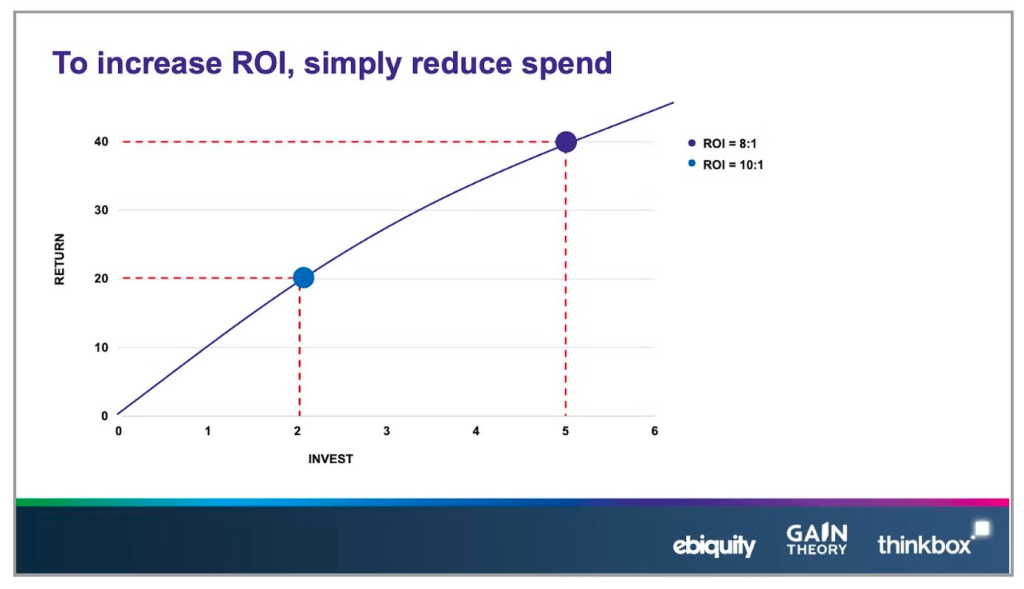
ROI tends to inversely correlate with profit growth, as due to diminishing returns ROI decreases as you spend more, and increases as you spend less. So the easiest way to increase your ROI is to decrease your media spend. Focusing on increasing ROI would therefore limit growth or even “send you broke” as Byron Sharp says.

Instead you should prioritise the incremental profit or revenue you achieve. ROI is not actually a measure of effectiveness but how efficiently you achieved it. So don’t use ROI as a target, use it to help you check the value for money you’re getting for your media investments. As Les Binet likes to say: “Effectiveness first, efficiency second – net contribution to value first. ROI is a useful metric but not the only one.”

The above is well known to some, but if people need a refresher take a read of my latest blog post ‘Marketing’s most marmite metric‘, or Tim Ambler’s coruscating article from 2004, ‘ROI is dead: now bury it’, a classic that should still be essential reading for marketers and finance people 18 years on.

Despite Ambler’s article, ROI lives on and never was buried. In fact, around the same time he was digging its grave, it actually spawned a new offspring for the digital age which shares the above problems and more besides: ROAS.

So what is ROAS?

ROAS is in very common use by many digital marketers as a buying objective in the real-time optimisation of performance activity across a range of platforms and channels.

The ‘return’ means the sales that occur during a specific time period when your advertising was served by the adtech. If someone is served an ad and if they purchase within a set time frame, those sales are attributed to the activity.

Whereas ROI is ideally calculated using market mix modelling (MMM, aka econometrics), ROAS is calculated using digital attribution, which can vary from platform to platform. Here’s a helpful article from Google on the different types of attribution modelling and the different ways credit can be attributed.

Digital marketers and finance teams love ROAS. They love the immediacy, predictability, the near instant reaction of the platforms and their algorithms, the confidence that if they plug the number into the adtech, it will buy them a sale.

The issues

Given its very common use as a target set by finance teams and as a buying objective in digital media, ROAS is likely to be leading to a real-time, real world version of the theoretical problems with ROI: short-termism, under-investment, de-prioritising longer-lasting activity and stifling growth.

ROAS isn’t what it says it is

The word ‘return’ in the name creates an illusion of causality that just isn’t true from how it’s calculated. The ‘return’ means the total sales from people who happened to be targeted with ads during a set period of time. If someone buys something at some point soon after they were targeted with an ad, it’s marked down as a ‘win’ for the platform. Or alternatively the last platform to receive a click within the chain might receive all the credit. Ex-Adidas marketer Simon Peel says: “ROAS is a misnomer. It should be called ‘credit for ad spend’.”

ROAS can take credit for other channels’ earlier work

ROAS can foster a sense that channels ‘compete’ rather than work together. Imagine a football manager believing their centre forward is entirely responsible for every goal so ditching their defence and midfield for 10 centre forwards. ROAS is only measuring what happens in the final third of the pitch. As Peel says: “It is a fraction taking credit for the whole.”

Chasing ROAS chases easy sales, not growth

The closer an audience is to the buying decision, the higher the ROAS will likely be. These are people who already know you and are ready to buy. And you can’t rely only on them for your growth, you need to fill your funnel with people who are further away from purchase, so will naturally deliver a lower ROAS. You need a more balanced plan, rather than expecting all activity to have a high ROAS and switching off anything that doesn’t.

Chasing ROAS can mean targeting people who would buy you anyway

A high ROAS may even mean the opposite of an ad ‘causing’ a sale: the algorithms finding people who were going to buy anyway. So it’s not just like targeting low-hanging fruit, but targeting falling fruit. Or like hanging outside a shop and tapping shoppers on the back as they enter then claiming you’ve enticed them in. It can mean inadvertently prioritising channels based more on their technical ability to tag people than their ability to reach or get attention from them.

ROAS may inversely correlate with growth

Brand growth comes disproportionately from light buyers, but focusing on high ROAS can lead to you targeting more and more heavy buyers, so limiting growth. It can make brands inward-looking and too focused on existing customers, rather than on reaching new customers.

So like ROI, ROAS has been presented as a growth metric, when it’s actually anything but. In fact, ROAS appears precision-engineered to keep brands small.

Some real world damage caused by maximising ROAS

Here are just a few real world examples I’ve seen that illustrate some of this:

  • A famous sportswear brand testing some well-known remarketing technology wasted millions of adspend, because while the tech claimed £4 ROAS, only 1-2% of the sales were found to be incremental.
  • A well-known online fashion retailer that’s been targeting a total ROAS across all media for five years has seen its share of search and share of market decline ever since.
  • A respected B2B financial services brand shifted budget to search, its most efficient channel, and subsequently saw net customer acquisition, revenue and market share decline year on year.
  • A sports brand heavily increased ROAS-optimised digital spend and saw share of search decrease and price sensitivity increase year on year.
  • A jewellery brand consolidated spend solely into commercial periods when they saw high ROAS, and saw brand associations with key category entry points decline over time.

So how did ROAS get so big?

A conspiracy theorist might think ROAS was created by the adtech world to frame what success looks like on their platforms, to massage the apparent success of campaigns, and make their platforms look like they perform better than they actually do.

Conspiracy or not, ROAS is among the innovations that helped the platforms and adtech become such dominant forces in marketing. Alongside digital’s promises of precision targeting, trackability, attribution and accountability, ROAS has proved to be one of digital’s decisive weapons against ‘traditional’ channels, which weren’t so easily able to demonstrate their value to a new breed of advertisers in real time.

New channels will appear to have an advantage over established channels if people believe wrongly that the higher ROI or ROAS they’re seeing from them is a sign of their superior effectiveness rather than that they’re new and people aren’t spending much on them yet.

ROAS is part of a skewed view of how advertising works

ROAS doesn’t stand up to a lot of scrutiny when seen through the lens of how advertising really works, not how adtech people assume it works.

In adtech’s worldview, people are rational economic actors: someone is targeted with an ad on platform A; they are now aware of product X; they consider it better than product Y; they click and buy; platform A was responsible for the sale.

We should be wary of the platforms’ sales pitch that ‘our platform A will drive more of your sales with a higher ROAS than platform B’ given it’s based on such a simplified fantasy about how people, brands, ads or buying work.

To be fair, it’s a philosophy that’s been around for a century. It’s the ‘strong force’ theory of advertising, and it attributes far more power to advertising or an individual channel or piece of communication than is ever the case.

Advertising mostly influences people’s behaviour by building and reinforcing brand memories before they’re in the market, and when they fall into the market, it can refresh those memories to help the brand be a little more likely to come to mind and be chosen. So rather than driving awareness, consideration and conversion, digital advertising is really part of a rich tapestry of thousands of little touches (including all sorts of stuff that isn’t ‘advertising’ or ‘digital’) that combine together to gently contribute to maintaining or increasing sales.

Ads on a given platform do not exist in a vacuum – with their own distinct ROAS number that can be calculated within that platform alone.

Below is a version of the standard ‘awareness-consideration-conversion’ funnel created to try and bring the performance and the brand marketing worldviews together and a little more in line with how brands grow and how advertising works. To build brands in people’s minds, nudge people who are in-market towards choosing your brand, and to help connect people to a brand online who have already decided to purchase. It’s not perfect of course but it appears to resonate with marketers with usually quite different perspectives.

So what now?

Brands are networks of mental associations. Audiences’ use of the platforms is interconnected and fluid. We should create creative campaigns and media strategies that build on and exploit this. Campaigns that bend, flex and scale across platforms. We should plan our media holistically not horizontally, not in separate rows on a spreadsheet and by splitting up available budgets in multiples of £100,000 per channel. And evaluate our campaigns independently from the platforms’ desire to present themselves in a more flattering light than the others.

If the digital advertising ecosystem is going to mature and evolve beyond its origins as a set of short-term direct response channels into the full-funnel brand-building marketing ecosystem it wants to become, the platforms need to become more geared to helping brands genuinely deliver real growth, to be better able to help build demand for brands as well as harvest that demand. So we need them to continue to re-engineer and evolve the way their ad formats, algorithms, measurement and metrics work.

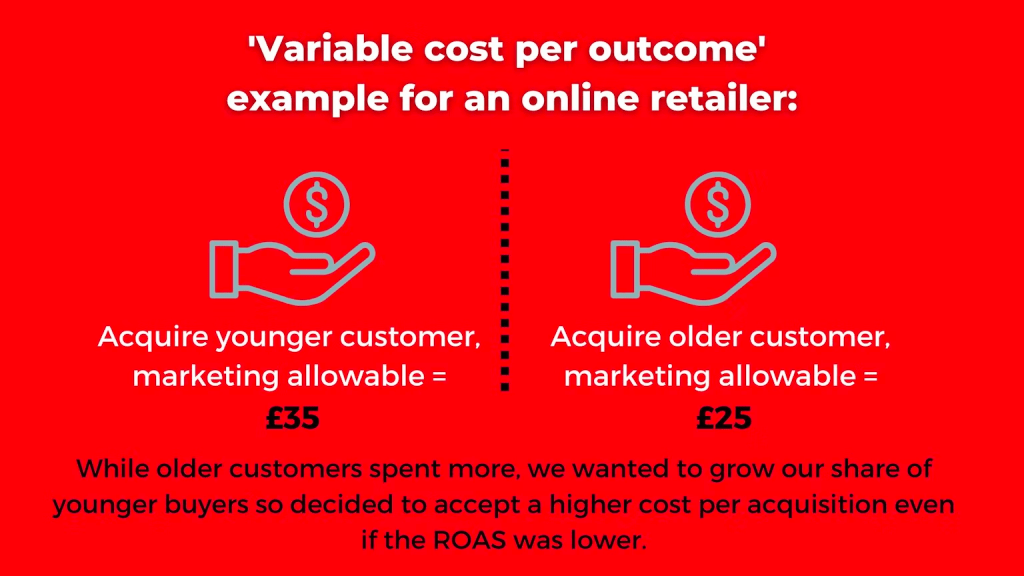
They are definitely trying to evolve. Many platforms now offer advertisers a much broader set of objectives and metrics than just ROAS or CPA targets, including reach and other brand goals. Some companies like ours have the expertise to bend the algorithms to make them work more effectively through the funnel. Being able to customise the analytics platforms now also means you can explore replacing ROAS as a target with other metrics that are more likely to incentivise actions that generate incremental growth from new customers, such as variable cost per outcome (example below), new SKU sales or rate of growth by territory.

This is not an argument against the use of hard metrics, it’s an argument for a more considered use of genuine growth metrics, not targets that can inadvertently limit it, and an argument for broadening out the metrics we use and never only focusing on maximising one.

But a strong bias towards efficiency metrics such as ROAS remains among many performance marketers. Digital marketers and their finance people will need to change their mindset, philosophy and understanding of how brands really grow and how ads really work. It’s definitely happening – a lot of ‘performance’ marketers really get it – but it will naturally take time.

Crucially, marketing teams will need to change the way they work together and are incentivised. If teams are set up to optimise everything to ROAS as a KPI, they could be unwittingly pushing an agenda that sets them against their colleagues and is to the detriment of their organisation.

But don’t just take my word for it on ROAS. Avinash Kaushik, digital marketing evangelist at Google, said this in his personal blog post ‘Die ROAS, Die’ in 2019: “I profoundly dislike ROAS…It distresses me to no end that companies and agencies all around us use ROAS as currency – inflating its value far, far beyond its minuscule value. It is a navel-gazing advertising-centric metric. It is not a business metric.”

Just imagine how much better digital advertising could be if we could get beyond arguments about how it all works. If we stopped using competing KPIs or metrics that limit rather than promote growth. If we stopped believing we all had to pick a team – team brand or team performance. Then we might be able to ditch our entrenched brand or performance marketing perspectives, for a marketing performance one.

Marketing’s most marmite metric

ROI is a mass of contradictions. It’s loved by many, hated by some, really hated by a few. It’s simultaneously what marketers say is their most important metric, whilst also being marketing’s most misunderstood, misused and even damaging.

Far smarter, more data literate people than me have been warning of the dangers of focusing on maximising ROI for a long time. Other equally smart people also say it’s ok to use ROI so long as you know what it’s good for and are aware of the pitfalls, and in any case what would we use instead to compare the value for money you’re getting from channels and campaigns? Both are right. 

For many, the problems with ROI are well known. But sadly because those problems aren’t easily intuited, it will always be important to keep reminding and educating ourselves about them so that fewer people get seduced by it and unwittingly allow it to limit their brand’s growth in the future.

So this is a public health warning for anyone who needs to be made aware of the side effects of getting hooked on ROI. If you know someone in danger of that, in marketing, finance or beyond, feel free to pass this on.

In 2004, London Business School marketing professor Tim Ambler proclaimed ROI dead and ordered its immediate burial. His article ROI is dead: now bury it is a stone cold classic. It’s lost none of its power in that time. In a similar vein, Byron Sharp calls ROI a ‘stupid metric….that can send you broke’. Peter Field has called it ‘incredibly dangerous’.

And yet. 

ROI lives on and no one ever did bury it.

ORIGINS AND DEFINITIONS

ROI’s seductive power for marketers is rooted in its origins as an accountancy term. This makes it irresistible to a discipline which is constantly told it needs to be more conversant in the language of the boardroom. And whilst it seems perfectly obvious that a business would want to achieve a high return on investment in everything it does, when you get into how ROI actually works it’s really not that simple. 

Most of the people who pepper their communication with talk of ROI usually don’t actually mean ROI in the correct definition of the term, and use it inaccurately to mean ‘results’ whilst trying to add a superficial sheen of commercial respectability to what they’re saying.

Peter Field says it best: “There are lots of flaky, woolly and totally moronic definitions of ROI floating around in the world of marketing, but there can really only be one – which is the definition of ROI that an accountant would understand. It’s an accountancy term and any attempt to use the term ROI on any of these flaky measures is completely misguided.”

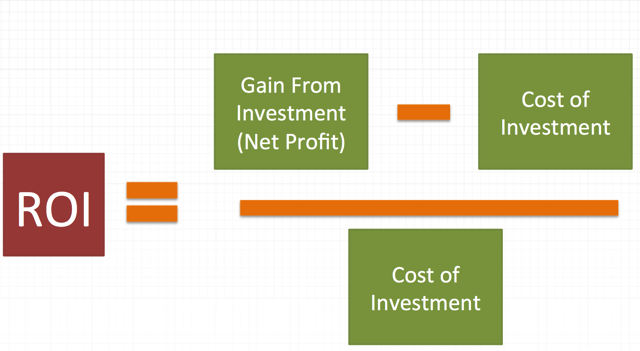
So let’s be clear on its definition: ROI is the net profit generated by your activity, divided by the total cost of that activity. Profit – costs / total costs.

So whilst it incorporates a measure of the effectiveness of your activity (ideally profit), it is not itself a measure of effectiveness, it’s a ratio designed to express how efficiently your activity achieved its incremental profit. As Les Binet likes to say ‘Effectiveness first, efficiency second – net contribution to value first. ROI is a useful metric but not the only one’.

IMPORTANCE

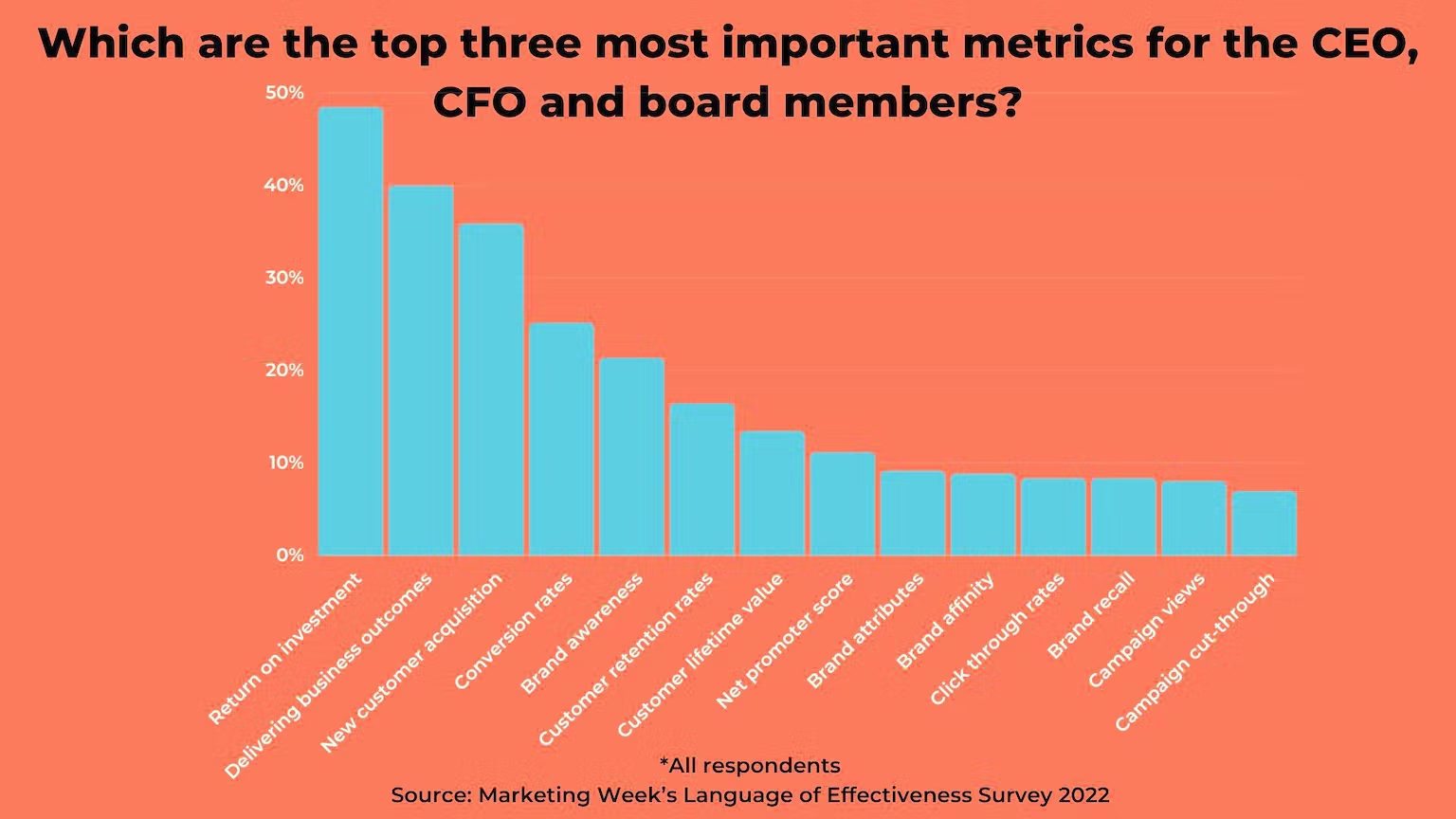
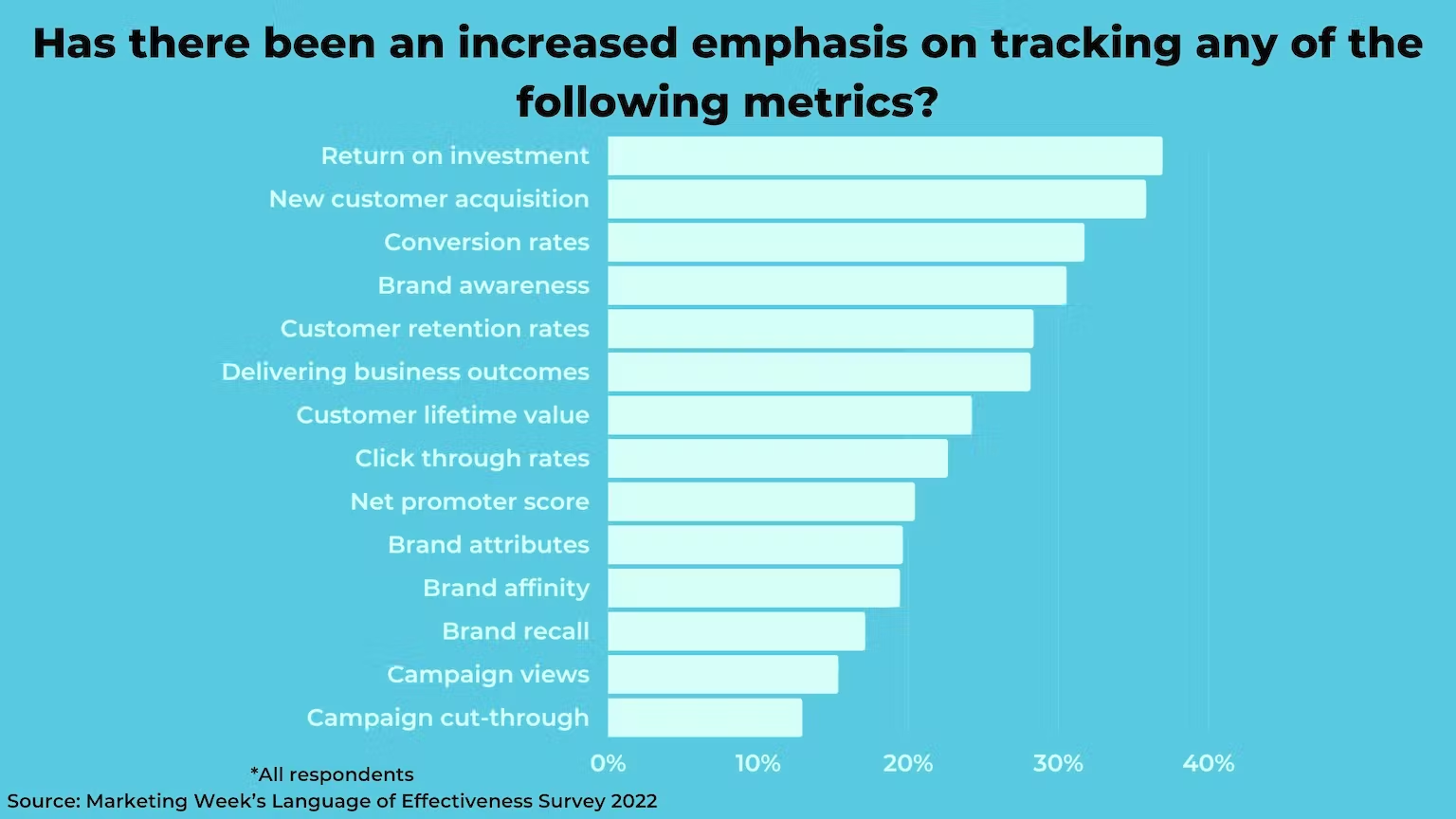
Marketing Week’s ‘Language of Effectiveness’ survey 2022 suggests why ROI is such an important metric for marketers. It’s what marketers believe their boards want to hear: 48% of marketers say ROI is the most important metric for their CEO, CFO and board members. Marketers know that boards like hard numbers, and there’s no harder-looking metric than ROI.

And despite the huge influence of its heavyweight detractors in marketing, ROI looks like it’s growing in significance. In Marketing Week’s survey, 37% claimed ROI has increased in emphasis, topping the poll.

ROI is used differently by different people 

I think there are probably four types of people when it comes to ROI, and they get more sophisticated but fewer in number as you move up the scale. The people who really know what they’re talking about are at the top of the pyramid in group 4. They’re vanishingly rare but we should all aspire to be like them:

  1. People who say ROI but mean something really vague (c70%?)
  2. People who say ROI but actually mean something specific like profit or sales (c20%?)
  3. People who use ROI a lot and use it correctly to mean net profit – costs / costs (5%?)
  4. People who use ROI sparingly and use real effectiveness measures instead (5%?)

There’s not much we can do about the people who use it incorrectly in conversation and presentations for spray-on credibility, apart from to suggest that using it like that will make them look a bit dumb if they are ever allowed into that hallowed boardroom. Using ROI to mean ‘results’ is just one of the very many things that makes us marketing people look stupid to non-marketers on a daily basis.

WHY FOCUSING ON IT CAN BE DANGEROUS

Focusing solely on ROI can be dangerous because, counter-intuitively, it’s likely to inversely correlate with growth. Here’s why.

Focusing on ROI tends to obscure the scale of effectiveness

One of the basic issues with over-focussing on ROI is that due to it being a ratio, it can disguise what really matters: the absolute amount of profit or revenue generated. You should if possible focus on the net profit generated by an activity when judging them against other activities. What matters most is how effective something is at achieving its objectives; how efficient it is at achieving them is secondary. A relatively low ROI of 150% on a $10m campaign (campaign A) drove a $5,000,000 profit, while an amazing 500% ROI on a $100,000 campaign (campaign B) drove only $400,000 profit. Plainly campaign A was far more successful despite its far lower ROI.

Higher budget activities tend to have lower ROI, lower budgets tend to have higher ROI

All budgets spent in a given channel, will at a certain point, begin to deliver diminishing returns. The first $ you spend will likely be the most profitable, and the last will be the least. Higher spends tend to be more effective (higher profit), but less efficient (lower ROI), and vice versa. Warmer prospects are more likely to notice and respond quickly, but colder prospects are likely to respond more slowly as they need more frequency to notice and pay attention, and more time so more can enter the market. When Les Binet was asked on Twitter recently, which ad campaign from his research had the highest profit ROI, Byron Sharp jumped in and said with his trademark penetrative wit “the one that didn’t spend enough”.

Focussing on ROI tends to favour fragmented spends

Focussing on ROI can lead to you splitting your budgets into lots of smaller, tactical, less scalable activities that make only very small amounts. These will likely have a higher ROI but are unlikely to make a big impact on a business. Whereas a more concentrated approach with fewer, bigger channels and higher total profit but lower ROI would be more effective. Here’s Peter Field on how focusing on ROI can deliver “very mediocre improvements in trading, but at a minute cost…These are typically…highly tactical initiatives that look fantastic in terms of ROI, but are not scalable and do not drive long-term growth”.

So having a high ROI may actually mean you’re not spending enough money to maximise sales or profit. A high ROI is better viewed as a signal that you should be working with your finance partners to unlock additional budgets to invest; it shouldn’t be seen as something to celebrate.

In summary: focusing on maximising ROI can destroy value

It can lead you to be satisfied with small budgets, or even deflate your budgets, and ultimately destroy value. That’s because the easiest way to boost ROI is not to grow the numerator (your net profit), it’s to shrink the denominator (your budget). If you focus on growing ROI rather than actual growth, it can lead to odd decisions like accepting smaller budgets overall or atomising your budget across too many channels.

SO WHY USE ROI AT ALL?
None of this is really an argument for banishing or burying ROI. Just seeing it as one metric that’s useful but not as important as what actually really matters to CFOs and boards – real business outcomes like new customers, increased sales, or better, profits.

Of course it’s important to know that growth isn’t coming at too high a cost to be sustainable, i.e. that it’s being delivered efficiently, but that has to be secondary: effectiveness first, efficiency second. It’s not a metric you should be using for big strategic decisions, but for keeping an eye on the efficiency of what you’re doing.

Another use for ROI is that it can help when making comparisons between activities that would otherwise be impossible to compare. For example the IPA Effectiveness Awards require brands to calculate ROI to help judges in their assessments between vastly different campaigns, brands and categories. But they’re judged very very carefully by a large panel of data and econometrics experts who are all intimately familiar with the issues. 

In talking to Dr Grace Kite about ROI, she was characteristically realistic and pragmatic about it all, and less academic or concerned by its use than other marketing effectiveness experts. “I stand behind ROI. Value for money is always important in big purchases, and million pound advertising campaigns are no exception. Marketing directors and CMOs know this, they are very rarely that strange breed of person that’s got more money than sense.”

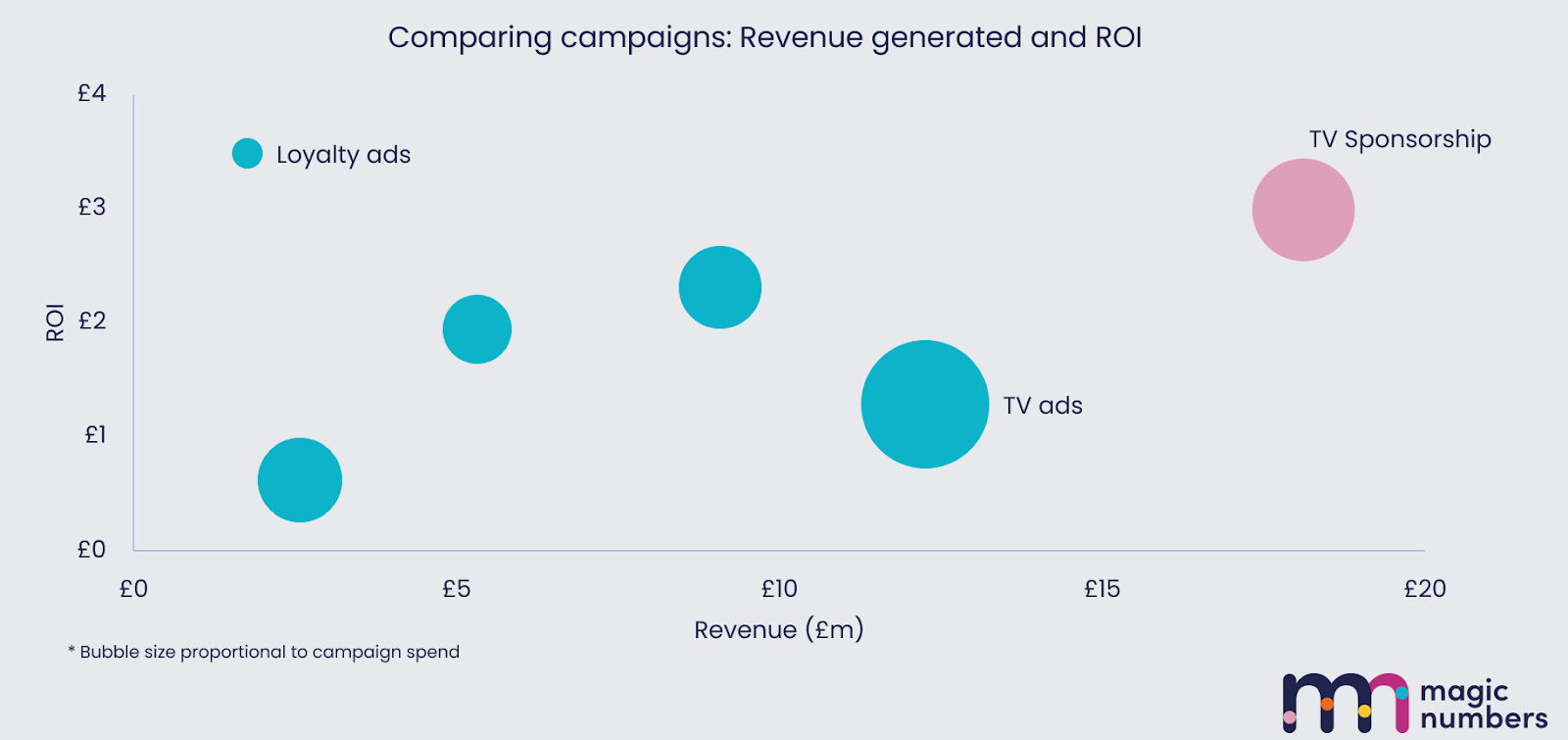
She shared a typical chart she uses with clients, which aims to plot the total revenue, scale of activity and the ROI achieved by different channels and activities – with the aim to get as many big blobs of activity in the right-hand upper quadrant of the chart.

So it’s ok to use ROI in context of the overall effectiveness of an activity, but it’s also important to be aware of the damage that an over-reliance on it can cause. Grace would argue that so long as you’re prioritising the scale of revenue or profit impact of your activity, and are aware of the dangers of reducing budgets to artificially increase the only secondarily important measure of efficiency, it’s just common sense to keep an eye on the value for money you’re getting in different channels.

So don’t focus solely on maximising ROI, use it to assess value for money alongside other, genuine measures of effectiveness.

Its digital doppelganger ROAS, however, seems to be more problematic, but that’s another story.

*For any non-UK readers, Marmite is a yeast-based spread whose long-running advertising slogan ‘You either love it or hate it’ has become so famous that if you describe something as ‘marmite’ to anyone in the UK they know that you mean it’s extremely polarising. And you can even do fun/tasteless things like this in ads on the death of a much loved/hated figure.

Why advertising will never die

Advertising’s not dead, it’s not dying and no one’s going to kill it any time soon. It’s never been more alive, so instead of taking aim, let’s be dead proud of it.

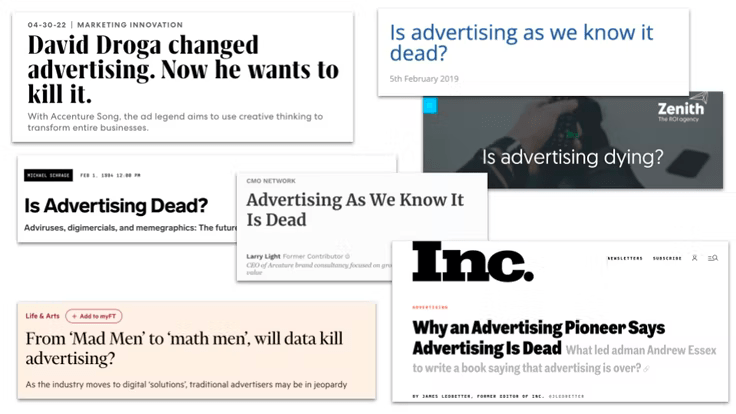
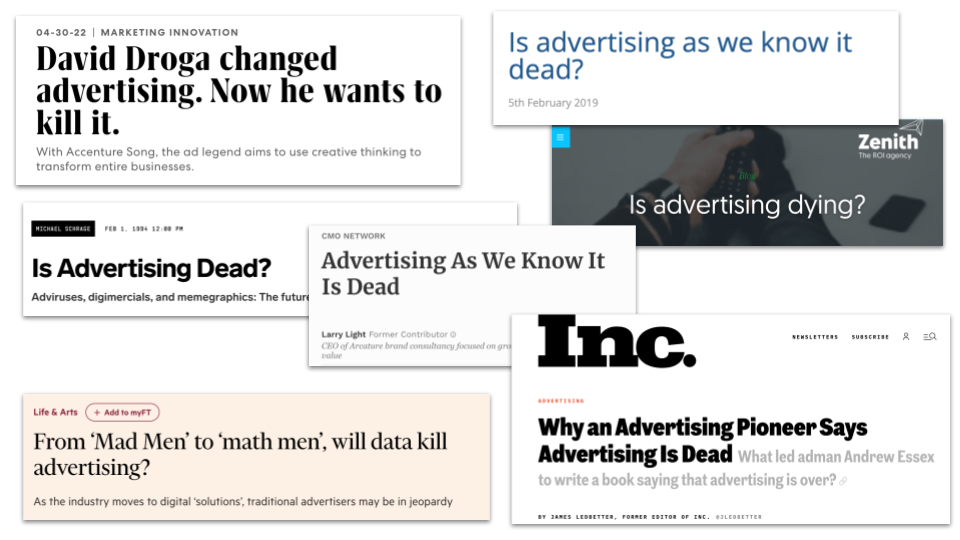
People constantly declare that advertising’s dead. Fast Company recently claimed David Droga wants to kill it. Elon Musk said Tesla doesn’t do it. Jeff Bezos said only unremarkable brands need it.

Why do so many people do advertising down, even from within the industry? It’s a thriving global business that’s never made a bigger global economic impact.

The idea that advertising’s dead or dying is bizarrely persistent, given it can be countered with just three words: Alphabet, Meta, Amazon. Their combined revenue from advertising was around $240bn in 2021.

If Netflix also joins the party, and with Apple also having a fast-growing ad business, the FAANG flush will be complete. For the first time ever, a handful of the world’s very largest, most powerful companies are, or at least include, significant advertising businesses.

So, if your metric is commercial success, advertising has never been more alive. Which means anyone claiming advertising’s dead, dying or needs to be killed is firing blanks.

Why the idea’s so persistent

The ‘advertising is dead’ trope actually appeals to a pretty broad church, which probably goes some way to explaining its longevity.

Many are nostalgics with a rose-tinted view of the past, lamenting a perceived decline in the creative quality and emotional impact of the industry’s output. They tend to be creative agency veterans disappointed with the changes they’ve seen in the industry since the 90s. For them, the current commercial success of the industry has come at too high a cost to the industry’s creative soul. They perceive their industry as having been under attack from outside forces and having been changed beyond all recognition. Far from being evidence of its vitality, for them, the three corporations mentioned above are partly to blame for its demise.

But the ‘advertising is dead’ line is probably more commonly deployed by people hyping up the dawn of a new era and new technologies. What unites both groups, whether they’re mourning advertising’s loss or dancing on its grave, is a belief that technology is responsible.

Much of it is really just lazy headline writing. The standard headline in the genre is actually ‘Advertising as we know it is dead’ or the classic QTWTAIN (question to which the answer is no) ‘Is advertising dead?’. Often what these articles actually go on to say is ‘TV advertising has a smaller share than it used to and other advertising channels like X are growing’. So it’s often just clickbait from people who are signalling they’re modern, innovative and disruptive…with some newer, shinier kind of advertising to sell you.

You could argue it’s just a harmless sales trick. But it’s a sales trick that’s been repeated so frequently that the word ‘advertising’ has collected a ton of baggage. Baggage that’s shaped perceptions that it’s old-fashioned, on its way out, wasteful, inefficient and ineffective. So not harmless at all.

The new platforms had new forms of advertising to sell. New types of agencies and consultancies emerged to help brands take advantage. Existing agencies wanted to show they were keeping up without looking out of date. Individuals had careers to protect and couldn’t risk looking like dinosaurs. We’ve all in some way been complicit in depositioning our core product. I know I’ve been guilty of it.

The people with new kinds of advertising to sell created an imaginary world called ‘traditional’ advertising. An old-fashioned and inefficient method of producing and distributing advertising, made by old-fashioned ‘legacy’ companies, used by old-fashioned brands, bought by old-fashioned marketing people.

We all bought into a related narrative about a golden age of advertising in the 20th century, led by the glamorous, cool, creative geniuses of the ‘Madmen’ era, and the idea that this has now been replaced in the 21st by the left-brained, data-driven types of the ‘Mathmen’ era. Leaving aside the stereotyping, the problematic terminology and that any talk of a golden age in any field should always be treated with scepticism, it’s a compelling narrative with a kernel of truth, but it’s ultimately a false dichotomy. Has the proportion of ‘creative’ people in our industry really shrunk? Possibly. But have we all gone from being Madmen to Mathmen? Of course not.

Social media was initially framed as a way to help brands reduce their dependence on costly and wasteful advertising, by allowing brands to tap into communities of followers and reach more people for free. This essentially anti-advertising stance of course had to evolve as the platforms developed their ad products and adapted their algorithms. Social media became less ‘social’ and more ‘media’.

With ‘Don’t make ads. Make TikToks’, TikTok is playing a similar game – using a disruptive anti-advertising stance to advertise its ad products to ad agencies and advertisers.

From this alone you can see how tainted the word ‘advertising’ and all its derivations have become. It would seem bizarre to anyone outside the industry, but even using the word advertising can sometimes feel like it sends out the wrong signals. We so often substitute it for alternatives like comms, campaigns, film, video, content, copy and of course the now ubiquitous asset. Anything but ‘ad’. Maybe we need to try to use that simple, useful, truthful little word a little more often?

Musk and Bezos on advertising

So far I’ve mostly been describing the collateral damage the industry has managed to inflict on itself from the inside. But just as damaging is how similar themes have been picked up beyond adland.

In the world of tech startups, word of mouth and virality are so highly prized that a reliance on advertising for growth has come to be seen as a weakness, a sign that a company hasn’t quite got the X factor, a tax on a poor product. In this environment, proclaiming you’re fundamentally opposed to advertising has become a way to promote your genius and the brilliance of your product to investors. A way of saying “we’re so smart that our innovation will earn us an outsized share of attention in the marketplace – we don’t need to do something as dumb as paying for ads”.

This is what Musk and Bezos were both doing when they made their famous anti-advertising declarations. Musk’s 2019 tweet, “Tesla does not advertise or pay for endorsements”, and Bezos’s still much-quoted line from 2009 “advertising is the price you pay for unremarkable thinking” both come from a similar place.

Debates about whether Tesla does actually pay for advertising or not usually come down to how you define ‘paying for advertising’, whether very narrowly (eg paying for TV spots or search ads), or very broadly (paying tens of millions of dollars to fire a product into space, place it in front of the camera and livestream the results to the entire planet).

If you define it broadly, as something like ‘the monetisation of attention’, Musk, already the world’s richest person and perhaps its greatest showman, is ironically a far more archetypal ad person than his CEO counterparts Jeff Bezos, Mark Zuckerberg, Sunder Pichai and Tim Cook – all in the ad business but not exactly ad people. Only time will tell if he can continue to support his position on paid advertising as Tesla’s strong grip on the EV market slips.

Whether Musk pays for advertising may be arguable, but Bezos’s U-turn is unarguably one of the greatest stories we have for the continued value and vitality of advertising:

  1. Bezos makes a famous and influential denunciation of advertising.
  2. He learns the value of advertising from Amazon’s own data and changes his mind.
  3. Amazon becomes one of the largest (and best) global advertisers.
  4. Amazon builds one of the world’s largest ad businesses.

Musk and Bezos are outliers. And yet, many brands continue to take inspiration from them by making overt rejections of advertising, often as a way to get attention and proclaim their genius in their early days. Similar claims from brands including Monzo and Brewdog were both later reversed when they grew and advertising was needed to help take growth to the next level. In fact it seems like there’s an immutable law of modern marketing that every vociferous rejection of advertising is later met with an equal and opposite endorsement of it.

Musk may not ‘pay’ for ad space, but he certainly has a deep understanding of one of its most valuable potential outcomes, fame. Many advertisers understand advertising but very few really understand fame. And unless you’ve got the same nose for fame as Musk, paying for attention is likely what you’re going to need to do to achieve it.

So it’s not just social media that’s guilty of deploying a kind of ‘bait and switch’ – claiming to be anti-advertising but then reversing their position when they need to make the commercials work – it’s a pattern that’s constantly being repeated by platforms, agencies and advertisers as they mature.

Let’s not do advertising down, let’s stand up for it and celebrate it

The ‘advertising is dead’ myth is especially bizarre because advertising has never been more alive. We have never had a wider, more varied array of options and opportunities available to us. But as an industry we often seem a bit embarrassed, even ashamed of what we do.

How the advertising industry uses the power of human imagination for commercial impact should be something we’re all in awe of. We’ve created commercially viable processes to harness human creativity, craft and design skills. We’ve developed the technology to distribute the output across billions of screens. When done right, our product can attract and keep people’s attention, entertain and move people, communicate powerful ideas, create indelible memories, and influence consumer behaviour both now and in the future.

Paid advertising in its huge variety of forms continues to provide a consistent, regular, controllable way of getting a company’s core message in front of new audiences that no other marketing communication can match.

Companies have many options open to them to help reduce costs and do things more efficiently, but few growth levers. Advertising is one and it’s proven. In fact there’s arguably no more researched, picked-over and proven discipline amongst all the different kinds of commercial activity most companies do.

The excellent work of Grace Kite and others in building the ARC database, a meta-analysis of hundreds of real-world case studies from companies of all sizes, categories and using all channels, shows advertising today returns an average £3.80 revenue for every £1 spent. IPA Effectiveness award winners return more, £13 revenue for every £1 spent, but they’re outliers, the very best of the best.

Advertising’s naysayers invariably have ulterior commercial motives for undermining perceptions of what it can do. It’s rare that they’re making any significant or serious point that’s in any way testable or backed up by data as robust as this.

Global advertising spend in 2021 was around $689bn and is forecast to reach $850bn by the end of 2024. Deloitte’s calculation of the overall economic contribution of advertising suggests that every $1 spent on ads generates $6 in broader economic impact. Which means advertising’s economic impact could be around $4tn annually. Roughly equivalent to the GDP of Japan or Germany. The role we play in driving the economy, and therefore society, forward is something we should be proud of. We often highlight advertising’s societal impact when talking about social purpose, but advertising’s economic impact alone should be a sufficient source of pride.

That $689bn would have been spent on trillions of ad impressions. Never have more ads been served to more people, more often. It probably doesn’t help advertising’s ‘brand image’ that they’ve also never been shorter, viewed on smaller screens, and attended to for shorter amounts of time. The shop window for our wares has definitely got smaller, less distinctive and less enticing (although with Netflix potentially joining the party, this direction of travel could be about to change). But that’s a technical issue that our ingenuity and creativity as an industry will overcome.

Could advertising be ‘better’ today? Of course. But everything can always be better. Are there big problems that need to be fixed in today’s advertising ecosystem? Of course. But are advertising’s problems existential? Of course not.

Advertising will be with us forever

When you take a much broader historical view of advertising, it reveals that – despite the peaks and troughs, the new channels emerging and existing ones evolving – advertising as a percentage of GDP always tends to stay remarkably constant over time. For decades ad spend has hovered around 1% of GDP in the US. Its growth mirrors the growth in the economy. It’s basically a historical constant. Wherever there are eyeballs, there will be advertising.

12 months since moving to Jellyfish, here’s my diary. 

Last January I moved from the creative agency world to a very different one. To Jellyfish, a full-funnel marketing performance company at the forefront of the convergence of brand and ‘performance’ marketing, media and creative, content, data and technology.

A blog post I wrote soon after about the move (‘I’ve never heard of Jellyfish’) got a surprising amount of interest, so whilst I don’t usually write about myself I thought I’d write a follow-up to that, covering my first 12 months here.

The most common questions people asked me when I started was ‘who are Jellyfish? and ‘why did you go there?’. A year on, people now ask things like ‘what are you getting up to there?’, ‘what are you learning?’, and ‘are you still enjoying it’? So this is an attempt to answer those.

TL;DR: the answers are loads, loads and loads.

Apologies if this all seems a bit self-indulgent. And I know I’m definitely biased, but I’ll try not to make this too sell-y.

January

First day. Catch-up with JP, the Chief Solutions Officer of Data & Planning here and my ‘Capability Partner’. JP reassures me that I’ve got a few weeks to get my head round things before getting into any client business as I’ll find things pretty different here.

First week. Full of slickly-run onboarding sessions and intro’s. Learn that Jellyfish clients include all of the FAANG (now, erm, MAANG?) companies for whom we do a wide variety of things. Strong sense of Jellyfish being an unusually unified global business, in many ways more tech platform than agency, with a tonne of very smart, very nice people. 

Meet the three people in my Personal Support Network (PSN). Jellyfish is dismantling old hierarchies and structures, including line managers and the classic agency ‘pyramid’, which perpetuates an ‘up or out’ mentality and puts an artificial limit on the talent you can have at different career stages. Instead all 2,150 Jellies have a dotted line to three individuals – a capability partner, a mentor, and a people partner – their PSN. Jellyfish is essentially a network of experts organised by a wide range of capabilities (across Media, Data, Analytics, Technology, CRM, Brand, Creative, Training etc).

Meet my brilliant peers on the Brand Planning ‘Steering Group’ – Tania, Amy, Michael and Matt. They have a wide range of backgrounds, including media, social, creative and consultancy. Without a pyramid structure there are no ‘heads of’ so there’s no need for people to move elsewhere to get promoted, to compete or be political to the detriment of the company. So a group who might be ‘Heads of’ or CSOs in competing companies can co-exist and collaborate extremely happily here.

Meet some great new colleagues in Data and Analytics. The brilliant Alex Davies, shows me Jellyfish’s Share of Demand Dashboard  which incorporates Share of Search tracking as well as actual traffic data. Very cool to see something close to what Les Binet and others have written about actually in real operational use for clients.

Meet some of the c400 Creative & Experience team, including creatives, producers, designers, content creators and other specialisms. C&E would be roughly equivalent to a creative dept if Jellyfish were a creative agency. Get a real sense of our creative people being closer to the platforms than in other places. Hear the phrase ‘in-platform origination’ for the first time – meaning creating and making things in the platforms, not in isolation of them. ‘Big’ ideas aren’t really what they do – ‘scalable’ ideas is more like it – ideas that start in one platform and evolve and grow across other platforms. Meet some familiar faces from past lives. My imposter syndrome had been flaring up but temporarily goes into remission.

First client work includes a project with one of the tech giants, helping define the role of social within their overall brand strategy and making organic content across key social platforms. Start working on this with the creatives responsible for Jellyfish’s (Emmy award-winning) social work for Netflix.

Another project is to define the brand and communications strategy for a new global brand in the fast-growing ‘social audio’ category. We were already doing their ASO (app store optimization: driving visibility and conversion in the app stores) but they now needed a better defined brand, and a full-funnel media and creative approach to help take growth to the next level.

Things feel good. Maybe moving to Jellyfish wasn’t so crazy after all. 

February

Pitches this month include a fun (and ultimately successful) creative one to make some Facebook video ads for TikTok to help them cast off their reputation for only being used by lip-syncing teens.

Present a new brand strategy and brand platform to the ‘social audio’ brand’s clients on the US West Coast. Goes down well. Start briefing creative people to bring the new brand strategy to life across the platforms. For the app store copy it’s the first time I’ve briefed a copywriter who’s thinking about how the algo’s first and humans second.

Meet the team responsible for case studies across the business. Identify a potential story in our work for a major US university, a 10 year client relationship that started out in acquisition channels but has grown to encompass brand-building activity too. See potential for this to become a great long-term marketing effectiveness case – feels unusual in the typically short-term, project-based world of digital marketing. Start warming up my IPA Effectiveness case study-writing muscles.

Begin thinking about some of the brand planning hires we need to make and the very particular sets of skills we need in different markets. Get the roles live on our jobs page (200+ roles currently available here across Jellyfish). Start meeting potential new hires. 

March

Discuss themes for future blogs and articles with JP. Write one on why I moved to Jellyfish. It starts getting used by our People and Talent Acquisition teams to help candidates and new hires understand more about what we are and what we do. Several client prospects get in touch to see if we could be a fit for their needs. (Content marketing works, people).

We decline to take part in a couple of big pitches. Both were large, well-established brands that didn’t really seem ready for a totally new approach.

Meet more of our analytics and measurement team, including the incredible data scientist Di Wu, to understand more about our campaign measurement tools, creative testing platforms, and our new ‘Hybrid MMM’ measurement approach.

Introduce my new data friends at Jellyfish to the brilliant Dr Grace Kite. I really hope we’ll be able to intro her to our clients where relevant, as her ‘classical’ MMM could be nicely complementary to how we work.

April

Meet some of the great team at Uncommon with whom we’ll be collaborating on a major tech brand. Uncommon will be looking after the ATL creative and we’ll be doing the social. Hopefully just the first of many similar collabs on other great clients with other great creative and media agency partners.

Creative presentation to a leading global travel platform. Creative and production on a scale I’ve never seen before, potentially several hundred thousand videos a year (every destination x every major market x in every major language). Our hybrid approach (human creativity plugging into automated production and adaptation) out-performs some purely technology-driven solutions in creative testing. Humans+tech=better.

May

Meet some great new potential hires – including Cleef Chong from MullenLowe Singapore for our new Singapore office, Vincent Johnson from Wieden+Kennedy for our new Amsterdam office,  Josh Reidy from Adidas for London.

Meet Phil Lloyd, the CMO of our new property platform client Boomin, for whom we’re doing PPC and paid social. Very smart team with an exciting vision to disrupt their category. 

Take part in a Marketing Society panel discussion about ‘balancing marketing investment in the short and long term’. Marketing Week cover the conference, and afterwards they get in touch to ask if I’d be interested in writing a regular column, to which the answer was an immediate yes.

June

Meet a really interesting new client, US/UK aviation start-up KinectAir, with a vision to be the on-demand flight network, the Lyft/Uber of aviation. Discuss doing their brand strategy, media, creative, and programmatic. This isn’t some fantasy about flying cars – it’s tech that can work now. Everyone’s especially fired up about this one. Great opportunity to show how the right & left brains at Jellyfish work together.

Meet the brilliant Prof Karen Nelson-Field of Amplified Intelligence. Discuss using her attention-based media planning tool to help optimise media plans for our clients.

Present a version of my blog about balancing and uniting brand & performance, ‘The Wrong and the Short of it’ at a Facebook conference.

Record an interview with digital consultant Neil Perkin for his Google Firestarters series, reflecting on my thoughts about the future of agencies and my move to Jellyfish.  Not normally at my best on video but this went ok.

July

Take Jellyfish’s two day digital marketing training course. Realise I know more than I thought, but with some specific gaps in my knowledge which I need to start filling soon (especially search/PPC, ecommerce). Imposter Syndrome flares up a bit.

Creative pitch for the launch campaign for a major new SME retail platform. Our CX team in the US were already working on the design of the platform itself so it made sense for the client to ask us to pitch for the creative for the launch campaign. Present a strong brand idea and executions across all the key platforms.

August

First visit to my actual office in the Shard. Incredible views, very cool bar, coffee machines controlled with an ipad. Meet some of the leadership, JP and some of my actual team face-to-face for the very first time. Everyone’s exactly like they are on screen, just some of them are taller/shorter than expected.

Film a version of my ‘Wrong and Short of it’ article for a virtual marketing conference. Meet Dr Grace Kite for the first time which is crazy given all the work we’ve done together. Do a filmed interview with her talking about the value of econometrics in ad measurement.

Get stuck into the brand positioning work for KinectAir, with the awesome Alessandra Pinho, a new Brand Planning Director in NYC, and meet all their key people including their hugely charismatic, ex-military pilot CEO. 

Present a piece at the Zeemelt marketing conference in India entitled ‘In a world of change, what won’t?’, on the unchanging principles of creative effectiveness that will remain true regardless of the technologies we use in marketing communication.

Invited to pitch for the brand media planning on a global online secondhand fashion platform. Experience the joy of working with our whip-smart, fast-talking VP of media strategy, Jenna Cummings, and an international group of media and brand strategists based in NYC, London and Paris (including Marlie, Josh, Celine).

A common theme is emerging from many of the great opportunities presenting themselves: brands, often platforms themselves, often more experienced in the world of performance marketing, who are looking to take growth to the next level by developing a more unified brand & performance approach to media and creative. This chart often seem to resonate with these brands:

September

Pitch our brand planning and media strategy approach to a DTC mattress brand in the US. We were already doing their programmatic, but the new CMO had seen one of the Marketing Week articles and they got in touch to talk about brand stuff too.

Attend sessions with the IPA’s Share of Search working group run by Les Binet and James Hankins, as they develop their research work in this area.

Write an article on the ‘sales funnel’. Seems to strike a chord with people and surprises me by becoming Marketing Week’s second most read piece of 2021: Why the sales funnel is the cockroach of marketing concepts

Start the 12 week Mark Ritson Mini MBA course along with a large cohort of other Jellies – part of our plan to make sure Jellies of many different, but predominantly digital backgrounds, get the best training in the marketing fundamentals too. 

October

Start working with the DTC mattress brand to plan an ATL media test across key US cities, and also optimise the creative assets they’d developed in-house with our creative asset optimisation team led by the very smart digital video expert Abi Howson.

Present a new brand strategy, media and creative thinking to KinectAir, to help position and launch the brand and get their crowdfunding campaign off the ground. Especially pleased with the brand platform we come up with for them, ‘Open The Skies’: an invitation to everyone to be able to experience the true joy of flight [see KinectAir’s wefunder page here]. The feedback from the CEO in the meeting was a humbling endorsement of the Jellyfish proposition:

“I have worked with really great creative and I’ve worked with really great quant marketing and lead gen, and I have never seen it fused like this before. Never. This is magnificent. To actually have Matthew present the left brain of the project, and then…going over to the right side, into the creative studio and start figuring out how to actually get into the hearts of people…I have never seen it in the same brain before. You are mindful of both hemispheres and how they interact. I continue to feel in great hands!” 

The sales funnel article is getting a lot of interest from our clients so we start presenting the thinking to a number of existing ones, and discussing how we can start applying it to their media and creative output.

Very interesting conversation with the Organisational Design team at one of the big 4 management consultancies who are interested in writing up Jellyfish’s innovative org structure as a case study.

Publish my next Marketing Week piece, on the 7 principles of creative effectiveness. Seems to go down well.

But the highlight of October by a mile is sitting on Jellyfish’s Business Case panel. This is the monthly panel that assesses anonymised written cases by Jellyfish employees laying out their evidence and data in support of a salary increase or job title promotion. Everyone can do this 1-2 times a year and it’s in addition to the separate annual inflationary raises guaranteed for everyone. The Business Case process is a central part of Jellyfish’s progressive approach to talent management and one that’s leading to a more diverse and inclusive approach to career and salary progression. On average 82% of female business cases get approved. Sitting on the panel was a genuinely inspiring experience. The process beats having to beg for a pay rise from your line manager and witnessing only their favourites succeed any day.

November

Great planning session with property portal client Boomin. Great to see the CMO bringing their long-term vision to life on flipchart paper covering a wall of a large room in the Shard.

Talk at a media conference on creative effectiveness in video. Luckily Abi had taught me a few things about best practice in the different platforms.

Fun evening at the top of The Shard for the launch of Orlando Wood and System1’s great new book ‘Look out!’.

Fascinating question from the COO and founder of an EU-based unicorn who gets in touch to ask: could we help with Podcast SEO? Answer from the SEO genius Nick Fettiplace and our Earned Media team: yes and here’s how you could get started…

December

A pitch covering brand strategy, acquisition media, CRM & creative for a buy now pay later app looking to scale and launch the brand across EU markets. Another great new opportunity to stress-test the Jellyfish proposition.

A great new social project comes in for one of the FAANG brands. Help assemble an EU-wide team and get cracking on the strategy work. Vincent in Amsterdam nails it before he hands over to the fabulous Ann-Sophy in Paris and Ingmar in Germany, and heads off for a well-earned holiday.

Talk with JP about the growing need for people with strategy/planning skills but also deep experience of the platforms themselves and where we’ll find them – social agencies, client-side, at the platforms themselves? Draft a new Job description for a Platform Strategy Director.

We launch the new Jellyfish brand positioning led by Tania and the brand planning team: ‘We give brands a platform to perform’. It’s a promise to help brands thrive in the platform world, which includes a bit of a re-framing of what performance means today: goodbye performance marketing, hello marketing performance…

So those are some of the highlights from my first 12 months here. Hopefully this sheds some light on what I’ve been up to and gives a sense of the diversity of what we do here in Brand Strategy. It only really covers a small fraction of what goes on at the intersection of brand, creative & media where I usually hang out, and only a tiny fraction of what Jellyfish does as a whole.

I probably couldn’t have predicted any more than 5% of it. I knew I’d do some brand strategy work, some pitches, write some briefs, make some campaigns, write some blog posts. But mostly I knew that a lot of it would be completely new to me. And 95% of it was. In 2022 maybe a bit less will be new, so my imposter syndrome may be a bit more manageable.

My predictions for what 2022 will hold for me personally include more work on what combining brand & performance really means in practice (not just theory), more on how you really get media and creative working together, more on what it means to help brands orchestrate their activity across the platforms, more on the new kinds of partners that clients need to help them do all this stuff better. And lots more learning. I’ll let you know in 2023.