A call to entries to the APG Creative Strategy Awards 2025 in my role as chair of judges this year.
Creative strategy has never been a more eclectic discipline. It’s no longer limited to one corner of the agency world and has made its way into every corner of marketing and advertising. It happens in-house, freelance, in media agencies, social agencies, PR agencies, CRM agencies, influencer agencies, experiential agencies, performance agencies, in offshoots of the big consultancies.
Together as a discipline we can influence and enhance every touchpoint, every stage of the customer journey. We can help inspire and fuel creativity on every canvas, device and platform. But just as we’ve seen with the splintering of media today, whilst eclectic, the discipline can feel fragmented, tribal, or even a bit lonely for some.
And sometimes you even see people trying to gatekeep what strategy is, saying ‘that’s not strategy, that’s just tactics’. Of course sometimes they’re right. But rather than gatekeep what it is, we want to open the floodgates to the best creative strategy thinking out there.
So with the APG Creative Strategy Awards 2025 we want to bring every part of the discipline together into one brilliant whole. To celebrate its breadth and variety today by bringing the best of the world’s creative strategy together in one place.
And as Chair of Judges for the APG Creative Strategy Awards 2025, I am thrilled to announce that this year we want to welcome entries from as far and wide as possible – to broaden out the awards so they truly represent and celebrate every flavour of strategy.
We’re calling for entries from anyone and anywhere that show how strategy of all kinds has helped a brand or organisation use creativity to help it achieve great things. We want to showcase the huge spectrum of creative strategy being done today from brilliant minds everywhere.
We’re looking for creative strategy stories that celebrate new thinking, diverse points of view and innovative ideas as well as classic brand planning.
We’ve got more special prizes than ever, we’re extending the eligibility period from two to three years, even including a category called ‘the one that got away’ (for cases from any era that people wanted to enter before but that for whatever reason didn’t make it).
So awards entries can come from any corner of the brand and business universe. From any kind of agency or client; large, small, specialist, generalist. And from anywhere on the planet.
For all the key details, dates, events and workshops for authors, and new, wider eligibility criteria see below. Final submission deadline 3rd April 3pm BST.
Brands today have to balance competing needs: more digital content to drive engagement, but also more consistency to drive long-term effectiveness.
Marketers today face a dilemma. They’re caught between two apparently conflicting demands: what the evidence says their brands need to thrive versus what platforms such as Meta, Google and TikTok tell them they need. Consistency and repetition or a continual stream of fresh content.
We now have a tonne of evidence for how effective brand-building communication works, which is essentially via the frequent repetition of consistently distinctive creative. But in apparent opposition to that, the platforms demand brands make a vast quantity of fresh, varied content to keep their audiences glued to their screens.
The backdrop to all this is the media fragmentation that’s been happening for decades. WARC lists hundreds of articles on it. Magic Numbers founder Grace Kite recently moved the topic on when she wrote about the future of brand building consisting of “lots of littles”, and about the importance of collecting up and co-ordinating them to create valuable synergies: “Data shows effectiveness builds as more channels and touchpoints are layered in but brands and their agencies need to ensure everything is served up in a co-ordinated way.”
The media multiplier effect is a long-established principle and this is a great modern take on it. But you can only benefit from the full potential of this effect if everything’s working collectively, which doesn’t just mean having a well-orchestrated media plan, it’s about what you fill it with too.
You need to be conscious of the limited, more fleeting attention many of these channels and ad formats usually get (as Karen Nelson-Field’s work warns), which could limit their ability to create or refresh the longer-lasting brand memories that can influence future sales. Attention measurement company Lumen recently introduced the concept of ‘aggregated attention’, which means thinking about the total amount of attention your campaigns are achieving.
And using a larger number of channels, platforms and formats gives you a problem when it comes to the creative you need, given that the standard view on advertising effectiveness is that ideally you’d make a small number of big things and run them repeatedly for a long time.
System1’s latest analysis provides even more evidence for the value of creative consistency, and will become a go-to resource for anyone trying to persuade a client or agency to stick not twist.
Need for more content
But in stark contrast to this, many of the practical, real-world forces on the ground are pushing brands into making thousands or even millions of potentially inconsistent pieces of creative content, across and within all the platforms they’re using. The platforms tell brands, agencies and creators that their content ‘fatigues’ very quickly, often in a matter of days, and that you need to keep producing more and more of it to feed their algorithms’ and audiences’ desire for fresh new stuff.
This may explain why there’s a never-ending debate in marketing today that goes round and round and doesn’t seem to make any sense: effectiveness people saying advertising wear-out doesn’t exist, the platforms saying ad fatigue is endemic.
So what we have now is not just a media fragmentation problem, but also a creative fragmentation problem. But search for that on WARC and you currently get zero results.
A common solution to this is for brands to create a small number of hero assets and some cut-downs to run in digital and social channels. It’s a pragmatic compromise but it means actively choosing to make things that won’t work as well on an individual basis as they would if they were made from scratch from a platform-first perspective.
Whenever I hear the phrase ‘cut-downs for social’ now, I have to bite my tongue as it means creating things that probably won’t do the job they’re being asked to do as well as more bespoke creative. They probably won’t get you anything more than a fleeting bit of attention to top up brand salience, which may be fine if that’s your objective, although it usually isn’t. And creating a small handful of cut-downs often won’t even provide the volume of assets the platforms say are needed to avoid ad fatigue in any case.
It’s an OK solution if the vast majority of your spend lies in TV, but it’s less OK as you start to spend a larger proportion of your media budget in non-TV channels. And it’s even more of a problem when a majority of your media budget is going behind assets that were not originally made for the platforms they’re ending up in.
So what we’re seeing is brands starting to flip the established hierarchy in their media plan, and ending the assumption that TV is the de facto lead channel and that whoever makes it is their lead agency.
This raises a load of questions. What should you consider to be your lead channel or lead executions in a campaign: TV, video, vertical video, maybe even TikTok? Where will the core brand or campaign idea come from? Who should be briefed to come up with it? Who should be seen as the lead agency today? Maybe the lead channel is just the best channel for the job and will shift every time? Maybe the lead execution is whatever people will remember seeing, not just the most costly thing? How do you stop a bun fight breaking out amongst your agencies with every brief? Maybe the whole concept of ‘lead’ anything ceases to be meaningful?
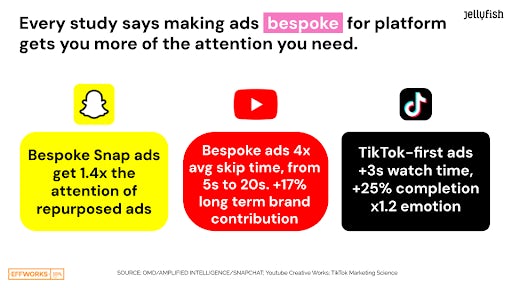
But back to effectiveness in this lots-of-littles world. Research from the platforms tends to say that ads ‘work’ best (both for immediate and longer-lasting effects) when made bespoke for each platform. I laid out the effectiveness case for platform-first creative at Cannes, and in more depth at the IPA EffWorks Global event (watch it here). Ads naturally work best to build your brand when they’re designed for the platform in mind; they work less well when you use the same assets in every platform; and they work even less well when they’re completely disconnected.
In some channels, there’s a penalty to pay if you make poor-quality ads, including ads that aren’t fit for platform – it will literally cost you more to run them. So the algorithms have an impact on paid creative, not just organic content. Meta (and it’s similar for other platforms) says its ad auction takes into account ‘user value’, which combines user attention (view time), engagement (eg comments, shares), and creative quality (eg requests to block). Advertisers with the ‘best’ ads get the best rates, with the more interesting ads attracting the lowest CPMs – more impressions for less cost.
In terms of ad quantity, Meta says its algorithms don’t directly incentivise making fresh creative, but that fresher ads do tend to get the best results. The company says there’s an average 60% drop in conversion after four exposures for ‘performance’ ads. It also finds that more diverse creative drives better short-term results, which includes more messages, different creators and a wider range of ad formats. Meta has found that campaigns with diverse creative can achieve 32% lower CPAs and 9% greater incremental reach versus the average. Its ad delivery system likes more diverse creative as it allows it to find new audiences more easily (hence the uplift in incremental reach). Meta recently found that using 20 or more executions in a campaign drives significant performance improvements (-29% incremental CPA compared with fewer than 20 executions).
But even in this heavily performance-driven, content-hungry environment, the platforms still recommend that ads are distinctively branded, ie come from a recognisable brand at a glance.
So there’s a new reality at play here that many brands and agencies have been slow to understand and accept: audiences aren’t the only audience now; fitting the platforms perfectly and also appealing to their algorithms are important factors in success. Like it or not, some of the creative work we run today needs to be made for both people and algorithms in order to ‘work’. And this is before we start thinking about the new third audience: the LLMs.
Some agencies prove resistant, still arguing for fewer, bigger things, which then don’t meet the needs of the platforms. And some brand teams literally cannot meet the demand they face – their inhouse studios are too small or overworked to cope with the quantity needed, and can end up missing deadlines for new promotional campaigns and activations. This is where GenAI creative and production tools like Jellyfish and Brandtech’s PencilPro can step in – allowing overstretched marketing teams to easily and quickly create the variants the platforms need.
According to Realeyes, the attention testing company, the Starburst brand team at Mars recently created 87 creative versions of an ad in one day and asked it to instantly figure out which would drive the best results. But it turns out 87 variants is nothing. A global cosmetics company recently asked Realeyes to measure millions of creative assets. The only way to create so many assets is with AI, and AI is the only way to evaluate them. Synthetic creative development needs synthetic measurement.
But we’re still in the foothills of all this, and in fact a major practical challenge is that a big proportion of the assets created aren’t fit for platform in very basic ways, with branding, aspect ratios, subtitling and messaging wrong, and so on. Again, AI is helping brands here. CreativeX, which uses AI to assess creative content at scale, says that 50% of digital ad spend is put behind ads that don’t get the basics right and this is wasting billions of ad spend a year. The company says 35% of media spend goes behind digital ads with no visible branding in the first few seconds and 32% of ads are an unsuitable length, often because TV ads are being poorly recycled for digital video.
Aiming high
One solution (that may not be right for every brand of course) is to aim for the best of all worlds: high consistency, high volume, high fit for platform.
High consistency
You need clearly defined brand codes, religiously adhered to, but with brand guidelines that can flex so that executions can speak the brand’s language whilst using the syntax and grammar of the platforms.
High volume
You need the people, agencies and tech to generate the volume of fresh, original content required. But also a singular, focused strategic idea with the longevity and flexibility to be executed in fresh, native ways and a breadth of potential messages to play with.
High fitness
You need creative people (probably including creators) who are extremely online and really understand the language of the platforms they’re creating for. But you need to get them working from one core strategic idea. This is a tricky balancing act and needs some sensitive community policing – or you won’t get what you need from your creators.
This kind of approach will allow a brand to benefit from the best of what we know works (reach, building distinctive assets, consistency), as well as what is required from today’s fragmented media landscape (high volume of assets and messages, fitness for platform or platform-first creative).
Some brands are doing a good job of making campaigns that work in the new environment by balancing these competing forces. McDonald’s seems to be making the transition beautifully. ‘Raise your arches’ and more recently ‘The McRib is back’ are singular campaign ideas, executed via a high volume of platform-first executions. The McRib campaign in particular did this in an especially fun way, with accidental announcements, glitchy ads and hints dropped in the run up to the launch.
Paddy Power is a master of making social content that’s funny and engaging and not too ‘addy’ but which also works well as paid advertising, giving them the best of both worlds in social – what we call ‘One Social’ at Jellyfish. It works brilliantly across different sports and events and is glued together purely through tone of voice, humour and visual brand assets. And even though it doesn’t tie back to a campaign line or big idea, there’s never any question whether it’s well branded.
So today when it comes to creative, it’s not just quality that matters; quantity does too. The challenge is how to generate the required quantity without sacrificing quality. The ad industry has always cared about doing the big things well, but that alone is not enough now. We also need to do the many small things as well, and as collectively, as possible.
Agencies have spent decades talking about ‘big ideas’ but what’s actually needed now is ‘scalable ideas’. They don’t necessarily need to start big; they can start small and then be executed in different ways on different platforms.
Of course, most of the fundamentals will never change. BBH’s John Bartle coined the term ‘imaginative repetition’ to help maintain the balance between creative freshness and brand consistency, and help brands “move it on without moving it off”. And decades ago, Jeremy Bullmore said that “people build brands as birds build nests, from scraps and straws we chance upon”.
It’s just that the scraps and straws we make for people to find and collect have got smaller and exponentially more numerous. We can’t allow our brands to be a disconnected mess, with meaning and messages lacking coherence and consistency. So it’s our job to weave these lots of littles together into a meaningful whole.
Advertising today is a myriad of smaller things, not just a few big things, and the ad industry needs to more fully embrace this reality or continue to be disintermediated.
There’s no shortage of advice out there about how to do the big things well. How big brands have used big budgets, in big channels, with big ads, to make a big impact. And Q4 is always the golden quarter for this kind of thing.
At October’s IPA Effectiveness Awards, it was big brands that picked up the really big plaudits, with the Grand Prix going to adam&eveDDB’s work for McCain – a decade of classic brand advertising which helped the brand do something that shorter-term, less consistent approaches would struggle to do: sell its chips for a bigger price and so increase profits.
The IPA Effectiveness Conference saw System1 launch new research on the power of creative consistency, with an analysis of TV ads from 56 brands aired over five years (with a media spend of £3.3bn in total, or around £60m per brand). It was great to see more evidence for the principle of consistency that many of us have been banging on about for years. Its lessons were as comforting as a chippy tea for the more conservative marketer: for big results, stick with your current agency, your current campaign, and spend big on TV.
Christmas ad season always leads to a glut of marketing content from all the ad testing companies on how the big advertisers’ big ads have scored on their proprietary testing methodologies. Finding top scorers at Christmas seems to have become a turkey shoot. Which may be just as well, as the rest of the year is extremely slim pickings these days.
But the biggest moment for me this year was actually more nuanced. Less of a comfort blanket, more of a wake-up call to a part of the ad industry in danger of sleepwalking into irrelevance.
New era of effectiveness
At the IPA Awards dinner, Catherine Kehoe, chief customer officer of Nationwide, delivered a sermon on the future of effective marketing, to a hushed room of hundreds of rarely silenced ad people. The content was fire and brimstone, the delivery ice cold. Everyone should read the full text here.
It was this section that chimed especially strongly with me: “We have entered a new era of marketing effectiveness, but still much of our thinking has been honed from the age of ‘air power’, that saw carpet bombing and surgical strikes managed from a central command post, powered by enormous targeting and machine learning in media buying. But this is going in reverse now.
“The growing weakness of TV as a mass-reach and mass-event medium is well documented; whilst data privacy laws mean the huge machine-learning data opportunities now sit in walled gardens controlled by Google, Meta and others. And so, we are increasingly entering into a world of brands being built on the ground, by armies of influencers, by brand partnerships and collaborations, and by in-feed and in-game activations. Hand-to-hand marketing is replacing fire-and-forget. And that means we are all learning new lessons every day in so many ways. And there’s no way any of us can keep up unless we work together.”
This was a big brand marketer, famous for making long-running, pure brand TV campaigns with big name agencies, and who’d just handed the coveted IPA Effectiveness Grand Prix to McCain, telling us all to get in training for a very different kind of marketing; a form of hand-to-hand combat, not the air war adland is currently better equipped for (sorry for the military metaphors).
This section of Catherine’s speech resonated with others really strongly too, including Magic Numbers founder Grace Kite, who has her own perspective on media fragmentation and its impact on strategy and marketing effectiveness – a theme she talks about as ‘lots of littles’ (more of which in the second part of this article, coming next week).
Specialists in the worlds of social, content, SEO and influencer marketing reacted to me posting Catherine’s speech on LinkedIn by claiming this is nothing new and they’ve been saying this for years. Fair enough.
But the reason her talk was so notable for me was less the originality of the message and more the context and the audience – it was delivered to a group that has shown a tendency to resist this view and its consequences for a decade or more, and often for really solid reasons. They’ve rightly been demanding to see the evidence that other kinds of creative work can be effective, which is now emerging. And they’ve been struggling to find ways to make it pay. So they’ve been waiting for the decline in the reach of linear TV to become a real problem before fully embracing emerging forms of marketing creativity.
Changing adland’s perspective
The speech raises big questions for a part of the industry – let’s call it ‘Big Advertising’ – that still sees the big ad as the epitome of effective advertising. Big Advertising is not a malign force like Big Tobacco or Big Oil, but its dominance has led it to adopt a similarly conservative, protectionist perspective, somewhat at odds with the industry’s self-image of being progressive creative radicals and misfits. The things that it still celebrates above all seem to have less and less in common with the things that the wider creative economy actually produces today, and that the client community is increasingly keen for its brands to benefit from.
No change or evolution ever happens in a straight line – it will have moments where the tectonic plates shift more dramatically. Perhaps this was one of those moments and we will now see Big Advertising adjusting its big black-rimmed glasses and seeing things from a new perspective.
I’m not writing this to be contrarian but out of love for the industry. This is not about either/or. I love big ads as much as anyone in adland. I used to work in the corner of the agency world that was and still is obsessed with creating the perfect single example of the art, craft and science of the big ad. I arrived at AMV BBDO in the afterglow of it making perhaps the greatest single commercial ever, Guinness’s ‘Surfer’. I’ve made big ads for McDonald’s, Mercedes-Benz, Sainsbury’s, Dulux and many other big brands. I’ve seen first hand the hundreds of scripts sacrificed in pursuit of the perfect John Lewis Christmas ad. Like many in the industry, I love this kind of work, the emotional impact it can have on people and the commercial impact it is repeatedly proven to have – and still has – for brands.
But it doesn’t take a genius to look at any of the screens or platforms we get served ads on, to see that advertising of this type is now only a vanishingly small proportion of the industry’s total output, and declining. And that the very rarefied kind of advertising (where big ads tend to be over-represented) that makes it to the IPA Effectiveness Awards probably represents rather less than 0.1% of all advertising.
We can mourn its loss. We can try to slow the decline. But we can also look to the future and try to drive our industry’s constant and inevitable reinvention. And we can try and make the quality of the new stuff, which is too often not great, better. (None of these options are mutually exclusive – it’s perfectly possible to do all this simultaneously).
Big Advertising used to be the epicentre of adland’s creativity, but its dominance in the creative ecosystem is being chipped away by the democratisation of advertising and content creation tools, self-service ad platforms, and brands working directly with platforms and influencers.
And now we see the inevitable rise of GenAI creative solutions which, whilst currently mostly being deployed fairly low in the funnel, are starting to climb up it, with rapid improvement in the quality of GenAI video. Coke’s GenAI version of its ‘Holidays’ ad inspired a thousand hot takes, as did Vodafone’s ‘Rhythm of Life’ film, but whatever your take, the implications are undeniable: GenAI’s coming for the world of big ads too.
Bigger isn’t better
The story of the last decade for Big Advertising has been one of disintermediation. The story of the next one will be the same.
Big Advertising has been shrinking because it hasn’t been listening hard enough to the client community or responding to their needs as fast as other, newer types of businesses. It has been slow to innovate and evolve its core product and so is losing share in the wider category of creative marketing. Big Advertising is an industry that’s not moving as fast as its clients, and that’s a problem.
And Big Advertising’s latest move? To bet on getting even bigger being the way forward. The acquisition of IPG by Omnicom shows that the industry at its heart still believes that big is beautiful – in contrast to the message from clients.
The niche-within-a-niche that is the marketing and advertising effectiveness community – despite all the incredible work it does proving the effectiveness of what has worked in the past – needs to focus as much time on exploring new theories and practice as it does proving and reinforcing existing principles.
I love the IPA Effectiveness Awards and owe a lot to them, but rather than see them decline in relevance I would like to see them evolve faster, or for the IPA to find additional new ways of celebrating the effectiveness of new kinds of work. The big brands currently benefit from a kind of ‘double jeopardy’ that makes it easier for them to enter and win, and harder for newer, smaller brands and organisations to prove their case. This needs to be addressed, either by significant reform of the core awards or by introducing new types of effectiveness awards and case studies. My hunch is the latter is a better bet.
The client community needs access to more fresh, current case studies with a level of rigour and proof far greater than the standard LinkedIn post on Liquid Death or Duolingo they’re currently having to rely on, but which is also far more accessible than a full IPA Effectiveness case. IPA entries are a huge effort and cost not only to write but also to access. Yes they’re the gold standard but they must be a driver of innovation, not a barrier to it.
So this is a plea to adland’s agencies, industry bodies, suppliers and research partners, to understand, evaluate, champion and of course learn to create new forms of advertising, at least as much as established forms. This happens in pockets, of course, but it still feels piecemeal and lacking in collective ambition, commitment and urgency from the industry as a whole.
Advertising is now a thousand kinds of smaller thing, not just one or a few big things. If we don’t embrace this truth our industry will fail to benefit from the massive shifts we’ve seen in the wider creative and creator economy.
This was the first of two articles on changes in the marketing ecosystem. The second, ‘Brand building in the age of creative fragmentation’, covers the implications for brands.
This is a version of a pair of articles that were first published in Marketing Week in June and July 2023 that started life as a talk for the IPA & WARC at Cannes Lions Festival of Creativity, ‘The 3rd Age of Effectiveness’.
Part 1 – brand building
There are still people in adland who would love to turn back time to a pre-digital age. Who make bold claims like ‘digital can’t build brands’, or ‘no brand has ever been built solely with social media’.
Of course, no brand is ever built solely with advertising of any kind, it’s just one of many levers to be used in combination. And advertising is only ever a weak, not a strong force anyway. You don’t have to believe online advertising can build brands alone – just that it can make a meaningful contribution.
There’s also a less extreme feeling, a lingering doubt, that I think may be shared by a bigger chunk of adland, that the platforms dominating global advertising today aren’t yet, and perhaps never will be, as good as the previously dominant channels at helping build our brands.
But beware golden ages, they’re always fantasies. Nostalgia’s an elephant trap for marketers – it won’t build our brands any more than neophilia will. We should prioritise the use of the tools that work today, not ones that worked much better yesterday or those that will only start working tomorrow.
Full disclosure. This is a personal perspective and one that’s bound to be influenced by what I’m learning in my role as VP Brand Strategy at Jellyfish, a connected media, creative, data and tech company that builds brands by finding smart ways to combine these elements.
Before I come onto some of the evidence for brand building being perfectly and increasingly possible using the platforms we have today, I want to touch on ‘why now?’. Why are we at an inflection point where the technology is maturing and increasingly being used for brand building alongside its longstanding role assisting short-term sales?
Battle of the platforms
A fundamental factor is good old-fashioned market forces and the ongoing battle for market share of global ad spend by the platforms. Google and Meta built an unprecedented share of global advertising spend over the last two decades, initially from dominating companies’ lower-funnel budgets and by making direct response advertising vastly more accessible to millions of small companies than it had ever been before.
Source: Joshua Benton, Nieman Lab, US data, 2022
That level of growth could never continue, and they’re now being squeezed by both the newer social platforms and the huge growth of retail ad networks. So they’re now looking to both defend their existing massive shares of lower funnel budgets and also grow their share of upper funnel budgets. Everyone’s looking to match TikTok’s success in short form video. They’re all increasingly pushing their platforms’ brand-building capabilities to grow their share of that piece of the pie.
The rise of video
The rise of the smartphone fuelled the explosion in digital video that’s enabling all this. Video now accounts for the vast majority of global internet traffic, around 80% by some estimates.
And where there’s video there’s brand building. Video is to brand building what water is to life on earth. More video content means more attention, more emotional impact, and sometimes a more personal and attentive viewing experience than on bigger, more public screens. All of which means more of the long-term brand memory encoding that’s needed to contribute to sales tomorrow, not just sales today. AKA brand building.
Google’s main weapon against TV is naturally YouTube. More YouTube content is being watched on the main large screen in a household than ever (around 33% of YouTube viewing in the UK happens on TVs, according to BARB, and 45% in the US, according to YouTube data).
YouTube videos are being made with ever-higher production values, so it’s great content to put ads in and around. It’s probably the most powerful of the digital platforms for brand-building still, given the number of seconds of attention its ads command. But TikTok’s closing in, and is also helping to accelerate the growth in the video-creator economy.
Meta had to play catch-up when it came to video, with video still responsible for only around 15% of all content viewed on Facebook at the time of writing. I suspect the proportion of time spent on a given platform watching video content is probably a crude measure of its potential as a brand-building channel.
In the case of Google, innovation is making its traditional search business more upper-funnel friendly. Google’s Performance Max product generates AI-assisted video and other brand assets that are more polished and consistent with a brand’s visual identity and tone of voice than ever. Improvements in the impact of brand-building advertising can happen through better integration through the funnel, not just by creating more impact at the top.
And, just as the first platforms made direct-response advertising more accessible to millions of small businesses, some of the tools of brand-building advertising are now increasingly available to businesses of all sizes. My teenage son’s first Saturday job involved making TikToks for the local trainer store, which regularly got hundreds of thousands of views and occasionally millions, and built up a followership amongst most of the sneakerheads in the area. A role for video advertising previously completely off limits to a tiny local store.
A brand-building counter-revolution
All this is being underpinned by a greater understanding than ever of how brand-building really works. I don’t think it’s a coincidence that several of the most important books on brand growth (including Binet & Field’s seminal ‘The Long and the Short of It’) were published during advertising’s digital revolution. I suspect the rise of the digital platforms inspired an intellectual fightback by the established marketing world in defence of what works to build brands over the long term, against a new world that was putting short-term digital tactics first.
Changes to privacy laws and Apple’s subsequent updates to its operating system also led to a renewed interest in brand building.
Privacy regulations affected the ability of adtech to capture data on users and use cookies to track them across the internet and apps. Some of the links in the chain that allowed a clear sight of the ads an individual is served and the things they buy broke. This made brand advertising, which rarely demands that level of granular understanding of its impact on an individual, relatively more attractive than previously, including to businesses who wouldn’t have considered doing something so ‘unaccountable’ before.
This led to the digital measurement world looking less to attribution and more to measurement techniques such as econometrics and geo-experiments – both better able to capture the impact of brand activity.
The performance plateau
Increasing numbers of brands, having once had a more performance-driven approach, have also got to a point where their lower-funnel activity reaches saturation, they reach a performance plateau, and they then try a more balanced full-funnel strategy. I’ve written about this previously so won’t go over that here – but the sheer number of brands experiencing this feels like it must be a factor in why more and more brands are turning to digital for brand building, not just performance.
Econometrician Grace Kite and the Advertising Research Community (ARC) produce meta-analyses of the econometric modelling of the impact of media on everyday brands and campaigns, not just effectiveness awards winners (which are the basis of Binet and Field’s research). This work has been helpful in understanding the optimum balance between online and offline ad spend. ARC’s conclusion in 2021 was that on average the optimum percentage to spend online was 40% to 50%
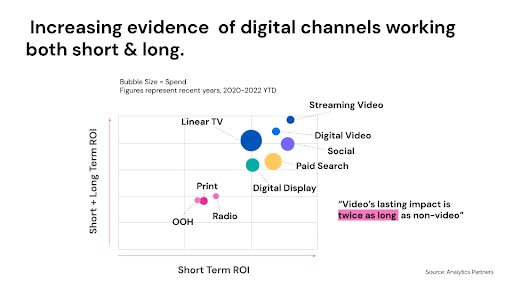
Various recent studies, including by ARC, have shown how many of the digital channels are equally capable of producing both short and long term effects, vital evidence to help end the view that digital advertising is just for triggering an immediate response.
According to econometrics company Analytics Partners, most digital channels are capable of contributing to the long as well as the short term. The importance of video for brand building is also evident in their analysis, the lasting impact of video channels typically being twice as long as non-video channels.
Brands built in digital
So what brands can we point to that have been built partly or solely using today’s platforms?
You have to be wary of placing too much emphasis on individual case studies, but Gymshark is a brand being ‘built in social’ with considerable creativity and marketing nous. Gymshark achieved profitability and unicorn status in a decade, and got there partly by growing a cult-like following in social media fuelled by influencer marketing. Too much has probably been written about Liquid Death already, but that brand’s mix of highly distinctive branding, impactful social-first communication, experiential and smart approach to distribution has proven to be a winning formula.
If we need more examples, there’s a fascinating and highly successful cohort of global SaaS brands such as Fiverr, Monday and Wix, which are often big YouTube advertisers, many of which continue to see success.
Are there bigger, more valuable brands and businesses out there that are less purely reliant on social or digital advertising? Yes. But it’s hard to imagine any of the world’s biggest brands not seeing digital advertising as an important part of their brand-building mix today, as well as of their sales activation mix.
Continued importance of brand equity
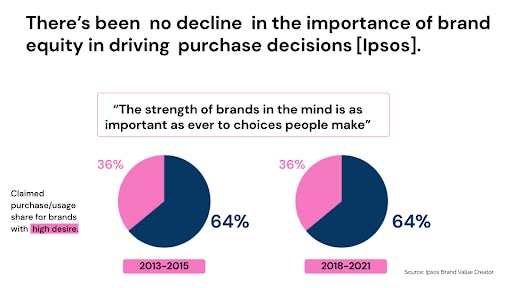
A discussion with Ipsos on the topic of ‘brand building in digital’ led to this question: given the massive shift in ad spend towards digital channels, if digital advertising were only about driving short-term sales, shouldn’t we have seen a big downward shift in the importance of brand equity as a driver of purchase decisions?
Well no, as it turns out. There’s actually been no decline in the importance of brand equity in the purchase decisions people make according to Ipsos’ ‘Brand Value Creator’, which suggests that “strength in the mind remains as important as ever as a driver of purchase decisions” – staying at the same level across its entire global database over the 2018-21 period as during 2013-15.
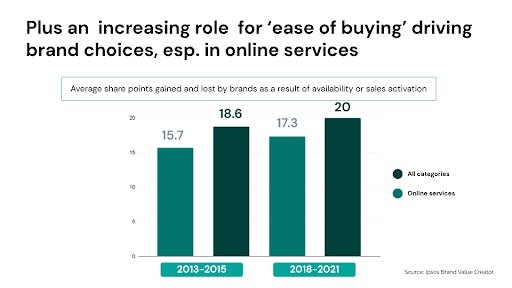
Ipsos data also suggests that ‘ease of buying’ as a factor in purchase decisions has grown over the same period, especially in online services categories, suggesting that whilst brands are still being built in the digital age, digital channels may also be creating greater opportunities to close the sale. Digital has been additive for marketing, not subtractive.
What marketers think
But what about the clients’ view of all this? What do marketers believe about brand-building in digital? Do they think digital has a lot of ground to catch up before it’s seen to be as useful as ‘traditional’ channels for brand building?
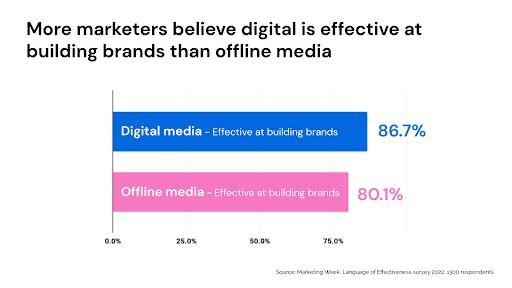
Actually Marketing Week’s ‘Language of Effectiveness’ survey of over 1,300 marketers suggests digital is far more mature for brand-building than others may believe. In fact a huge number, 86.7%, believe digital media is effective at brand-building, which is more than the 80.1% who believe offline media is effective at building brands.
So marketers are far more optimistic than any remaining adland sceptics, and their perspective is much more in line with the econometrics data.
All of which suggests brand building is absolutely possible in today’s platforms, and that many brands are achieving it already.
The nostalgics may have had a point – maybe we just weren’t very good at using digital to build brands initially. But over time we’re learning how to use the new tools and are getting better at it.
But could we get even better? Almost certainly, especially when it comes to creativity. And we’ll look at that more closely now.
Part 2 – Creativity
Major issues do still exist in terms of creativity in digital advertising, including short-termism, a legacy from when its principal or even sole role was the narrow targeting of hot in-market prospects. That meant brands missing out on driving more sustainable long-term growth by reaching new audiences, and left many brands on the performance plateau. It meant too many ads that are ignorable or even irritating to everyone apart from those ready to buy right now.
Brand building relies on reaching people who are not currently in the market and so requires a different creative approach. As they’re mostly not interested in you, you have to try much harder to get their attention and make a lasting impression, so that when the time comes, the little seeds you’ve sown in their synapses have a chance of doing their work.
And this leads us to the biggest issue we face if we’re going to get better at using the platforms to their full potential to help build our brands.
The attention problem
Karen Nelson-Field’s work on attention gave us the alarming headline that 85% of 130,000 digital ad views she researched didn’t achieve the 2.5 seconds or more of active attention necessary to impact longer-lasting brand memories and build mental availability.
Impact of attention time on mental availability (MA). Source: Amplified Intelligence
The theory is that ads under this threshold can basically only drive a click. Ads over it are able to influence future sales too. This is the essential difference between brand-building ads and direct-response ads. Karen Nelson-Field’s work suggests the more seconds of active attention an ad receives, the more days it can stay in the memory, and the longer it can work.
Another important finding from Nelson-Field is that a given platform has a set range or limit on the amount of attention people will pay to ads there – it’s the platform and format, not the creative, that makes the major contribution to the total number of attention seconds it will receive. Optimising your media plan for attention is becoming increasingly common.
But whilst platform and format choice determines the broad range of attention your ads can receive, it’s creativity that helps get you to the top of that range. “Attention elasticity forms the opportunity for ad creative,” says Nelson-Field. So good ads can get you somewhat more attention than bad ads on a given platform, albeit this will likely still be limited.
This is a challenging finding if, like me, you’d love to believe that the sheer force of human creativity can break through any boundaries and get everyone to watch every last second of everything you and the team have laboured over. The idealist in me still believes the finding must be wrong and wants every campaign to be an outlier; the realist in me has to admit this is extremely unlikely.
Whilst getting enough attention is a major challenge in digital advertising, it’s not a new one.
Ads of all kinds have always had surprisingly large drop-offs in attention. Data from measurement companies such as Lumen shows, for example, that magazine ads can have attention curves close to a YouTube non-skippable ad, and newspaper ads can have a steep retention curve akin to an in-feed Facebook ad. The difference is that we now have the data and are more aware of the drop-offs in digital ads than we’ve ever been before.
And it’s not a new issue for creative people to be wrestling with either. You can see it in the famous quotes of many of the ad legends of the 60s:
Bill Bernbach: “If your advertising goes unnoticed, everything else is academic.”
Mary Wells Lawrence: “People are very sophisticated about advertising now. You have to entertain them. You have to present a product honestly and with a tremendous amount of pizazz and flair. But you can’t run the same ad over and over again. You have to change your approach constantly to keep on getting their attention.”
John O’Toole: “[We’re] an uninvited guest in the living room of a prospect with the magical power to make you disappear instantly.”
O’Toole was talking about people flipping TV channels here, but could just as easily have been talking about ad skippability or scrollability today.
The issue of how to get and keep attention is one ad creators have always had. It’s not caused by ‘digital’ or by specific platforms, it’s caused by people not being as interested in ads as the stuff they’re actually there to see. And the solution is both simple and hard: creativity.
Platform best practices
But before applying that creativity you need to understand the dynamics of the platform you’re creating for. Why people are there, what they’re there to see, the ‘grammar’ of the stuff they like there. Only really knowing how things work on a platform, and knowing what the algorithms favour, can help you get more attention there and help you flatten the curve.
Adopting platform best practices prevents attention dropping off
And this takes time to learn. We’ve had 70 years to learn how to make TV ads, but only four or so years to make TikToks. Of course we’ve not perfected this yet and of course we’re only going to get better at it.
All the research evidence says you need to learn the ‘rules’ of each platform and create bespoke ads for them to be able to maximise attention on them. Kantar found that campaigns with ads tailored to specific digital channels have 13% greater impact on brand equity overall versus using the same ads on each platform.
Similarly, Ipsos found that the same creative often doesn’t perform well across formats. In their research, strong performing TV commercials didn’t translate well into skippable and in-feed environments, and ads developed for skippable formats performed pretty well in-feed but badly in TV.
A common finding from these studies is that you have to apply a platform’s ‘best practice’. This often includes the story structures that work best to get and keep attention. YouTube’s advice is to use ‘emerging story arcs’ not ‘traditional story arcs’. YouTube ads using new story arcs get four times the average watch time before being skipped – 20 seconds compared to five – and ads with traditional arcs are twice as likely to be bottom performers. This is similar to TikTok’s advice, which says you should start with a bang to hook people’s attention, not the ‘slow build’ of a TV commercial.
In an analysis by Kantar of 11,000 ads, applying YouTube’s best practice principles (attention, branding, connection, direction) was found to contribute +17% in long-term brand contribution. Similarly, bespoke Snap ads get 1.4 times the attention of ads repurposed from other platforms and bespoke TikTok ads get three seconds more watch time and 25% more completed views.
So definitely don’t just put your TV ad on the platforms. And don’t put your Facebook or YouTube ads on TV. But also, you can’t just put ads for one digital platform onto another one, and expect them to work as well as something bespoke.
One of my favourite findings comes from Ipsos: “Challenge category conventions. Taking an unconventional creative approach produces 40% longer viewing time on average for skippable ads.”
It’s exactly the same principle they’ve been teaching from day one at creative agencies for decades: it’s pure ‘when the world zigs, zag’.
Emotional impact
Another principle that’s coming out of recent studies, but isn’t always mentioned in the basic platform best practice, is the importance of emotion in driving brand impact.
System1’s studies of ads on Meta and Pinterest show ads that create a strong emotional response are much more likely to also drive brand awareness or brand lift. High-emotion ads on Pinterest drove six times as much brand lift as low-emotion ads for example.
When you look across these principles, they’re actually principles that Bernbach, Ogilvy and Wells Lawrence would recognise.
You need to know what works on a given platform, make ads bespoke for them following their technical advice, and ensure they deliver the holy trinity of attention, branding and communication. But as well as A, B and C, you also need D and E: difference and Emotion. So:
Get attention fast
Integrate brand/product
Use stories to communicate (and use new arcs)
Difference works best
Evoke intense emotion
None of these principles is ground-breaking, in fact they should be meat and drink to all creative advertising people.
And brands are learning. We’ve had years of people in the industry complaining that digital ads aren’t different, funny or surprising, but I’m seeing more evidence in my feeds of agencies and brands getting it right.
Tesco are clearly having fun and some success experimenting with TikTok, including with their #VoiceOfTheCheckout campaign.
Hilton Hotels’ 10-minute TikTok was genuinely great craft: a funny script that played with the grammar of the platform and a great performance from Paris. I doubt many people watched all 10 minutes, but then that’s not necessary for it to do its job.
Screenshot: Hilton’s 10-minute TikTok ad
And on top of this advice for paid ads, we now also have another really useful tactic. There’s a huge and growing army of creators who live or die by knowing what works best for their channels and their personal brands to retain viewer attention. And creator-led advertising is growing fast, reaching around $16bn in value globally last year.
Creators earn more attention
The best creators know how to make attention-grabbing thumbnails and opening shots; to deliver the promise of a video straight away; that music creates a feeling; that you need repeated emotional highs to keep people watching.
And when applied to brand creativity, their work can sometimes work even better than the professionals’. Platform-native creative made by creators on TikTok consistently outperforms repurposed or adapted ads in driving brand recall there, according to TikTok’s marketing science team. Influencer marketing can be easy to dismiss as hot people holding things. But when it’s creative people making things it becomes an entirely different proposition and much harder to dismiss.
Maybelline’s mascara TikTok was a joyfully silly PR stunt, with the quirky ‘is it real or fake’ intrigue of the Jacquemus handbags video from earlier in the year. You can argue about what it’s actually ‘saying’ about Maybelline. But if its job was to get attention for the brand in a distinctive way, it looks like a big success.
Screenshot: Maybelline’s computer-generated mascara video on TikTok
So this is the second creative opportunity: to break the attention curve and not just flatten it, with native content made by creators that can earn even more attention.
Which gives us two tactics: paid ads that are highly tailored to the platforms, and creator-made videos that are totally native to them.
All this has implications for budgets and consistency. You don’t want to stretch your communication too thinly across too many platforms, or end up doing one-off campaigns that don’t add up to a greater whole. You need to be as focused in your brand strategy as ever. You may have to use fewer platforms, but select them more deliberately. Some of these are media strategy questions, but plainly have an implication for creative: another argument for planning media and creative more closely together than has become the norm.
And once we’ve mastered the current crop of platforms, new ones will of course come along for us to get to grips with. And so the cycle continues.
This article was first published in July 2020. It seemed to strike a chord, and people on the frontlines of modern marketing tell me it’s been helpful. It remains my most read article. I especially love it when it gets shared by people who weren’t previously familiar with the work of the big names in marketing effectiveness from the UK/Aus/NZ, especially US performance marketing people. So if you know marketers struggling with the limitations of short term tactics, with brands that are stuck on the performance plateau, or with leaderships who ‘don’t get brand’, who might benefit from reading this, please do pass it on.
I was inspired to publish this slightly updated version, after the marketing author and illustrator Dan White sent me a brilliant new set of illustrations he’d done of all the charts in the original.
Short-termism and long-termism are both just wrong-termism. So let’s end the false choice between long and short-term marketing tactics, maximise the compound effects of getting them working together in harmony, and close the value-destroying divide between ‘brand’ and ‘performance’ marketing, which limits marketing effectiveness and growth.
Long term ‘VS’ short term is probably the most commonly cited false choice in marketing.
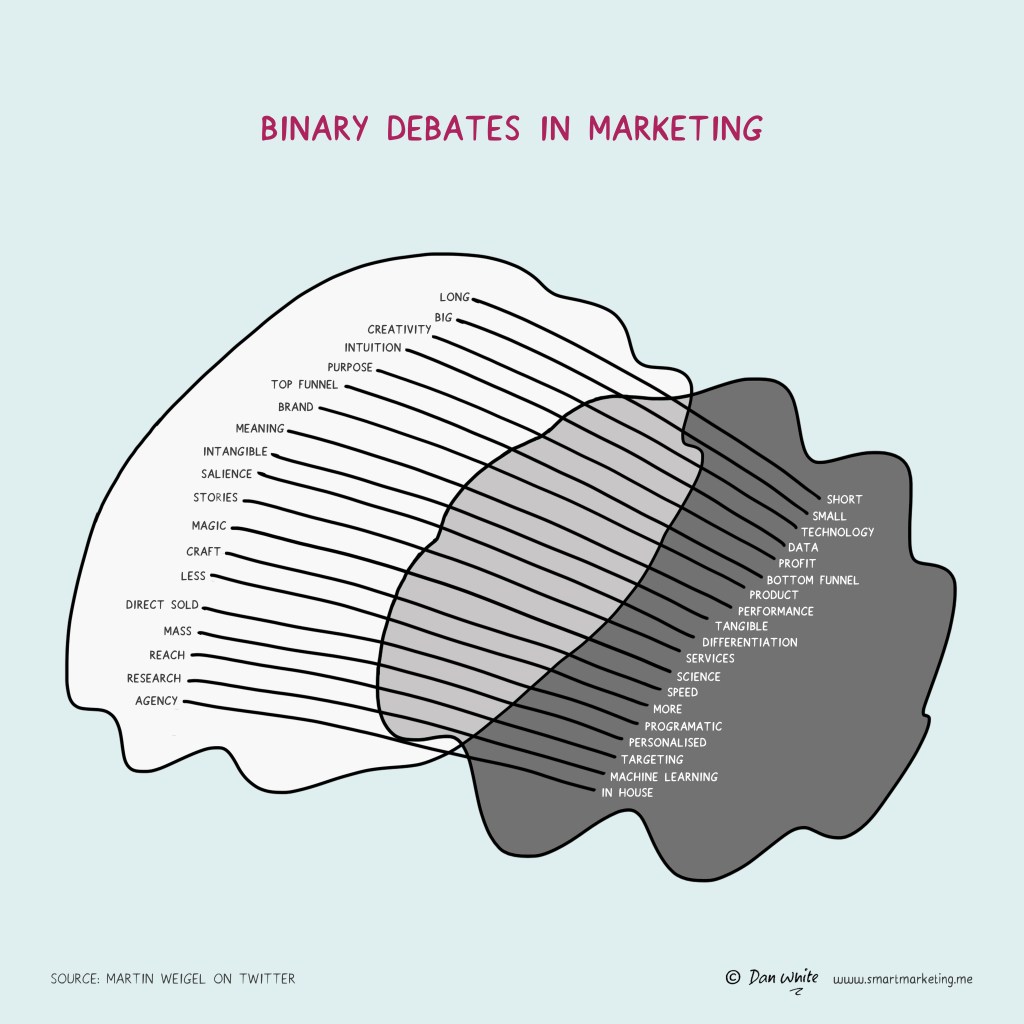
And that’s saying something, as we love false dichotomies in this industry: brand vs performance, emotional vs rational, creativity vs technology, intuition vs data, art vs science, to name just a few that we constantly debate.
And of course the answer to most of these is ‘&’ not ‘or’.
It may seem a little unnecessary for yet more to be written about the long and short-term in marketing given two industry legends have literally already written the book on it [i]. But whilst the theory says we should all try to achieve a balanced approach in order to maximise both saleability and sales simultaneously, there’s still a massive gulf between the theory and actual practice, which is too often divided between practitioners of brand and performance marketing.
And it’s even quite common for people to overlook the central importance of the theme of balance in Binet & Field’s most important work, and to think of them as ‘the high priests of the long term’.
SHORT-TERMISM
Short-termism rightly gets a lot of criticism, and there have been plenty of brilliant critiques of it by other people, so I won’t do that here [ii].
There are irresistible pressures pulling marketers towards the short term [iii]. And there’s also a huge asymmetry in terms of accessibility to performance channels vs brand-building channels. Google, Facebook, Amazon and other platforms have given millions of businesses of every size and type, easy, self-service access to a giant direct response advertising eco-system. And this universal accessibility is also ensuring there’s a ready and growing supply of ‘performance’ marketing specialists and a dwindling supply of ‘brand’ marketing specialists – a factor that further exacerbates the divide.
LONG-TERMISM
Too many people though, especially on the ‘brand’ side of the divide, also wrongly assume that because short-termism’s a bad thing, long-termism must therefore be a good thing, despite the potential for it to be just as damaging in different ways.
There’s always been a lot of magical thinking about the long term in advertising. That you can just do something big and expensive as a one-off, then close your eyes and cross your fingers and hope no one commercially-oriented asks any awkward questions for six to twelve months, until future sales start magically happening.
But communications that are successful over the long term don’t work by activating some kind of ‘sleeper cell’ in buyers’ minds which suddenly bursts into frenzied commercial action after many months of lying completely dormant – communications need to achieve some level of short-term sales success as well as improving a brand’s mental availability if they’re also going to achieve long-term growth.
And whilst short-termism may give people a bad name within certain corners of the marketing world, it may actually be long-termism that gives some marketers a bad name within their organisations and amongst the rest of the business community, perhaps because some marketers appear to act like selling’s a dirty word to them (for example by getting evangelical about certain marketing approaches that appear purposefully designed not to sell stuff).
WRONG-TERMISM
And whilst they’re quite different, it’s possible to simultaneously see short-termism and long-termism as equally bad practice – wrong-termism, if you will.
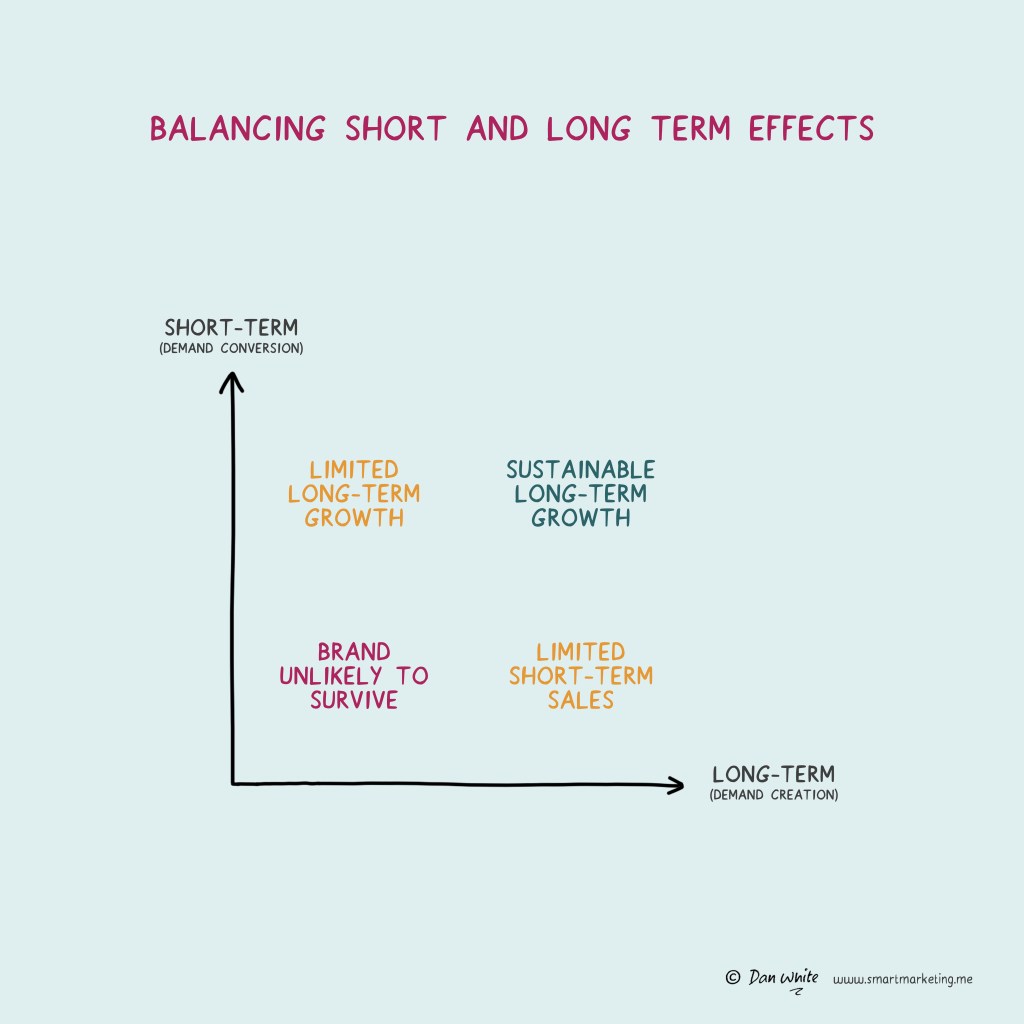
Wrong-termists get it wrong in two different ways: short-termists restrict the long-term growth their marketing can achieve, and long-termists restrict its short-term sales impact.
THE LONG THROUGH THE SHORT OF IT
Marketers have never been under more pressure to make every marketing $ work as hard as it possibly can. We’ve never been more aware that without short-term success there may not even be a long-term for some of our brands. And the best way of securing both will be to embrace the fertile middle-ground that lies in combining the power of short and long-term effects.
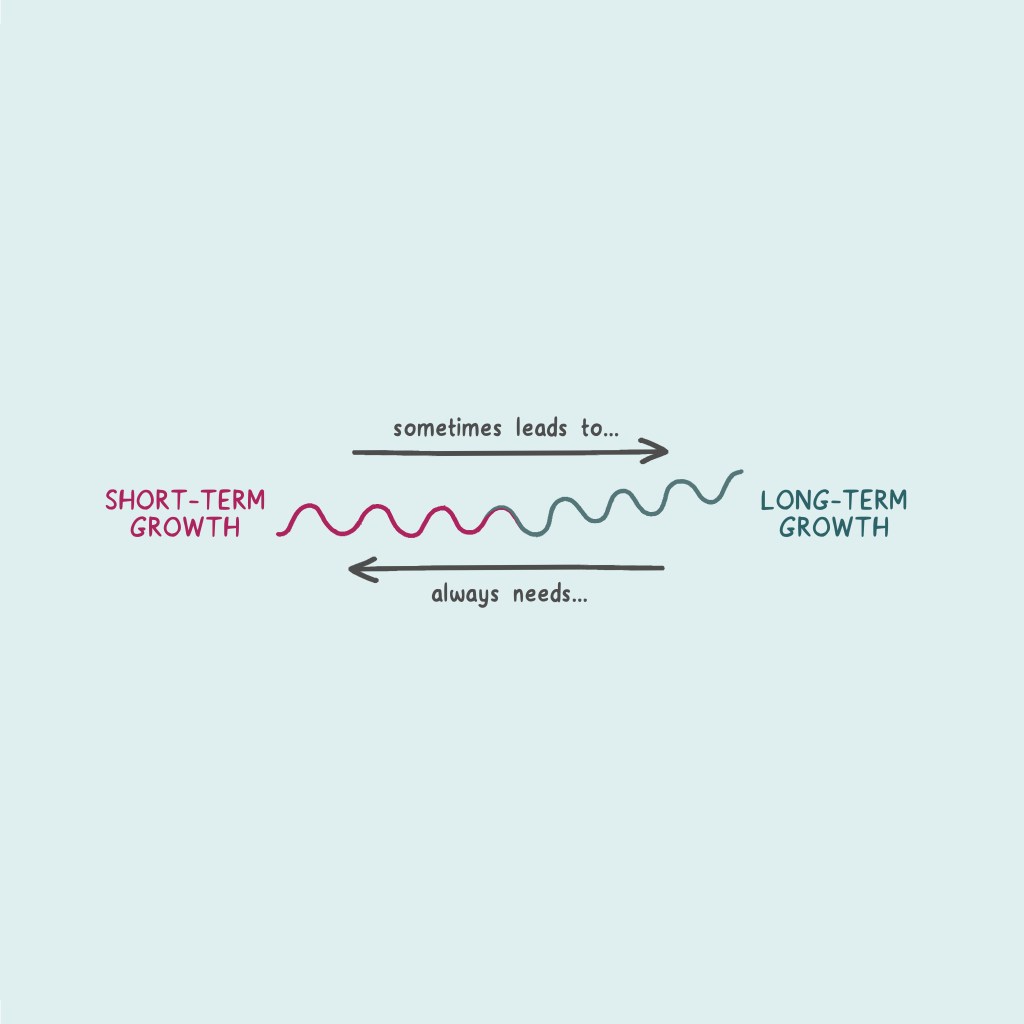
Long-term growth always has its roots in the short term. The two are connected, influence each other, and if you get the two working perfectly in harmony together, you’ll achieve the strongest, most sustainable growth possible.
But we so often miss out on maximising growth in this way because of our binary belief systems, the organisational silos we inhabit, the different job titles we have, the different channels and formats we tend to use and the different metrics we try to optimise.
It’s important to say that long-term growth isn’t just achieved by adding up a series of short-term effects. It’s more complicated than simply being additive: it’s a multiplicative, compound effect, which starts slowly but strengthens over time.
And whilst all long-term growth actually has roots in the short term, only some kinds of short-term activity also lead to long-term results.
So the roots of long-term growth are there in the present if you do the right kind of marketing communications.
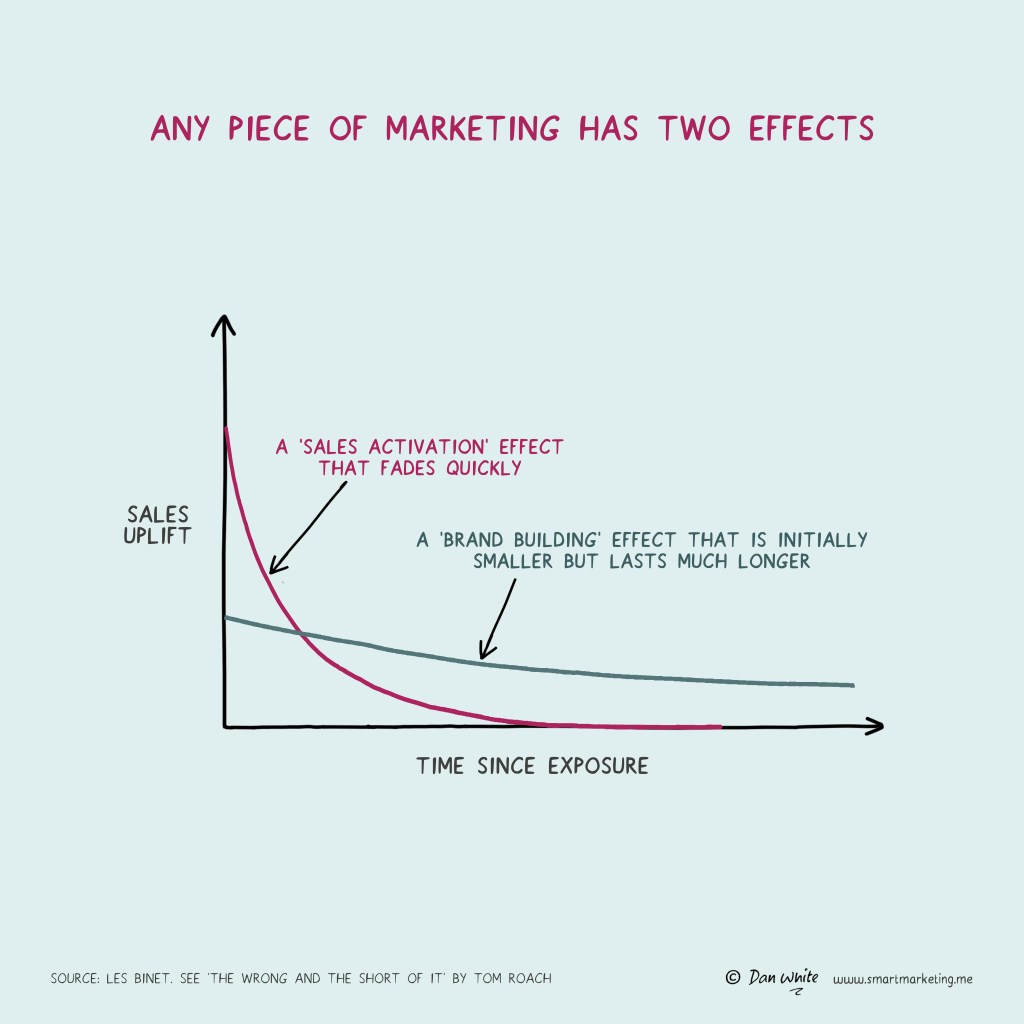
The two are always happening simultaneously, to some degree, in the same marketing campaign and in everything a brand communicates about itself. Les Binet’s chart below shows two kinds of sales impacts from a single exposure to a single execution. A short-term sales spike and a longer-term tail.
The two lines are interrelated. If you try to push the red spike higher, you’ll reduce the length of the black tail (e.g. a promotion or offer would push the red spike higher but massively reduce the black tail). Which means to achieve equilibrium you’ll need a balance across a campaign and across your entire marketing plan (although not necessarily within an individual execution).
It’s practically the law that any discussion of the long and short-term in marketing must include Binet & Field’s classic ‘steps’ chart illustrating the two different ways in which communications can drive sales – through short-term sales activation and long-term brand-building, so here it is:
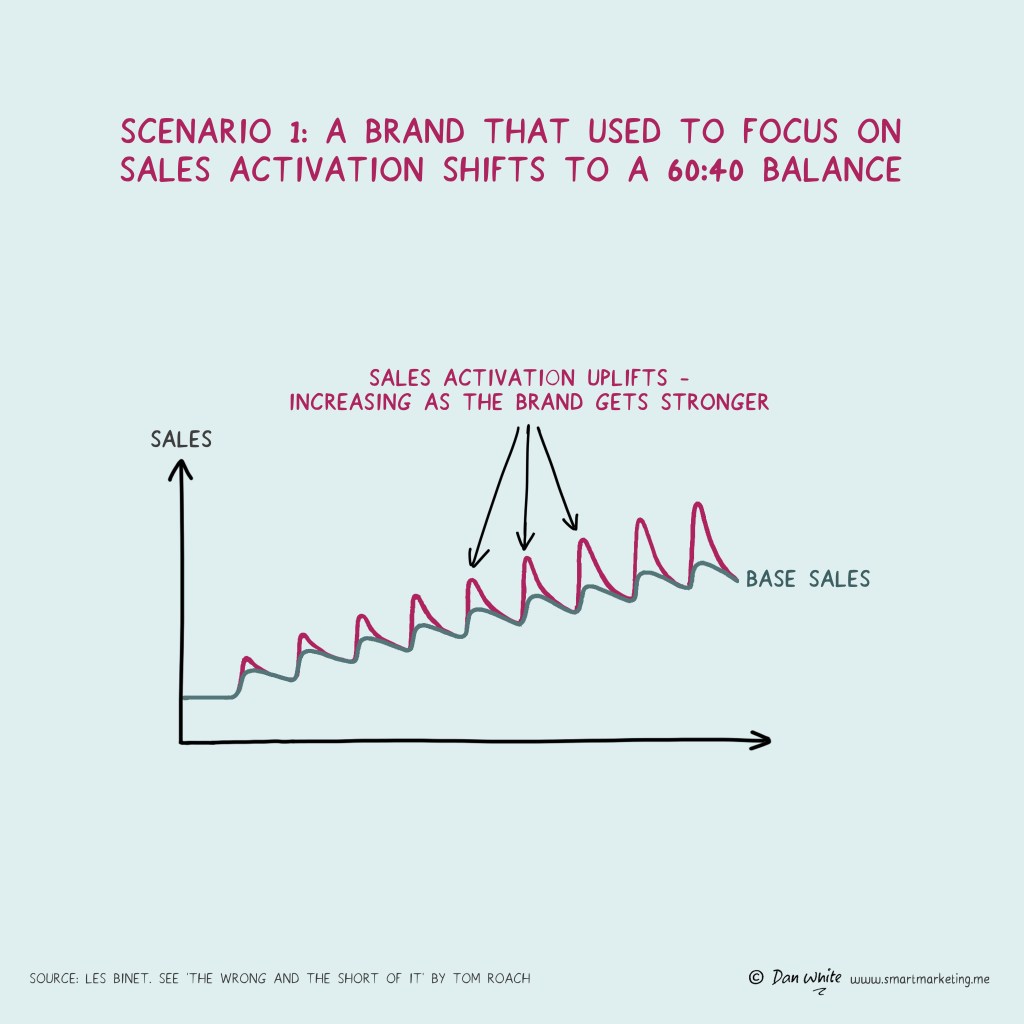
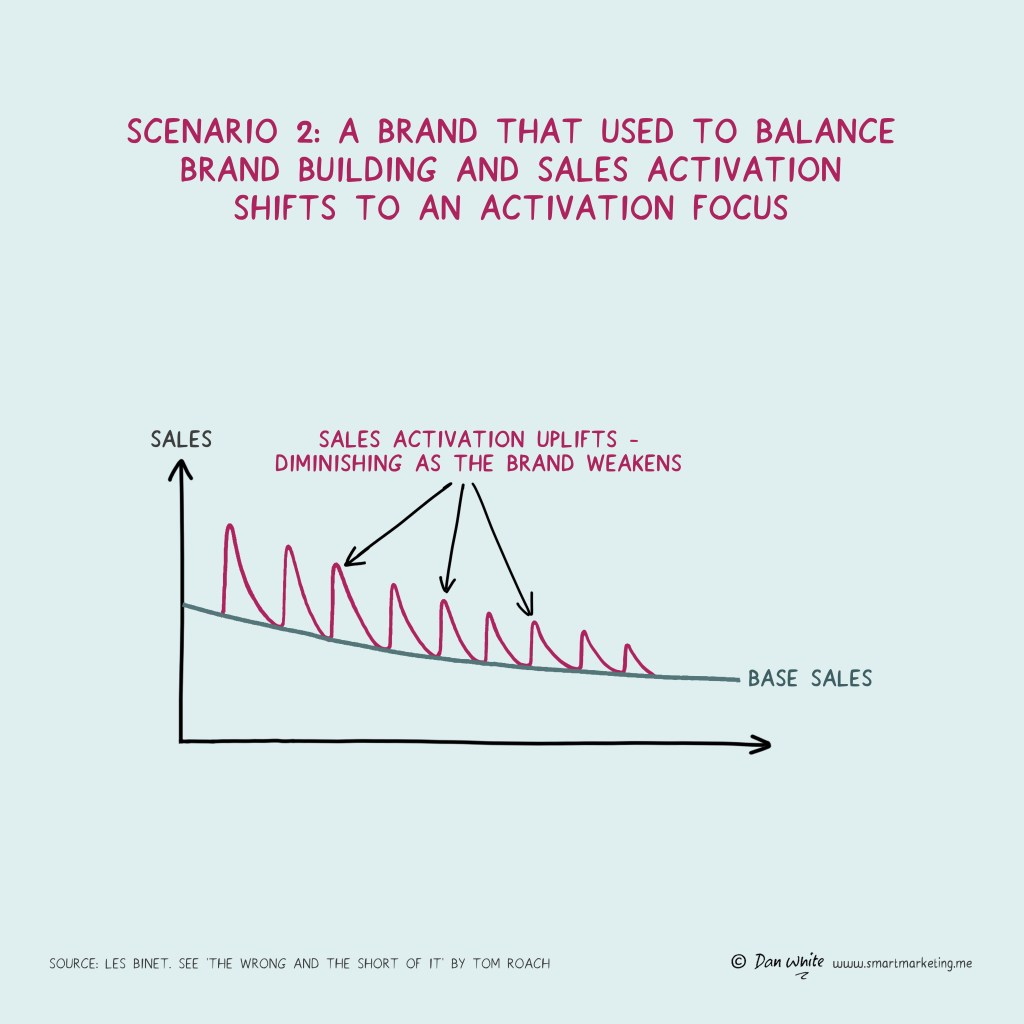
And what follows are some illustrations by Les Binet that build on this, but this time rather than separating the short and long-term effects, they show the combined effects of doing ‘brand building’ and ‘sales activation’ together in different combinations. They’re just theoretical, they knowingly exaggerate the effects for clarity, and there will of course be real world exceptions.
Scenario 1 is what could happen if a brand that had been heavily biased towards sales activation shifts its balance in favour of brand-building activity (Binet & Field suggest a balance of 60:40 is a good rule of thumb – not a fixed ratio but a good place to aim at if you’ve got no data yet on what works best for your brand). It could see lower initial short-term sales peaks, but base sales would begin to rise and the short-term sales peaks could start rising too as the strengthening brand helps improve the impact of sales activation.
Scenario 2 shows what could happen if that brand switched back to being heavily biased towards sales activation from a more balanced plan. Short-term sales peaks could get lower and base sales could drop over time. It’s a cautionary tale that you may have witnessed, for example with the arrival of a new CEO or CMO who ‘doesn’t believe in doing brand marketing’.
But charts like these don’t always totally reflect the real world options available to modern marketers, for example where performance activity is usually ‘always on’ rather than pulsed, and where the idea of scaling it back dramatically or even switching it off could feel like instant career suicide.
So below is an illustration by econometrician Grace Kite and me building on the classic ‘steps’ chart from the perspective of a common real world scenario, that of a digital-first brand whose initial strong growth from always on performance activity has levelled off, after which point brand-building activity is successfully deployed in order to take growth to the next level. It’s based on the econometric modelling Grace has done for a wide range of brands facing similar challenges.
It shows growth initially being driven by always on activity in performance channels, and the impact of that activity reaching a plateau which often happens when saturation point is reached. Then it shows the impact of a successful decision to layer in ‘brand-building’ activity. Note that this brand activity both delivers its own short and longer-term sales impacts, as well as improving the sales generated by performance channels. It also shows the compound effects of all this marketing activity working together and becoming stronger over time as the brand-building activity is further optimised.
‘All models are wrong, but some are useful’ of course, but hopefully this shows performance-first brands the growth potential of adopting a more balanced approach that includes layering in brand-building activity, and gives brands like these a little more confidence when taking the big step into doing ‘brand-building’ communication.
A PROMISING METRIC FOR MEASURING THE LONG THROUGH THE SHORT?
The long-term growth potential of campaigns should be measurable in the short-term, even if you’re not currently set up to monitor it. So you may need to start thinking about boosting your existing measurement (which would ideally already include a balanced scorecard of long and short-term metrics), with new kinds of short-term measures that can also predict long-term performance.
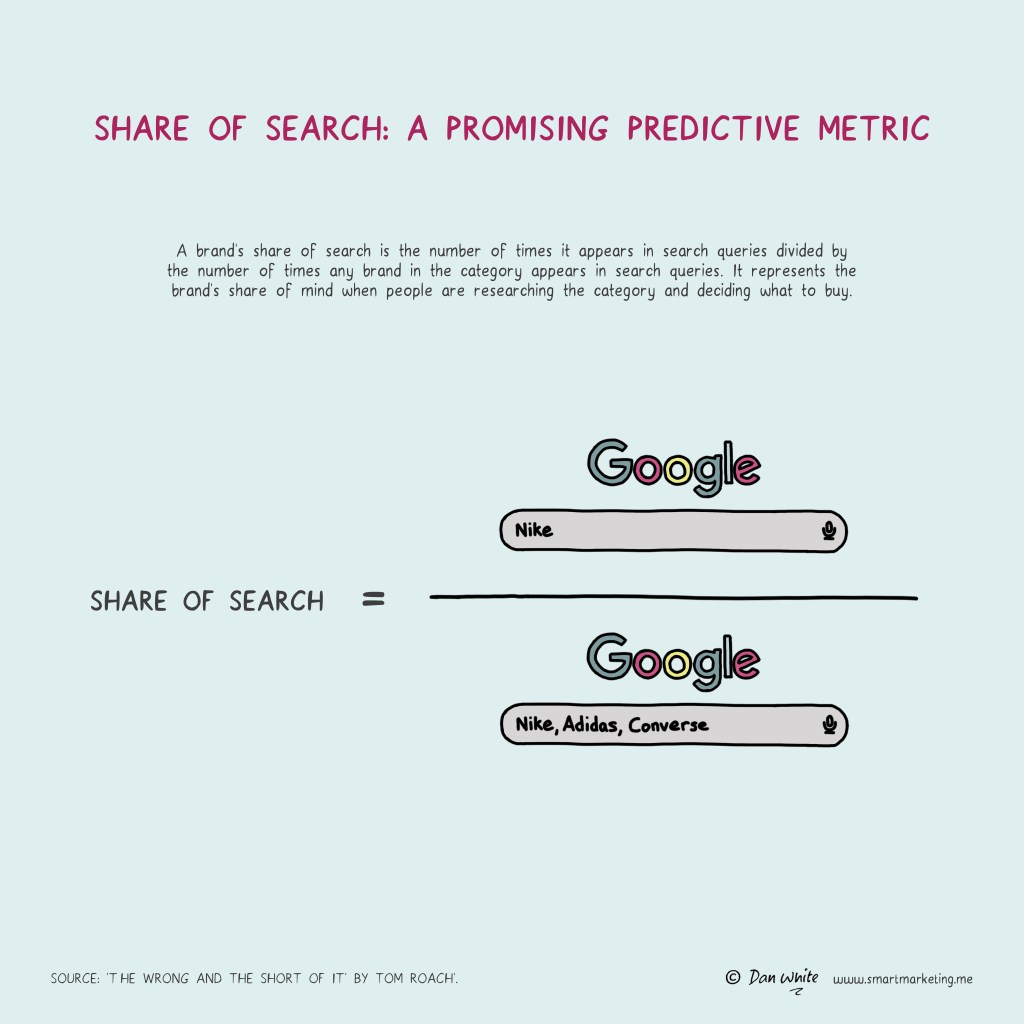
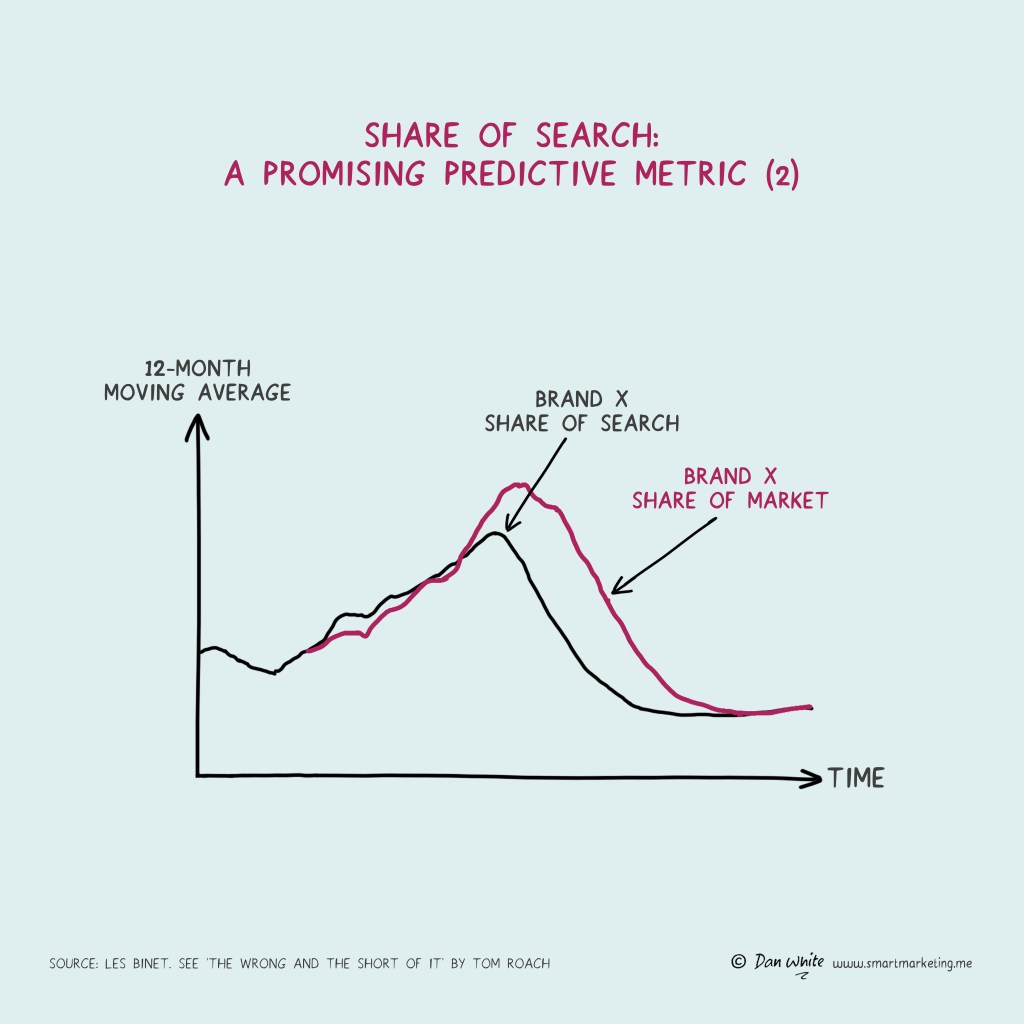
One metric that’s proving useful for this is share of search. Millward Brown (now Kantar) have seen that search volumes can strongly reflect how salient or famous a brand is [iv]. Google believe share of search reflects brand health and market share for brands in some categories [v].
Les Binet and James Hankins have done some great work looking at whether a brand’s share of google search can predict its market share, and have found this to be true in a wide range of categories.
Since the original version of this article was first published in 2020, share of search has become more widely known and monitoring it has become reasonably common.
I especially like it as it’s a rare example of a metric that crosses the brand / performance divide and so can connect marketers across it. Brand people instinctively know that brand search behaviour will be reflective of a brand’s fame and mental availability, and know that investing in high reach communication can be an effective way to improve it. And performance marketers of course know brand search is a hugely important source of traffic and conversion.
I believe it’s never been more important that we close the artificial divide between brand and performance marketing, and to do what’s most effective for our brands collectively.
For some brands, overcoming the barriers to this will be a big task, but if anything here helps a single team start to do this in their business that’s a win.
Brands should be aiming to create long-term communications engineered for immediate success. Advertising that, in the words of the great Jeremy Bullmore, sells ‘both immediately and forever’ [vi].
If you know marketers struggling with the limitations of short term tactics, with brands that are stuck on the performance plateau, or with leaderships who ‘don’t get brand’, who might benefit from reading this, please do pass it on.
Or drop me a line, as Jellyfish, part of The Brandtech Group, is uniquely set up to bridge a range of common divides across marketing – whether that’s brand & performance, media & content, data & creativity, and marketing’s latest false dichotomy, GenAI & humanity.
 You need to be conscious of the limited, more fleeting attention many of these channels and ad formats usually get (as Karen Nelson-Field’s work warns), which could limit their ability to create or refresh the longer-lasting brand memories that can influence future sales. Attention measurement company Lumen recently introduced the concept of ‘aggregated attention’, which means thinking about the total amount of attention your campaigns are achieving.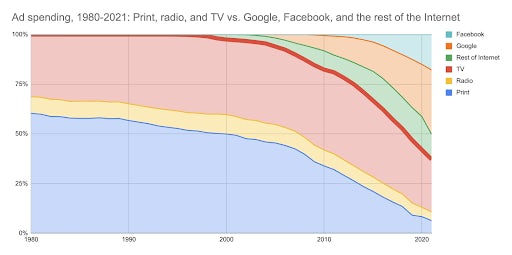

 And it’s not a new issue for creative people to be wrestling with either. You can see it in the famous quotes of many of the ad legends of the 60s:






 Tom Roach