Winning hearts, minds and models: Brand building in an AI world

First published in Marketing Week in October 2025, this piece explores brand building in the LLMs and how to influence this new audience with brand communication.

AI isn’t just giving us a new toolkit to create brand content with, it’s building us a whole new audience to create brand content for.

Marketers need to start thinking about how their brands will reach, be thought of and show up in the LLMs and the many kinds of generative AI content they produce.

We have new inputs (synthetic data and insight), new outputs (GenAI ads, AI overviews, LLM answers), new audiences (LLMs, agents), and new consumer outcomes, with brand choices increasingly influenced by LLM answers and shopping agents (like Amazon’s Rufus).

But while consumers are already being influenced by generative AI content, even in its early-stage forms, for many brands this influence is currently only happening accidentally and serendipitously, rather than being intentionally orchestrated.

As AI use cases multiply, marketers must co-ordinate how they explore and exploit them.

Search isn’t dying, it’s having babies

While overall, search is actually increasing, some brands are reporting significant drops in website clicks of up to 30% because people are getting what they need without having to click on a link (‘zero-click search’). A high search ranking still matters (many generative answers start with a web search), but brands must also earn LLM citations by creating content referenced within AI answers

This is where GEO (generative engine optimisation) comes in. GEO shapes how generative AI systems perceive, interpret and present your brand, so that you show up as a trusted, preferred answer when people ask questions relevant to your business. It’s essentially about creating and structuring content to be easily digestible by the LLMs to influence AI summaries to feature your brand.

Success is more than simple web traffic, it’s about understanding brand visibility, perception and citation rates within LLMs via tools such as the Share of Model platform built by the company I work at, Jellyfish, part of the Brandtech Group.

And as LLMs become multimodal (processing and generating text, image, audio, video), the content types that influence answers about brands are multiplying in type and quantity too.

New search behaviours

First, there’s generative search, with AI answers embedded directly in search results, which are cannibalising click traffic. The opportunity is to be cited as a credible source within these summaries.

Next is conversational AI on platforms like ChatGPT and Gemini, where users engage in extended research sessions averaging eight to 14 minutes according to Similarweb, versus one to three minutes for traditional search. Here, brands need to establish themselves as subject matter experts so their content feeds directly into LLM training inputs.

Finally, agentic AI will see agents autonomously research and purchase for users, bypassing traditional discovery. Success requires ensuring your content is visible and your website offers the right tooling for agents to integrate with.

So AI isn’t killing search, it’s reshaping it. Before AI, searches were becoming more fragmented and distributed across more platforms, surfaces and engines, and AI is accelerating this. So to steal from what Thinkbox, the TV industry body, said when talking about the evolution of TV in a world of video platforms: SEO isn’t dying, it’s having babies.

That’s the most I’ve ever written about search, so for more on GEO, it’s probably best to speak to GEO experts with deep SEO expertise too, who are thinking about how these things work together (and not people dismissing SEO as no longer relevant).

How does this relate to brand building?

Much of the GEO conversation focuses on lower- to mid-funnel content, an area that is often perceived by brand marketers and strategists as technical and disconnected from the upper funnel, which is more commonly assumed to be the focus of attempts to influence brand perception. But GEO makes search more relevant to brand strategy than ever before – because these new search responses can be influenced to be more on-brand and on-message than ever before. And upper-funnel communications will increasingly have an impact on them too, as we’ll see.

All of the above can only really be thought of together in the context of your overall brand. What do you want it to be known for; who are your audiences; what do you want them to think, feel and do; what and where do you need to communicate with them? Classic brand strategy questions.

As LLMs increasingly mediate the answers to these questions, you’ll have to think about your brand through an LLM lens, not just a human one.

This is leading to marketers asking us big, new questions. How do we ensure our brand guidelines are fit for an AI world? How is our brand showing up in LLM outputs? How do we monitor how the models perceive our brand?

Adapting brand communications to an AI world

People start to predict ‘the death of brand’ every time a new technology promises easy access to ‘perfect’ information for rational comparison. It happened with the digital revolution, and it’s happening now. (Scott Galloway never stopped.) But ‘brand’ didn’t die then, and it won’t die now.

Given the GEO advice to create well-structured, authoritative and comprehensive content for easy LLM recall, it’s tempting to imagine that brand advertising and other communication should all be similarly information-packed so it’s well-adapted to its new audiences.

This would probably be a big mistake.

Yes, brands will need to create content that builds the same brand narrative, and builds associations with the same core set of key category entry points (CEPs), but it’s vital to recognise the difference between human and LLM audiences.

Humans have short attention spans and need emotional rewards for attending to brand communication, through advertisers making it entertaining, useful or valuable to them. We have poor memories, only remember a few brands spontaneously, and recall very little in-depth information about brands and products. Our brains are lazy and miserly – we don’t want to use up our own precious resources by doing any actual work.

LLMs, on the other hand, have an effectively infinite capacity for detail, can generate in-depth research efficiently and require well-structured, information-dense content.

Electric vehicle brand Rivian, for example, has relatively low human brand awareness compared to its AI brand awareness – it seems to be doing things that are right for GEO but less well adapted to building human brand awareness. Closing your human/AI brand awareness gap could be a useful objective for brands looking to take a first step.

Source: INSEAD, ‘How to Market to LLMs and Sell to Humans’

Share of Model results often show superhuman brand recall, with the LLMs mentioning far more brands when unprompted than in human surveys. And when you go deeper, for instance, by analysing your brand’s share of voice within each model, you begin to find differences that can point to gaps and opportunities in a brand’s content approach.

Historically, telling your brand’s story was a way to create an emotional connection with consumers. In the age of AI, that story can be a crucial data signal. Strong brand narratives will now be dual-purpose: translating into powerful, emotional communication for humans while simultaneously serving as the source code for machines.

So if the LLMs learn that a brand stands for ‘helpfulness’, ‘thoughtfulness’ or ‘Vorsprung durch Technik’ through a consistent narrative across its online footprint, it uses that information to inform its recommendations. A brand story becomes a core piece of structured data that can explode out into an array of on-platform content. Maintaining consistency is critical: if your communication to human audiences doesn’t tally with the information your structured content provides to machines, your brand could become an incoherent mess – a fatal flaw anyway but especially for LLMs, which prize clarity and consistency. Both human minds and LLMs love brand consistency.

AI for creativity, creativity for AI

Previously I’ve written about using AI for creativity. This is about creativity for AI.

Generative AI is acting as a content creator for some brands now. LLMs can generate everything from marketing copy and social media posts to personalised customer emails and chatbot responses. This requires your brand voice to be defined not just for human writers, but for a machine that can now help us scale content production at an unprecedented rate.

As AI agents become more sophisticated, they’ll be acting as brand reps and handling ever more complex customer interactions. For example, for a telco this could mean helping a customer upgrade their handsets or switch tariffs. Humans will do less browsing and shopping on their own on retail sites, and we can already see shopping agents such as Amazon’s Rufus making an impact. These agents become an extension of your brand’s personality and values, and their words and actions have to align with your brand’s voice and behaviours.

AI interpretation of brand guidelines is crucial. One Jellyfish client had a ‘warm’ tone of voice, but early GenAI models failed to pick up and interpret this in the content they were generating, writing ‘cold’ copy lacking a friendly feel. Only through prompt testing and reverse prompting did we translate the tone of voice into machine-readable terms, specifying it as friendly, accessible and colloquial, to ensure on-brand copy.

We don’t need to be coders, but we must be concerned with how our instructions are being interpreted. Machines are literal: ambiguity causes confusion. Brand guidelines must now communicate effectively with a new audience, both the creatively-minded human marketers and the very literal LLM agents.

Category entry points (CEPs) are a strong point of connection for creative content that can speak to both human and machine audiences. Shane O’Leary has pointed out the importance of the concept of category entry points in this new world and I echo that. Queries via conversational AI are longer and more complex, with more specific references to someone’s own personal use case or specific needs, and often include a web of interrelated CEPs.

So an example of a traditional search might be “best noise-cancelling headphones travel”. When researching this with Gemini, it suggested this as an example: “I need a new pair of wireless over-ear headphones for my upcoming 10-hour flight to Tokyo. They must have exceptional noise cancellation, be comfortable for long periods and ideally have a strong reputation for battery life, as I hate running out of charge mid-trip.”

This LLM query demands a nuanced and detailed set of brand associations. Being known only for ‘noise cancelling for travel’ is no longer sufficient for a brand to be recommended.

Getting this right means understanding what consumers need from your brand and products, your communication and your product development.

This isn’t just product, SEO, content or ad strategy – it is, or at least starts with, brand strategy.

Campaigns engineered for LLM readability

One thing that brands could start doing is engineering campaigns to create more earned media for their brand, which can be a strong indirect source of training data for LLMs. Since LLMs are trained on vast public data and give greater weight to more credible sources, campaigns that trigger talkability and earn coverage and conversation in places which are known to be used to train the LLMs could be designed to influence a brand’s share of model.

Reddit, for example, is well known as a source of LLM training data, Meta’s an important source for Llama, and YouTube videos are now being transcribed for conversational text by Google’s models. What once seemed like a transient or self-obsessed ad tactic (‘creating conversation’) could have much more lasting value to a brand in this new ecosystem. So making a campaign that becomes highly talked about in Reddit, shared on Meta or commented on on YouTube isn’t just about driving salience with a specific tribe – it becomes about driving citations for a potentially much broader audience group.

So more brands may want to create famous, talkable campaigns. But they may also need to be designed with an eye on ‘AI-friendliness’ – clear, distinctive and memorable themes with narratives that are easily summarised and referenced by an AI. But it won’t be enough for campaigns to trigger sharing and conversation amongst people; the campaign’s core message will also need to be absorbed and embedded in the AI’s knowledge base.

Campaigns creating buzz without directly tying back to specific product messaging may even have a stronger impact than perfectly ‘AI-friendly’ ones that fail to connect emotionally with people.

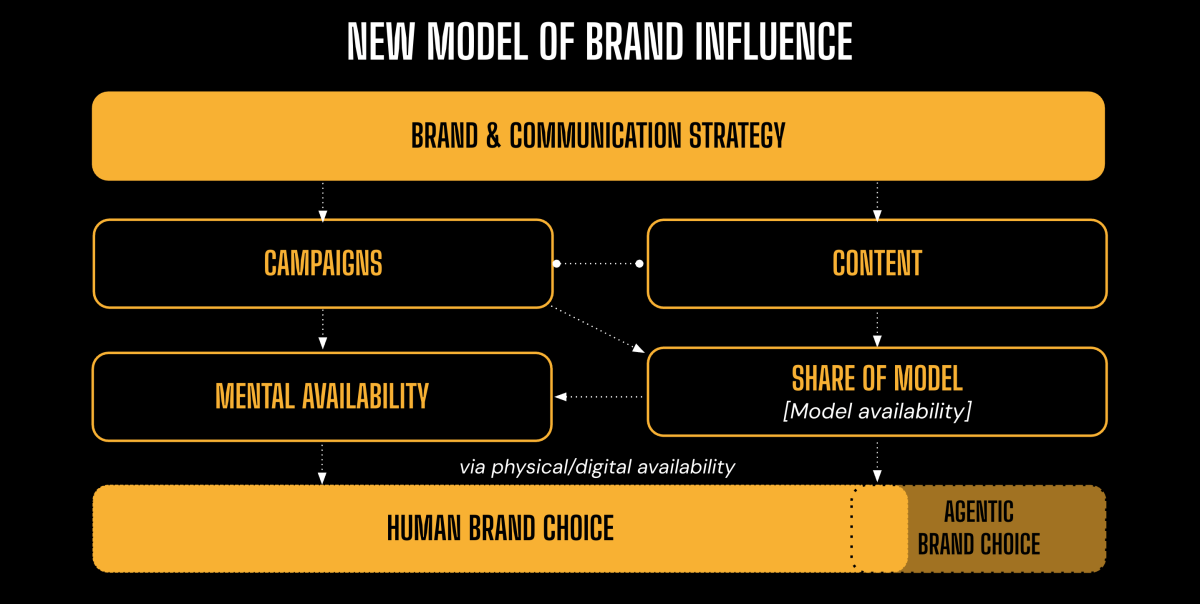
‘Brand’ in this world is far from being a static set of words in a strategy document. It’s a dynamic network that simultaneously builds and refreshes human memory structures while being constantly interpreted, reproduced and represented by machines.

Brand communication always needed to build mental availability; now it’s needed for model availability too. And when physical and digital availability are also strong, you have the conditions for brand choice – by both humans and agents.

The Creatives Are Coming.

Creative people will be at the heart of marketing’s AI revolution – this is an optimistic view that this advertising revolution will be a more creative one than the last. First published in Marketing Week 2.9.25.

The last advertising revolution was not a creative one. In fact, creatives were pretty far from its epicentre. This one is, or at least could be if even more creative people embrace it.

AI puts the means of production into the hands of the people with the ideas – the creatives. If adtech democratised ad media, GenAI democratises ad creative.

The previous marketing revolution (the digital one) was more about media and tech than creative. Last time round creatives only played minor roles, and some even stood on the sidelines brandishing pitchforks.

But this time things are different. The underlying tech innovation will impact every part of the marketing industry, but some of the most profound changes will be in the creative part of it. And this time round there are plenty of creative people at the heart of the revolution.

I suspect their relative absence last time round may have exacerbated problems we’re either still suffering or only really beginning to recover from now. Ugly ads, crappy formats, ad clutter, hyperbole about hyper-personalisation, short-termism, getting the balance wrong between ‘performance’ and brand building. I’m not saying creatives people’s absence caused these problems, but I’m pretty sure it didn’t help.

But in the AI revolution, some really progressive creative people are playing a major part. For every Dor Brothers (who have produced hundreds of AI videos including dozens of commercials which have received over 100 million views) there are 100 other professionals getting commissioned by brands, and another 1,000 amateurs making AI videos who will soon be making a killing from the industry. Rather than allowing scepticism or fear to hold them back, creatives embracing the new technology are already helping shape this revolution right from the start.

This time many of the companies leading this – in particular Google and Runway – are developing their technology hand in hand with creative people, and the tech is being developed and tested with creators from the outset. And wherever those relationships are working best, that’s where the most progress is being made.

These companies are leaning much more heavily into content creation than in the digital revolution, when the leading companies saw themselves as neutral distribution platforms for other peoples’ content and not active originators of it. It’s become the norm that every update to a new AI video model launches with viral videos showing off its new capabilities. Google DeepMind’s latest, Genie 3, goes further than just video – given a text prompt, it can generate dynamic worlds that you can navigate in real time. And its latest image model (Nano Banana, aka Gemini 2.5 Flash Image) is built to give creatives even more control over image generation.

Two previous revolutions in communications technology led to the development of arguably the most effective and efficient ad formats ever, the 30-second TV spot and the search ad. The jury’s still out right now on whether this revolution will spawn an equivalent that’s genuinely as innovative as those ad formats were, but get it right and we could get something just as revolutionary. Where DeepMind is going suggests something in the world of immersive game-like video experiences could provide the white space where the next genuinely revolutionary ad format could be born.

From access to media to access to creative

The last marketing revolution opened up access to advertising space for millions of tiny companies for the first time by lowering the barrier to entry to buying ads. But the creation of creative content was still something they had to hire individuals, agencies or production companies to do.

So this latest revolution is in many ways a continuation or completion of the previous one – it will allow millions of tiny companies access to professional-quality video and other content for the first time. A very different part of the marketing world from the highly polished world of big brands and agencies, perhaps, but a revolution in creativity and content nonetheless.

But the very biggest marketers are also taking advantage of the access they now have to vastly more cost-effective content production. Unilever recently announced that it is building a ‘Beauty AI Studio’, an in-house system for creating AI assets for paid social, programmatic display and ecommerce, for brands including Dove, TRESemmé​ and Vaseline across 18 markets. It’s built around Pencil Pro, Brandtech Group’s proprietary AI platform for enterprise clients. Full disclosure: I work at Jellyfish, part of the Brandtech Group and major users of Pencil Pro in our work with clients.

In the previous revolution, the new advertising technologies proved themselves at the bottom of the funnel first, with upper-funnel activity following on much later, as video and social started to prove their brand-building abilities.

But video is there more or less from the start this time. And where there’s video, brand-building advertising’s never far behind. So while the last digital revolution was mostly about the democratisation of direct-response advertising, this one will be about the democratisation of the production of content that works through the full funnel from the start, or at the very least moving up the funnel much much more rapidly than the last.

Believers in brand building should be excited by what’s coming – the opening up of access to creative tools that can help companies of all sizes build brands.

What about ‘AI slop’?

It’s a common belief that ‘slop’ will soon take over the internet, and to be fair it looks like there is a lot of poor-quality AI content already on some platforms. Some of this will be GEO content (‘generative engine optimised’, however that can also be human-made, of course). This is a big topic that I won’t cover here – in this I’m talking about AI-assisted advertising creative designed for human audiences.

Human audiences are naturally going to be more discerning and won’t reward poor-quality content with their precious attention – so slop should get punished by the algorithms. I’m aware this is an optimistic take on the topic and other views are available.

Creative content that’s focused on human audiences will improve in quality as the tools improve. Which they are – rapidly. And in any case, as Sturgeon’s law says, 90% of everything’s crap anyway, and if we’re honest with ourselves that’s probably always been the case in advertising. But let’s leave the 90% to the amateurs. Our goal as an industry should be to produce the top 5% to 10% of creative content.

Which is exactly what we managed to do with an experiment we carried out to build a brand in 24 hours for a talk we gave at SXSW London in June. A team of six of us from Jellyfish (two strategists, a creative duo, an AI designer and AI video maker), created Moodlings, a fictional new brand of mood-enhancing gummies with all the moving parts you’d need to launch it, including packaging, social and video assets.

The strategists used Springboards, the AI creative strategy platform, and the creatives used Pencil Pro which has Google’s Veo 3 built-in (and all the other LLMs). The brand video we made in a couple of hours scored at 3.7 stars on System1’s five-star rating – well inside the top 10% of all ads they’ve ever tested, and above their vitamin and wellness category average of 2.0 stars. It was a fun demonstration of an end-to-end strategy, creative and production process, much faster than standard processes but with no reduction in the quality of the output.

Springboards AI also happens to be leading a global, industry-wide exercise in researching the creative potential of the LLMs. Its results suggest that Gemini and Claude outperform ChatGPT at creating a wide range of ideas, but that overall most models still tend to come up with ideas that are still too samey. Another finding is that the models still need ‘humans in the loop’ to select the strongest ideas. Human creative direction is still going to be needed for some time to come. Look out for the unveiling of their full findings in the coming weeks.

Little or no visible difference now

The quality of AI video and imagery is improving all the time, and we’re getting very close to AI video not being obviously AI any more. It’s been a while since people were able to impress their LinkedIn followers with jokes about six-fingered hands and horrific clips of AI Will Smiths eating spaghetti. Criticisms of AI creative quality now have to be far more nuanced and technical. When the best AI ads are tested on human audiences they very rarely pick up on it – professionals necessarily have an eye for detail that’s different from our audiences. We’re currently at a stage where professionals can tell but consumers very often can’t. Soon most professionals won’t be able to either.

Industry insiders’ fears about a reduction in quality is probably based on what they see from tiny companies – the ones who are freer to experiment, move quickly, may never have advertised before, and wouldn’t make especially great content of any kind with or without AI.

And there’s a dramatic difference in quality between what these tiny, agile, experimental brands on the edges are happy to put out versus what big companies are happy to approve and air. (My current ‘favourite’ is a coffee machine D2C retailer on TikTok which repurposes video clips of interviews with Rory Sutherland, then summarises his insights into an AI voiceover over clips of its coffee machine range.)

But the quality of AI video that major companies are happy to put out shows no signs of being reduced. The exceptions to this are so few and far between as to be negligible – Toys R Us went early with a poorly produced fully AI ad and got slammed for it. Coke’s AI-generated ‘Holidays are coming’ ruffled some industry insiders’ feathers but was barely different from its CGI versions. If Coca-Cola were to make it now, nearly a year on, no one would be able to tell and no one would care very much at all. The spec ad for Liquid Death from a month ago seems to have marked a step change in quality – strong idea and script, almost flawless production, and much praise from the industry. We’ll look back on that as one of many watershed moments on the journey we’re all now on, I suspect.

Big brands with experienced, professional marketing teams want to do things well. They want to achieve the same or better standards of creative but with vastly reduced production and time costs. See Diageo’s announcement this week of its use of AI to drive efficiency of its £2.7bn marketing budget. The conversations we’re having with major global advertisers show that while they’re happy to experiment with AI technology they’ve got no appetite to lower their brand standards.

Premium brands will still occasionally want some traditionally made creative content as part of their comms mix, and maybe some will even use AI-free production as a flex. Like hand stitching on an LV bag or a hand-painted stripe on a Rolls-Royce, some may want to use the very best handmade human craftsmanship as costly signalling. This will always be available at a price. The creative agency world will reorganise itself to reflect these new realities. The middle market is going to be a very hard space to play in if you decide you’re only going to make traditionally produced creative.

At Jellyfish we have clients saving on their ‘non-working’ media costs by switching to AI performance content production. And clients going beyond performance content into AI-produced brand and social creative as AI video quality improves.

We have video producers becoming AI video makers, copywriters becoming AI copy strategists, and an executive creative director who’s leading from the front in making AI videos herself and upskilling her creative department  – everyone’s learning new skills to enhance their traditional ones. These are not people letting the technology autonomously do their jobs – they’re embracing tools that allow them to collaborate in new ways, and are working faster and smarter than they’ve ever done before.

But can AI ever really be truly creative?

People are still claiming that AI can’t be, or will never be, truly creative. That it will only ever deliver derivative work, devoid of human emotion or insight. They’re judging it based on what they’ve seen so far, which is only natural. Feed it real insights, give it great ideas to execute, see it as a creative production tool to enhance existing human creativity, and then let’s discuss whether AI is helping us give clients what they need from us as an industry.

The question of whether AI will ever go beyond being an execution and production tool and be able to have its own genuine creative ideas that are as strong as human ones (‘Could it come up with Cadbury’s ‘Gorilla’?’ as someone asked me last week) is still up for debate. My argument in favour is that combining existing things and ideas is exactly what AI is very good at – and this is precisely what creativity is all about.

We’re not yet in a place when AI is able to autonomously generate new ideas like this with zero human input, but it is already proving incredibly useful as a way for creative people to enhance, execute and produce the ideas they themselves are having – faster and at a greater scale than was ever possible before. And that’s a win. Having loads of ideas and iterating them is another special skill of AI – quantity is often a route to quality when it comes to creativity. So much so, I’m optimistic that it can help solve a problem that we’ve always had with creativity – that it’s historically been hard to scale.

Beware of some of the myths

My experience so far suggests there are still some key myths to be dispelled amongst clients and marketers. GenAI does not result in instant creative ideas that magically appear without a brief, a strategy, time, any budget, or most bizarrely of all, without creative people. Yes it speeds up the process, and uses fewer people to create more ideas and produce more executions more quickly. But anyone that’s still selling it to you as some sort of magic is selling you snake oil.

Only last week, a platform called Icon that launched to much LinkedIn fanfare a few months ago as an ‘instant AI ad maker’ with loads of big name backers (including Peter Thiel) turned out to have hugely over-claimed what it can do. So it’s pivoting to become a managed creative agency-like service, not purely self-service AI platform.

Will AI reduce the total number of creative roles in our industry? It’s too soon to say definitively, but yes, it seems likely. There’s been huge change and flux in the classic ad agency part of our industry anyway, with a huge explosion of creative roles moving client-side and being generated in the creator economy. And AI will absolutely create loads more new types of creative roles. We have to accept and lean into that, rather than mourn the loss of jobs that were hugely threatened by other changes in any case.

Will AI kill creativity? Of course not. You can’t kill creativity. It’s far too powerful and innate a human instinct for that, and far too valuable for businesses that will always want to harness it to get an edge on their competitors. Businesses will always source their creativity from the most effective and efficient place – whether that turns out to be from people, from AI, or from people and AI.

And my money’s on people and AI.