I miss Twitter, and more specifically, I miss writing tweets.
Since Musk took over it’s changed a lot, all of the fun many of us used to have there has evaporated, and so I use it less and less.
Twitter used to have a great community of marketing and advertising people, mostly strategists, creatives and some clients. We’d trade opinions, new work and the odd cutting remark. It was a place of high emotional intensity, with lots of ups and downs. Though a less positive and forgiving place than LinkedIn, it had an edge that made it more entertaining and compelling for some of us.
Part of the game there was to try and write the ‘perfect tweet’; to express an opinion as succinctly and as satisfyingly as you could in 140 characters or fewer; to write with “maximum meaning, minimum means”1.
When Musk took over, things changed, some people left for political reasons, the feed started to fill up with more hateful stuff, the algorithm evolved, and the niche little community we’d built ebbed away.
Despite attempts by people to promote alternatives like Threads, Bluesky or Mastodon, LinkedIn ended up being the main beneficiary.
Then the other day, I was reflecting on the fact that it’s nearly five years since I moved from the creative agency world to a different one – to Jellyfish, a marketing company uniting media, creative and data with AI.
I wrote up some observations on my first five years, and when looking at my notes for the post, I realised much of what I’d written was essentially just tweets – individual summaries of the ideas, opinions and beliefs I now hold as a result of my experiences over the last five years. Things I probably wouldn’t believe had I not made the move to Jellyfish.
Previously I’d have tweeted them individually, but not now. So here they are all together in a blog post. Some may turn into a full article here or in Marketing Week at some point – in fact if any strike you as being articles you’d want to read in longer form, let me know.
30 beliefs in 30 tweets
1. Marketing works in 10,000 ways, not in a single, marketing guru-approved way.
2. Build and own your brand freehold, not leasehold2. It’s better to create and own, not rent, your brand assets.
3. People telling you X is dead, are just snake oil salespeople selling you Y.
4. Practices change, principles remain. So be rigid in your principles, flexible in your practices.
5. What’s not going to change is at least as important as what is3.
6. To grow, brands need to act a couple of sizes bigger than they are.
7. People have always built brands ‘as birds build nests, from scraps and straws we chance upon’4. It’s just today’s scraps and straws are smaller yet massively larger in number than before.
8. The best performance marketing people are also big believers in brand and creativity – because they’ve seen its impact on the performance of their work.
9. You can’t escape the formative experiences that shaped your marketing worldview, but don’t ever be a prisoner to them.
10. Media and creative belong together, will eventually reconverge, and AI is driving their reconvergence.
11. Run at the future5. But walk only slowly away from the past.
12. A brand isn’t a luxury, it’s your future cashflow6.
13. You won’t get off the performance plateau7 armed with spreadsheets alone.
14. Don’t dismiss performance marketing, it can buy you time, credibility and revenue for brand building.
15. It takes lots of littles today to help you build big8.
16. AI isn’t just giving us a new toolkit to create brand content with, it’s building us a whole new audience to create brand content for9.
17. You can’t push people through a ‘funnel’ – people enter markets in unpredictable ways and progress at their own pace.
18. The funnel’s not collapsing, it’s a metaphor. Metaphors can’t collapse.
19. Marketers need to know their audiences – and today that means humans, algorithms and AI.
20. Adtech needs to be built by people who understand how humans, brands, communications and creativity works – not just tech.
21. Many of the people who will be the future of commercial creativity are currently serving apprenticeships in the creator economy.
22. Ads don’t convert people, they’re just tiny particles of cultural DNA floating past their field of vision and occasionally getting a fleeting moment of attention.
23. Advertising isn’t a great word for what we do today, as it’s too strongly associated with a narrow type of paid communication. The meaning of the word needs broadening or we need a new one.
24. Marketing communication is a 1000 piece jigsaw. Strategists help paint the picture on the box.
25. There’s never been a golden age of advertising. Nostalgia doesn’t build brands. (And it won’t rebuild the industry).
26. Adtech democratised ad media, GenAI democratises ad creative10.
27. AI puts the means of production into the hands of the people with the ideas – the creatives11.
28. New principles for brand building in a world of creative fragmentation – high consistency, high volume, high fit for platform12.
Grace Kite coined ‘lots of littles’, I borrowed ‘big as a collection of smalls’ from Sir Nigel Bogle, and together we’ve been talking about the overall theme of ‘Building big from lots of littles’ ↩︎
Share of model, a new marketing measure for the GenAI era, could become the latest in the canon of marketing’s ‘share ofs’, which appear to go hand in hand with each successive new era of marketing and the new technologies that enable them.
It looks like we could be at the start of a new era in communication. We’ve had the print and the electronic eras, and the tectonic plates are now shifting from the digital to the GenAI era.
Within marketing specifically, all kinds of new things will emerge to take advantage of the new technology. New roles, new skills, new brands, new objectives, new tactics, new agencies, new creative forms, new production techniques, new research methods. And new metrics to help us track success.
But it’s always important to think about what’s not new and what’s not changing too. Too much of what’s new in marketing gets built by people with no real understanding of the fundamentals and what’s proven to work. Which is why, whenever thinking about what’s coming, my instinct is to try to connect it to what’s gone before.
So when a colleague at Jellyfish, Jack Smyth, started talking about ‘share of model’ early this year as a way of measuring a brand’s presence within AI data sets, I had a few basic thoughts in quick succession. First, that sounds genuinely new. Second, it feels reassuringly familiar. Third, I wonder if, as with share of voice and share of search, it relates to share of market. (And fourth, ‘why the hell didn’t I think of that?’.)
With most apparently new ideas, they’re never 100% new but are always combinations and evolutions of previous ideas. In fact, for new ideas to gain traction, they usually need to be both original and also familiar. The novelty helps them get attention and the familiarity helps make them easy to adopt.
Jellyfish has built a platform to help monitor share of model (you can get a flavour of it here), and is working with a number of major brands to make it work in practice as a marketing and brand insight tool.
But before looking at what share of model is and what it could become, here’s a brief look at its ‘share of’ forebears, the giants whose shoulders it’s standing on.
Share of market: The ‘share of’ metric to rule them all
Share of market (or market share) is the Patient Zero of all the ‘share of’ metrics. It really caught on from the 1950s onwards with the explosion of mass production and mass consumerism, as global markets grew, competition intensified and assessing a company’s market position relative to competitors became a priority.
Businesses had previously relied on anecdotal evidence and intuition to gauge their market positions, but from the 50s companies began collecting data more systematically and on a bigger scale, conducting surveys, tracking sales and using more sophisticated statistical methods. The simultaneous rise of early computers enabled all this.
Source: Google NGram showing the rise in mentions in publications of ‘share of market’ and ‘market share’ from the 50s
Market share had its big moment around 1974-75 when the Harvard Business Review published an article about the positive correlation between market share and ROI, saying that businesses with higher market share tend to have higher profit margins, with economies of scale, market power and quality of management amongst the major factors driving this.
While market share growth remains a primary goal for most brands, over the last 20 years the spotlight (at least in marketing) feels like it’s shifted somewhat to metrics that are more in marketing’s increasingly narrow control, are easier to monitor and move more quickly. Today’s marketers are addicted to the instant gratification of metrics that see bigger, faster shifts. Market share is perhaps more suited to stable and mature categories, and a little hard to keep track of in dynamic and emerging categories, which may mean it’s become less of a North Star for some, however wrong that might be.
Share of voice: The ‘share of’ metric for the mass media age
Marketing’s next big ‘share of’ metric, share of voice (SOV), is essentially the concept of market share applied to media spend, and was especially useful in the pre-digital mass media. Les Binet, adam&eveDDB’s head of effectiveness, directed me to the fact that Unilever had pioneered the use of SOV as far back as the 1960s, although the company kept quiet about this at the time.
Source: Google NGram showing the rise in mentions in publications of ‘share of voice’ from the 50s
James Peckham at Nielsen brought all this out into the open in the early 70s, and then John Philip Jones made it famous with a big, multimarket study in the late 80s and early 90s. The key insight in all this work was that brands investing more in media than their market share implied were much more likely to grow their market share over the longer term.
Binet and Peter Field built on Jones’s findings, featuring it in 2007’s ‘Marketing in the era of accountability’ and later work. Binet told me he first explored using SOV for Volkswagen as early as 1993 and coined the term ‘excess share of voice’ or ESOV then, ESOV being the difference between a brand’s share of voice and its share of market. This concept was known to Unilever as ‘dynamic difference’, although Binet wasn’t aware of that work at the time. Binet and Field’s work established SOV as a core planning principle, especially useful for budget setting.
Source: Binet and Field, Media in focus: Marketing Effectiveness in the Digital Era, IPA
But SOVs pre-digital roots are now showing and it’s getting harder to calculate due to a lack of comprehensive and reliable data on brands’ digital media spend relative to competitors. Some even think the link between SOV and market share has now broken. It seems unlikely that the fundamental principle no longer holds true, but it does point to the need to think about effective share of voice, not just share of voice, when planning media.
Share of search: The ‘share of’ metric for the digital age
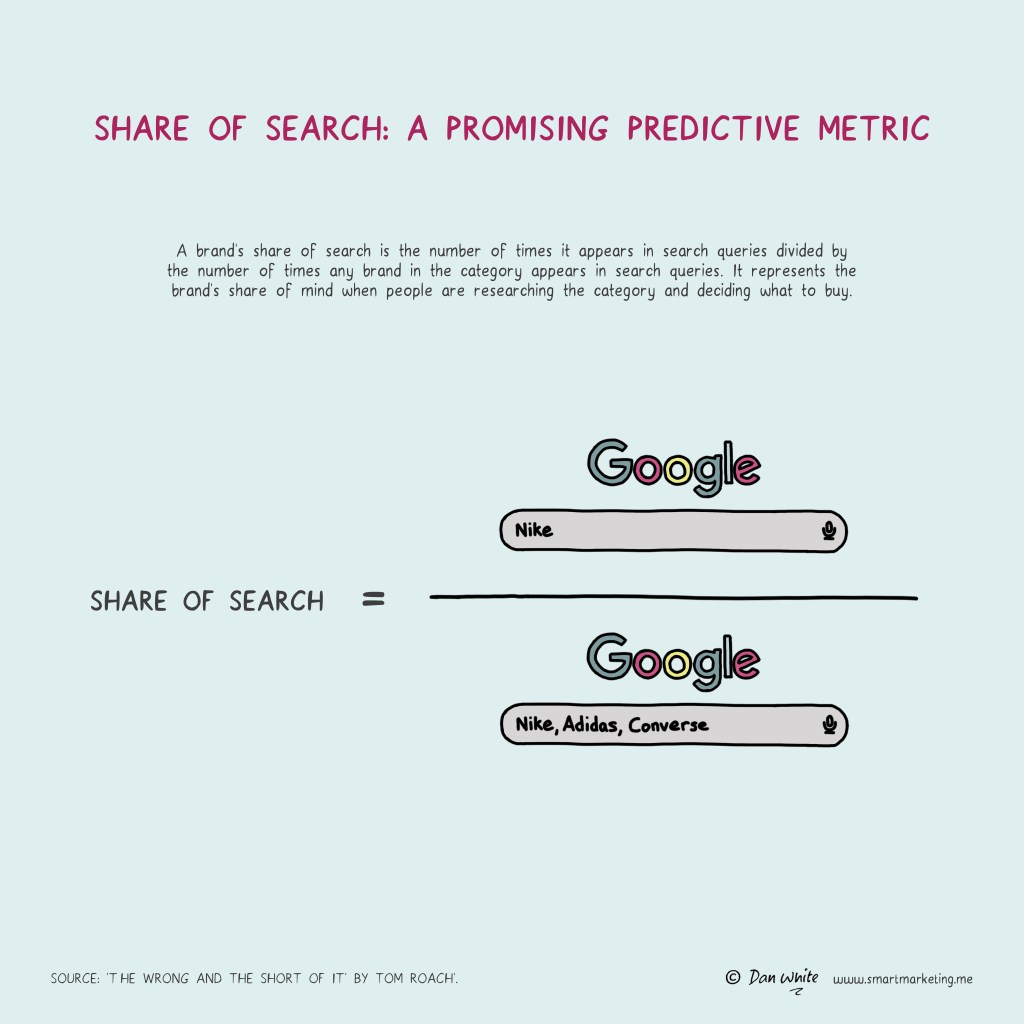
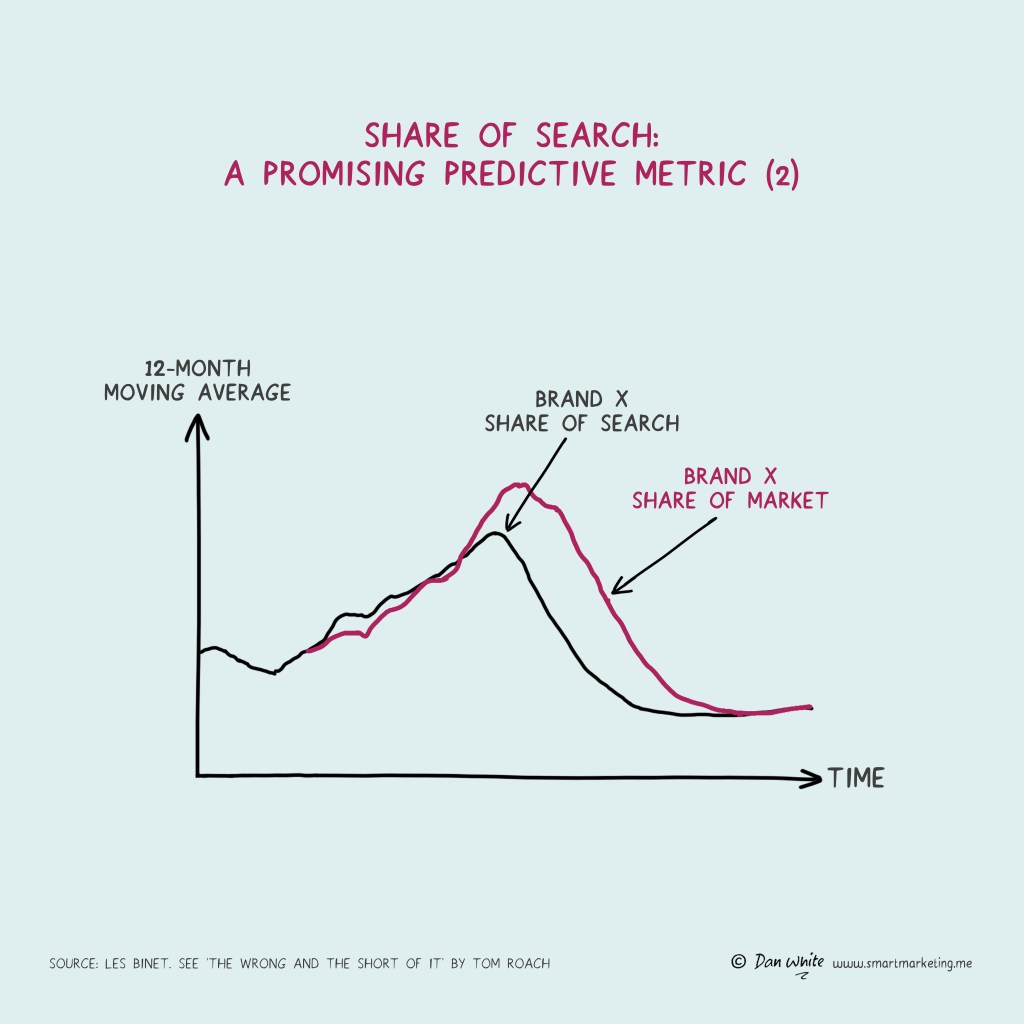
Share of search measures the proportion of online searches for a brand compared to the total searches in its category. It was popularised by Binet and James Hankins from around 2020, although people in the performance marketing and SEO worlds claim they’d been using a version of it for some time as part of their toolkit, they just hadn’t been shouting about it. Google and Kantar have shown that share of search is a proxy for a brand’s mental availability, and Binet and Hankins’ work with the IPA showed that in many categories it’s a leading indicator of market share.
Based on freely available Google Trends search data, it’s relatively easy and inexpensive to measure compared to traditional market research methods, and because various platforms and tools exist to monitor it, it has become standard for many brands to track.
All of which feels like a natural progression to the new kid on the block.
Share of model: The ‘share of’ metric for the GenAI age?
As with the earlier ‘share of’ metrics, the development of each being intrinsically linked to the emergent or dominant marketing technology of the day, share of model has arrived hand in hand with a new era in marketing and a newly available data source.
What the AI large language models (LLMs) ‘know’ in relation to brands is essentially the sum total of everything in their datasets about a brand, its touchpoints, its communications and, increasingly, the new content each model can find on what consumers think, feel and do in relation to it. All in one place, and all for free, or at least without the need for costly surveys and panels.
Marketing Week’s Mark Ritson noted the power of synthetic data for market research last year, after the publication in October 2022 of academic research suggesting LLMs could generate perceptual maps and brand attributes closely resembling human-generated data.
Plainly, any vast repository of data on a brand that’s essentially free will be interesting to marketers, and so the race has been on to find robust, stable, replicable ways of organising what LLMs know about brands that can be of use to marketers.
Enter share of model – defined here as the number of mentions of a brand by one or multiple LLMs, as a proportion of total mentions of brands in the same category. It essentially gives a picture of a brand’s overall ‘visibility’ to AI models and so to marketers. Tracking a brand’s mention rate as it shifts over time in relation to key competitors can make this practical and actionable.
But it’s not just about visibility, it can also be about brand positioning. At its simplest, brand positioning is about improving positive brand associations, reducing negative associations and distinguishing a brand on key associations where there’s an opportunity for relative differentiation.
Share of model could also help here. LLMs can generate clusters of positive and negative associations with brands and categories, and so we can use them to compare a brand with its competitors on those associations and track them over time. So the models can be a great source of brand positioning insight, as an input to help identify positive brand associations to build, negative associations to reduce and relative differences to further distinguish a brand, and as an output to track progress towards an ideal positioning.
So what next for share of model?
It’s too early to say if share of model will prove to have the universal utility that has been the key to the success of its ‘share of’ predecessors, and there’s a lot of work to do if it’s to become anywhere near as widely known and used.
Firstly, as with SOV, ESOV and share of search, establishing if there’s a relationship with share of market feels important. Do improvements in share of model reflect or even predict market share gains? Can changes in the communications approach impact share of model and share of specific brand associations? Can the insight generated help us produce new, more relevant creative content? How do we ensure creative gets the attention of its human audience in order to influence brand growth directly? How do we ensure content reaches its new ‘audience’ – the models – in order to influence it indirectly? All are questions we’re exploring at Jellyfish.
No doubt some brands and marketers will use this as a reason to open the floodgates to huge quantities of poor AI content of all kinds to try and ‘game’ the models, as in the early days of search engine marketing. Any new metric is likely to lead to some unintended consequences. Let’s do everything we can to avoid that.
Let’s hope people use this to help create better, longer-lasting, strategic communications with a higher goal – to drive share of market – not just to get a short-term boost for their share-of-model measure.
This article was first published in July 2020. It seemed to strike a chord, and people on the frontlines of modern marketing tell me it’s been helpful. It remains my most read article. I especially love it when it gets shared by people who weren’t previously familiar with the work of the big names in marketing effectiveness from the UK/Aus/NZ, especially US performance marketing people. So if you know marketers struggling with the limitations of short term tactics, with brands that are stuck on the performance plateau, or with leaderships who ‘don’t get brand’, who might benefit from reading this, please do pass it on.
I was inspired to publish this slightly updated version, after the marketing author and illustrator Dan White sent me a brilliant new set of illustrations he’d done of all the charts in the original.
Short-termism and long-termism are both just wrong-termism. So let’s end the false choice between long and short-term marketing tactics, maximise the compound effects of getting them working together in harmony, and close the value-destroying divide between ‘brand’ and ‘performance’ marketing, which limits marketing effectiveness and growth.
Long term ‘VS’ short term is probably the most commonly cited false choice in marketing.
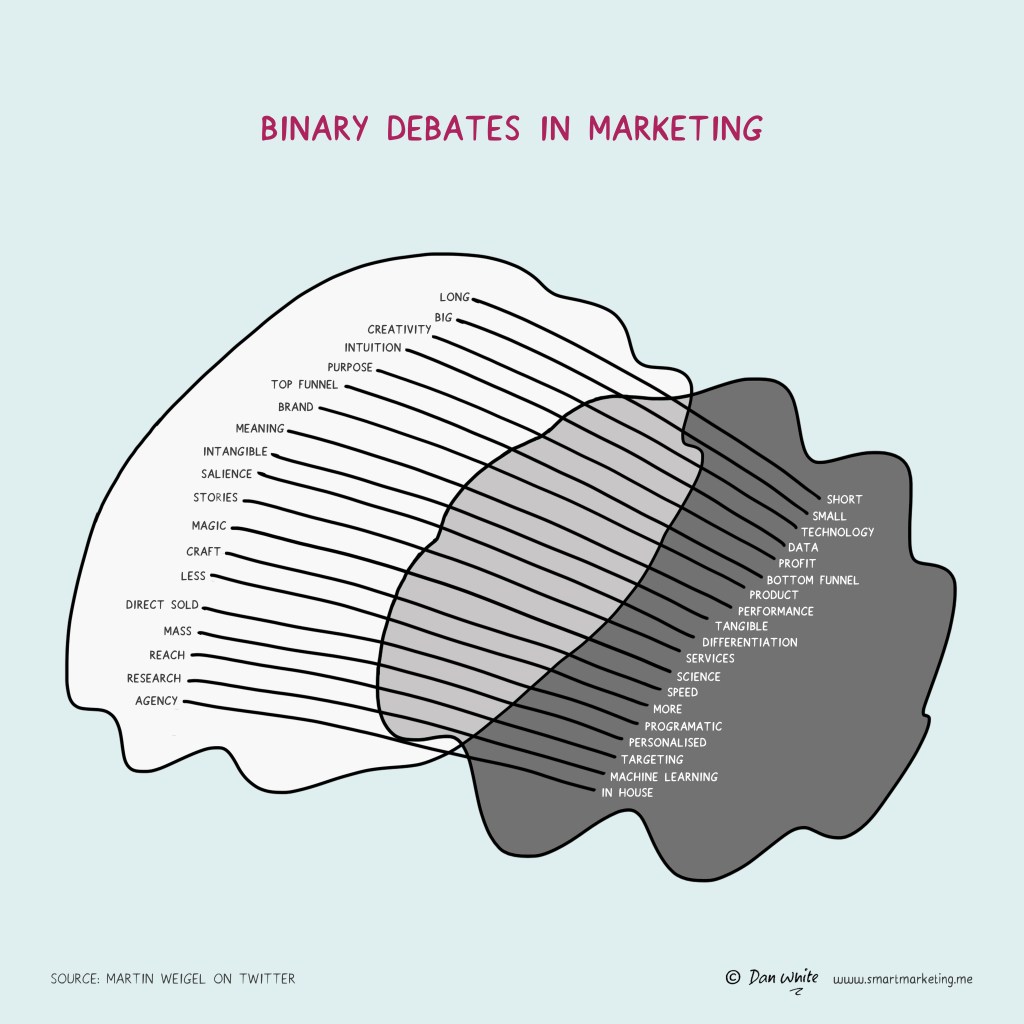
And that’s saying something, as we love false dichotomies in this industry: brand vs performance, emotional vs rational, creativity vs technology, intuition vs data, art vs science, to name just a few that we constantly debate.
And of course the answer to most of these is ‘&’ not ‘or’.
It may seem a little unnecessary for yet more to be written about the long and short-term in marketing given two industry legends have literally already written the book on it [i]. But whilst the theory says we should all try to achieve a balanced approach in order to maximise both saleability and sales simultaneously, there’s still a massive gulf between the theory and actual practice, which is too often divided between practitioners of brand and performance marketing.
And it’s even quite common for people to overlook the central importance of the theme of balance in Binet & Field’s most important work, and to think of them as ‘the high priests of the long term’.
SHORT-TERMISM
Short-termism rightly gets a lot of criticism, and there have been plenty of brilliant critiques of it by other people, so I won’t do that here [ii].
There are irresistible pressures pulling marketers towards the short term [iii]. And there’s also a huge asymmetry in terms of accessibility to performance channels vs brand-building channels. Google, Facebook, Amazon and other platforms have given millions of businesses of every size and type, easy, self-service access to a giant direct response advertising eco-system. And this universal accessibility is also ensuring there’s a ready and growing supply of ‘performance’ marketing specialists and a dwindling supply of ‘brand’ marketing specialists – a factor that further exacerbates the divide.
LONG-TERMISM
Too many people though, especially on the ‘brand’ side of the divide, also wrongly assume that because short-termism’s a bad thing, long-termism must therefore be a good thing, despite the potential for it to be just as damaging in different ways.
There’s always been a lot of magical thinking about the long term in advertising. That you can just do something big and expensive as a one-off, then close your eyes and cross your fingers and hope no one commercially-oriented asks any awkward questions for six to twelve months, until future sales start magically happening.
But communications that are successful over the long term don’t work by activating some kind of ‘sleeper cell’ in buyers’ minds which suddenly bursts into frenzied commercial action after many months of lying completely dormant – communications need to achieve some level of short-term sales success as well as improving a brand’s mental availability if they’re also going to achieve long-term growth.
And whilst short-termism may give people a bad name within certain corners of the marketing world, it may actually be long-termism that gives some marketers a bad name within their organisations and amongst the rest of the business community, perhaps because some marketers appear to act like selling’s a dirty word to them (for example by getting evangelical about certain marketing approaches that appear purposefully designed not to sell stuff).
WRONG-TERMISM
And whilst they’re quite different, it’s possible to simultaneously see short-termism and long-termism as equally bad practice – wrong-termism, if you will.
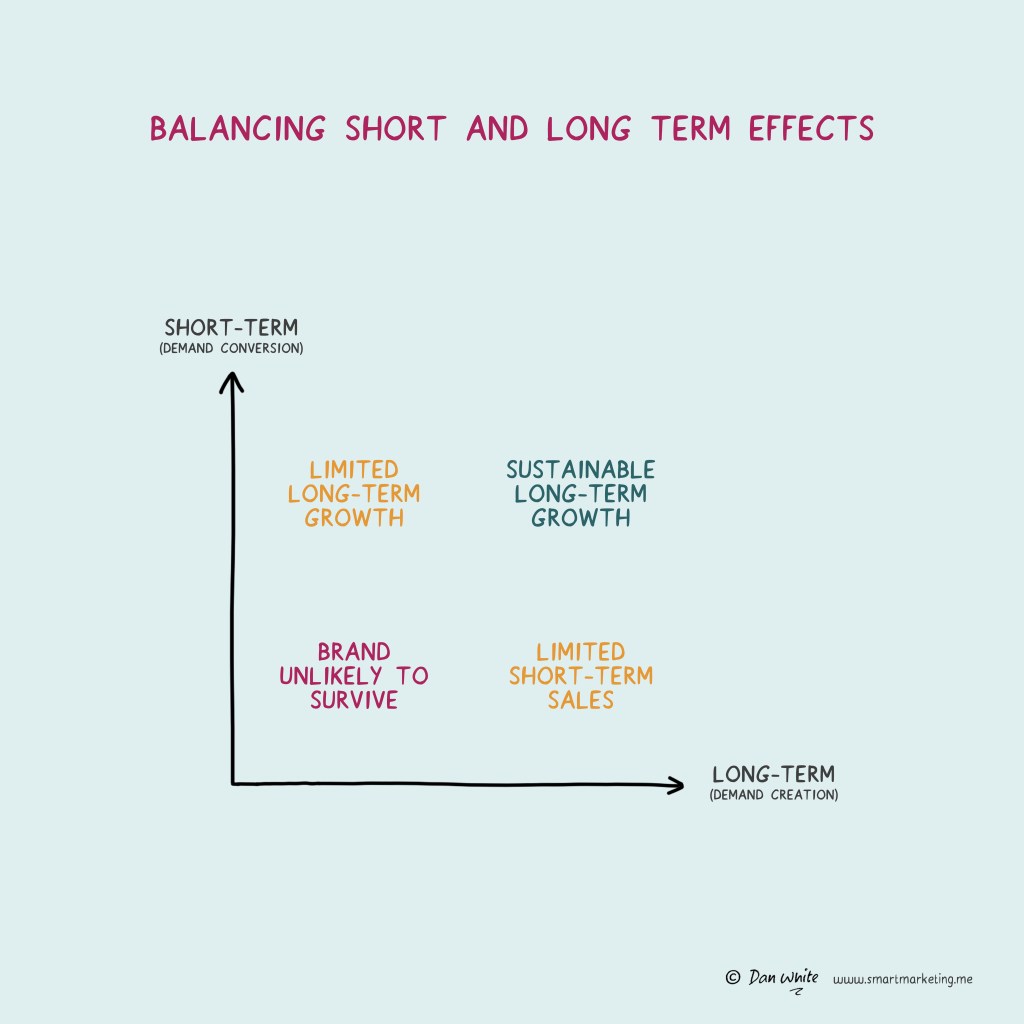
Wrong-termists get it wrong in two different ways: short-termists restrict the long-term growth their marketing can achieve, and long-termists restrict its short-term sales impact.
THE LONG THROUGH THE SHORT OF IT
Marketers have never been under more pressure to make every marketing $ work as hard as it possibly can. We’ve never been more aware that without short-term success there may not even be a long-term for some of our brands. And the best way of securing both will be to embrace the fertile middle-ground that lies in combining the power of short and long-term effects.
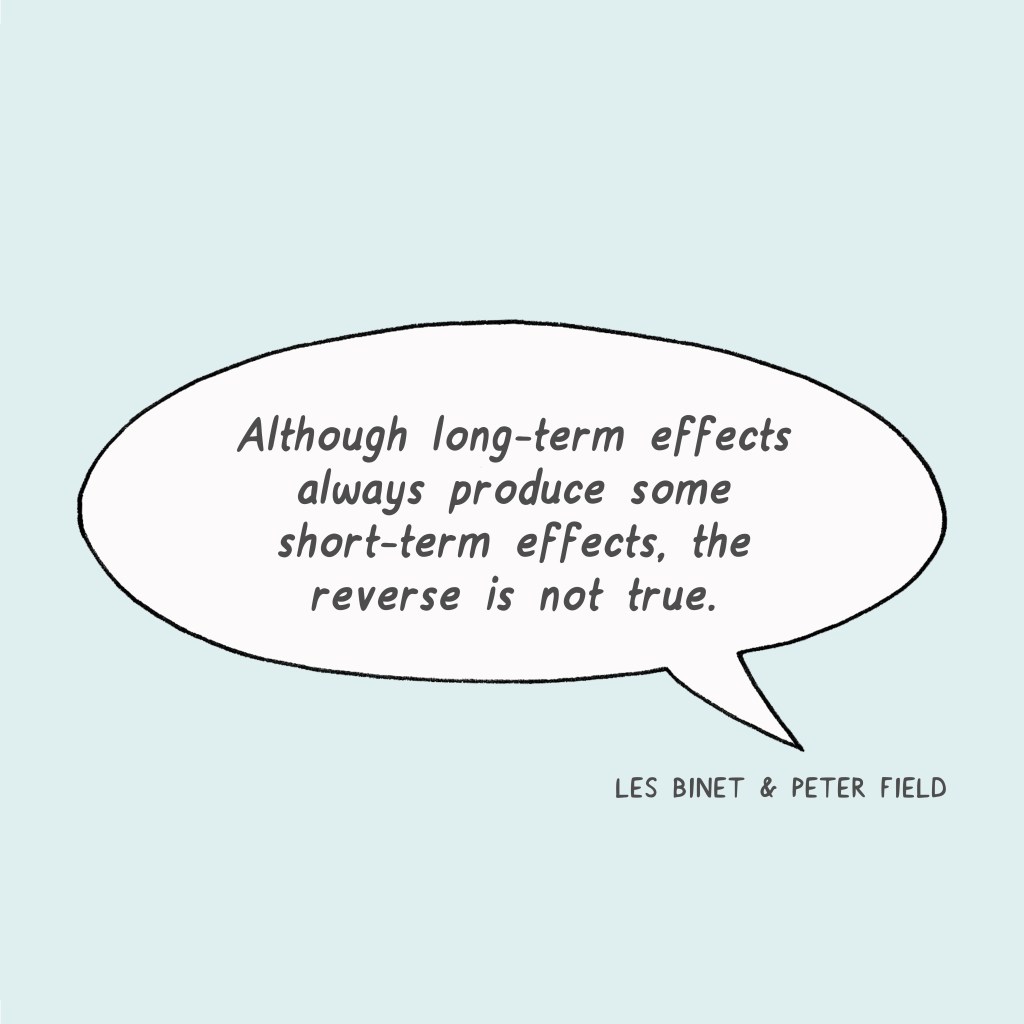
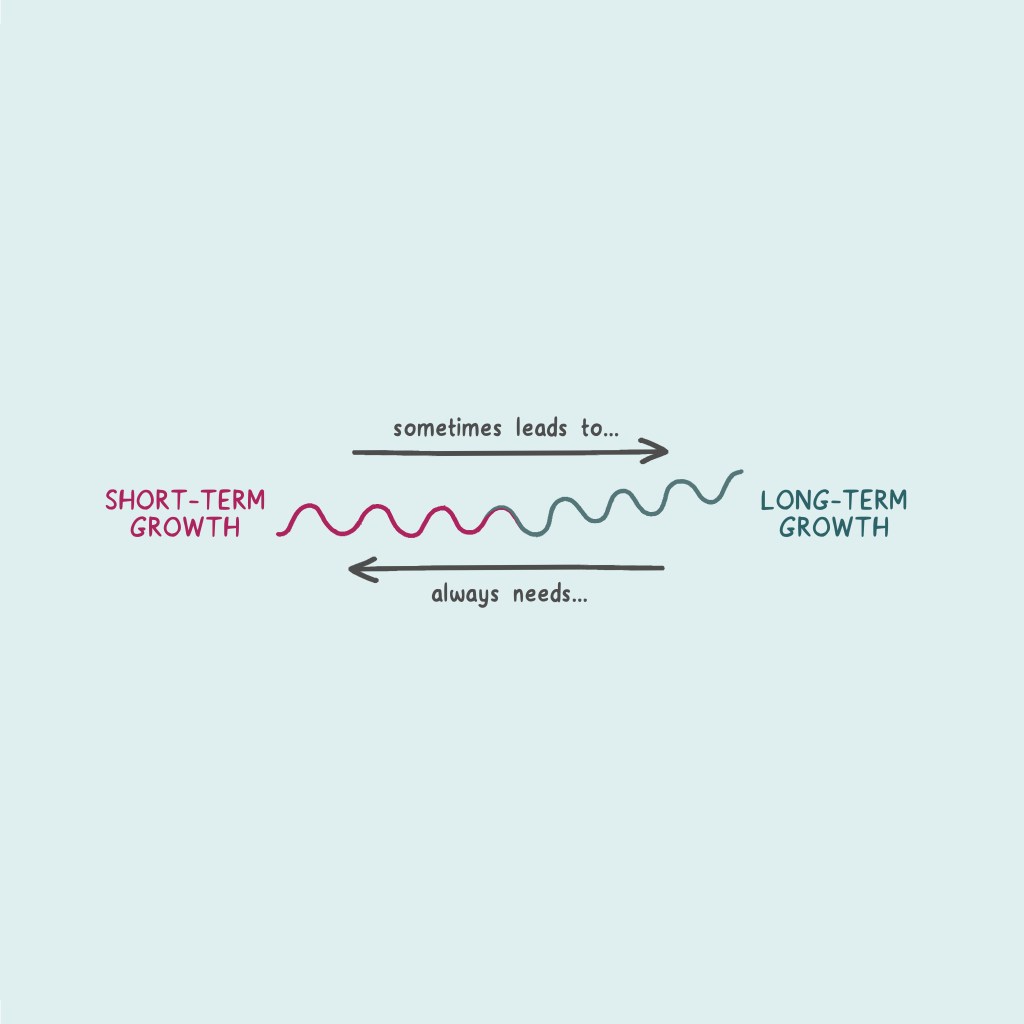
Long-term growth always has its roots in the short term. The two are connected, influence each other, and if you get the two working perfectly in harmony together, you’ll achieve the strongest, most sustainable growth possible.
But we so often miss out on maximising growth in this way because of our binary belief systems, the organisational silos we inhabit, the different job titles we have, the different channels and formats we tend to use and the different metrics we try to optimise.
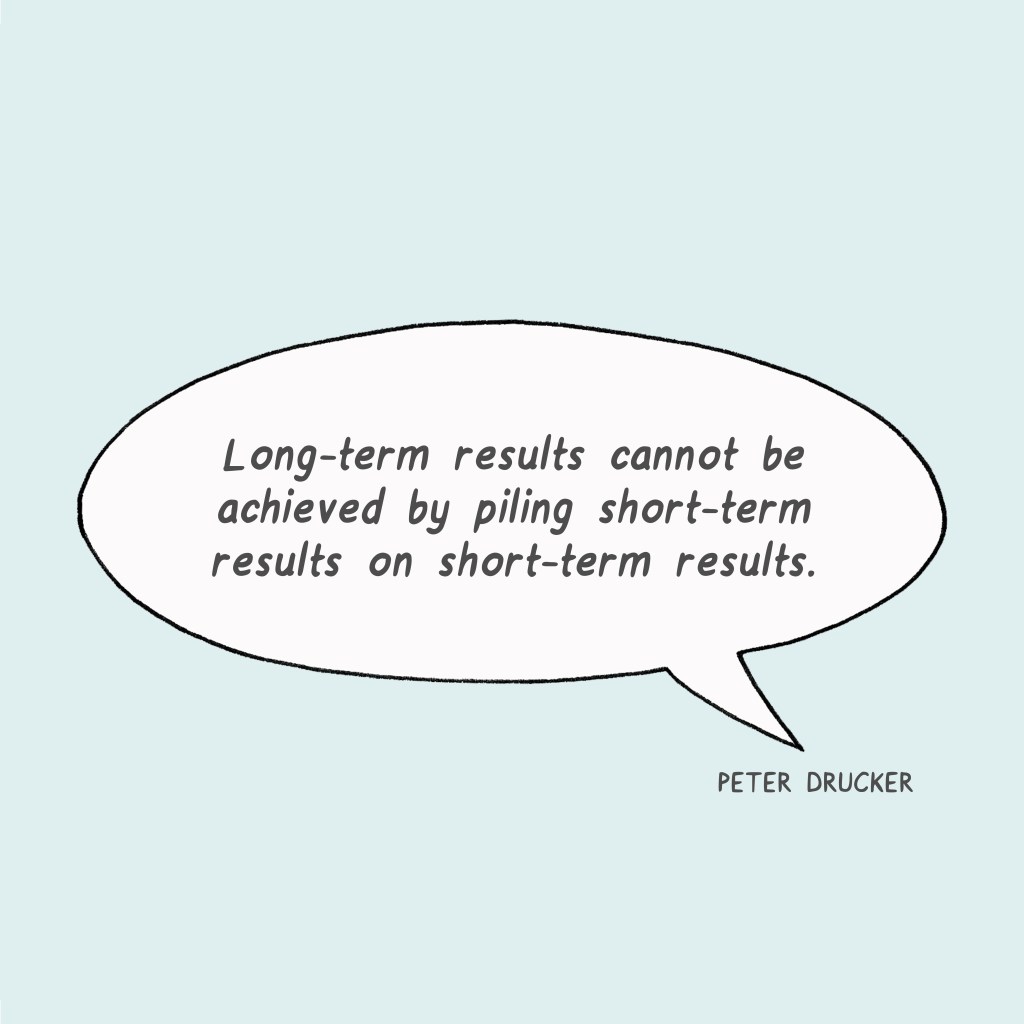
It’s important to say that long-term growth isn’t just achieved by adding up a series of short-term effects. It’s more complicated than simply being additive: it’s a multiplicative, compound effect, which starts slowly but strengthens over time.
And whilst all long-term growth actually has roots in the short term, only some kinds of short-term activity also lead to long-term results.
So the roots of long-term growth are there in the present if you do the right kind of marketing communications.
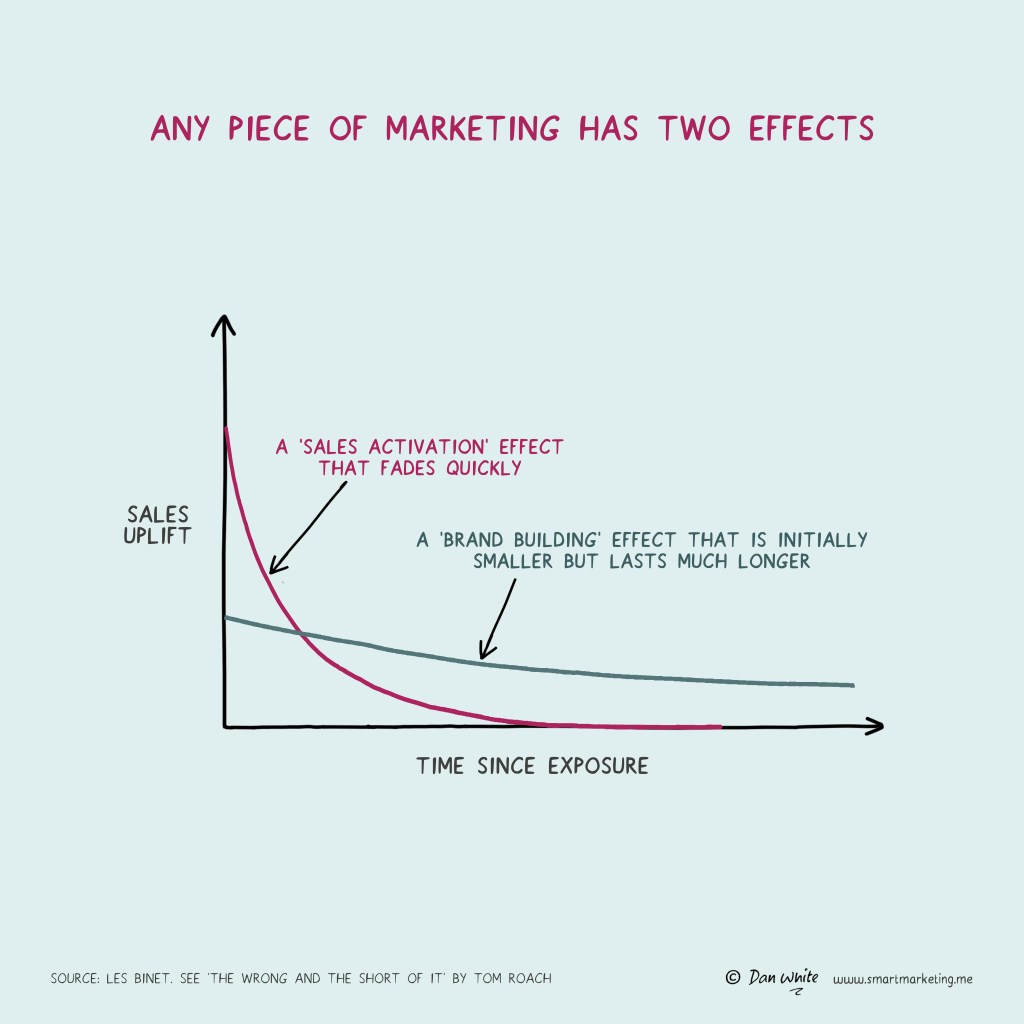
The two are always happening simultaneously, to some degree, in the same marketing campaign and in everything a brand communicates about itself. Les Binet’s chart below shows two kinds of sales impacts from a single exposure to a single execution. A short-term sales spike and a longer-term tail.
The two lines are interrelated. If you try to push the red spike higher, you’ll reduce the length of the black tail (e.g. a promotion or offer would push the red spike higher but massively reduce the black tail). Which means to achieve equilibrium you’ll need a balance across a campaign and across your entire marketing plan (although not necessarily within an individual execution).
It’s practically the law that any discussion of the long and short-term in marketing must include Binet & Field’s classic ‘steps’ chart illustrating the two different ways in which communications can drive sales – through short-term sales activation and long-term brand-building, so here it is:
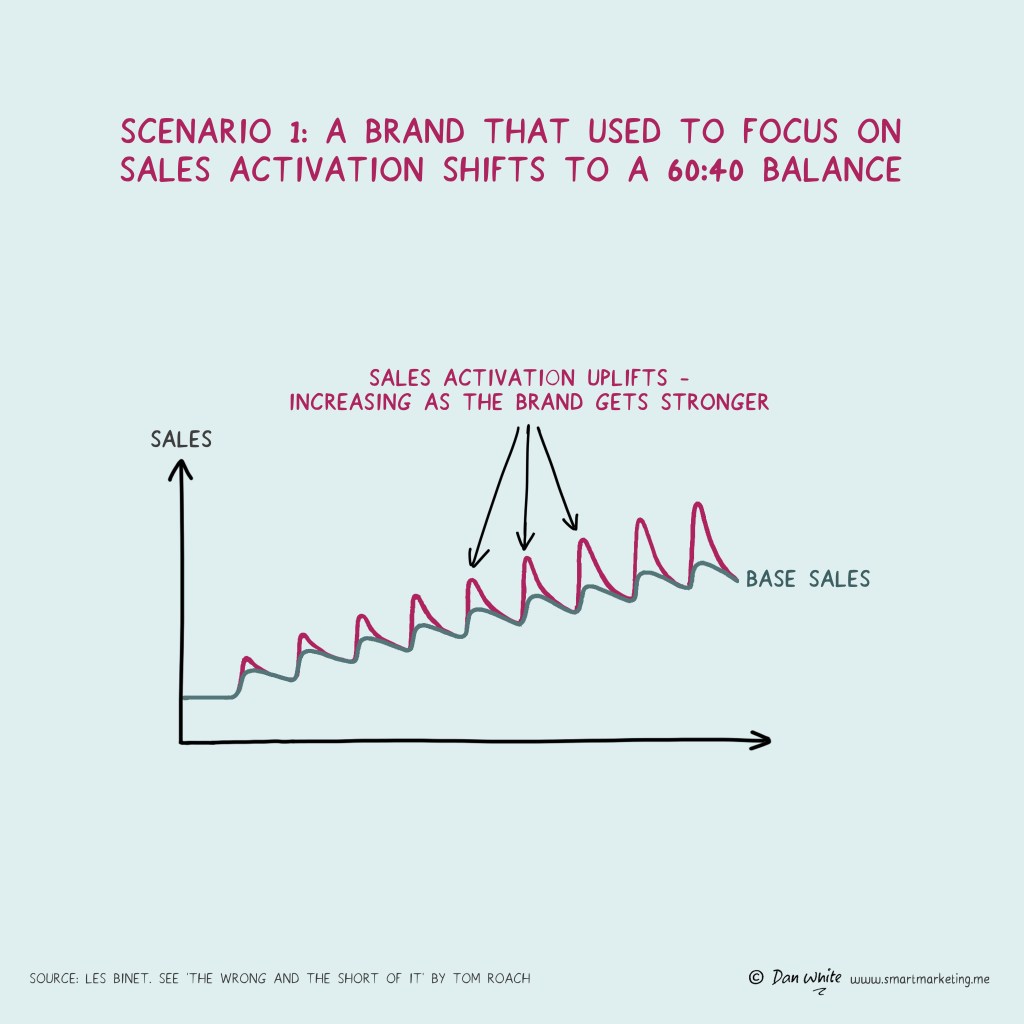
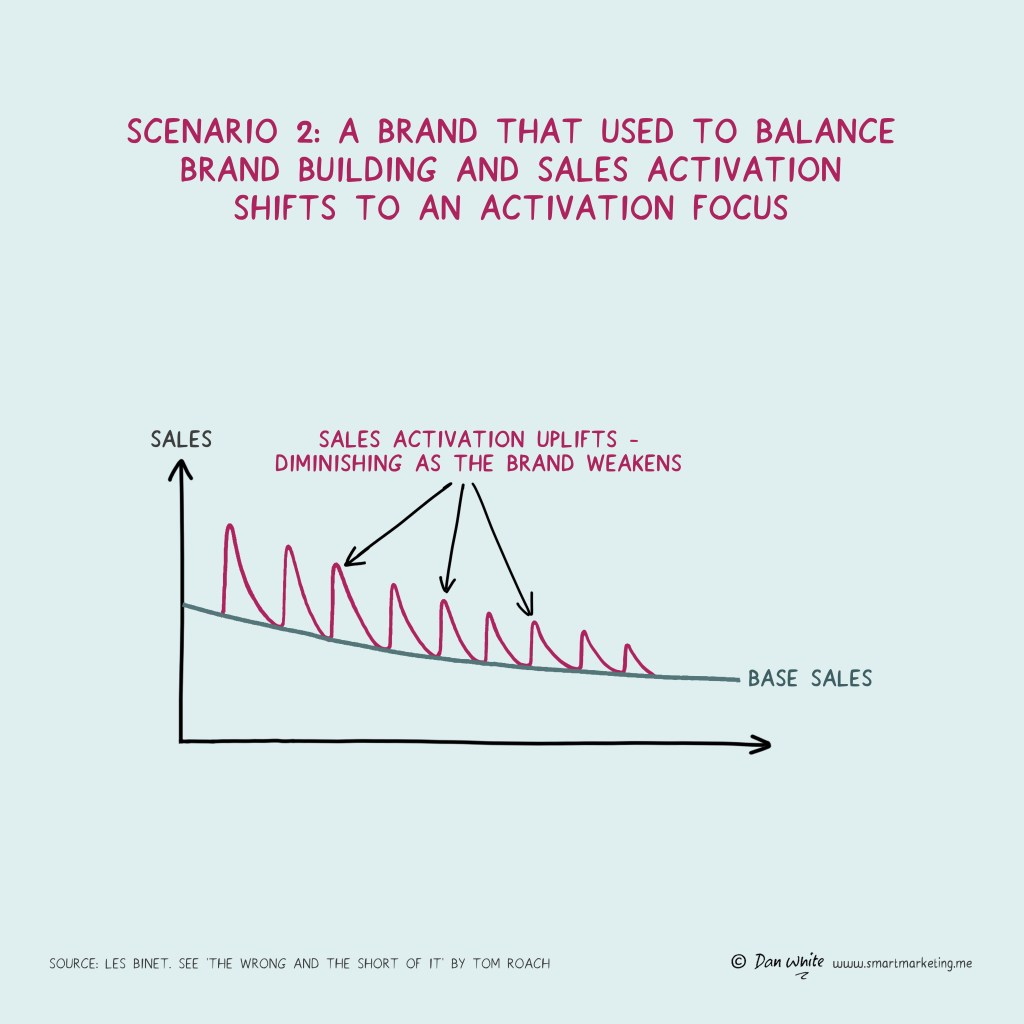
And what follows are some illustrations by Les Binet that build on this, but this time rather than separating the short and long-term effects, they show the combined effects of doing ‘brand building’ and ‘sales activation’ together in different combinations. They’re just theoretical, they knowingly exaggerate the effects for clarity, and there will of course be real world exceptions.
Scenario 1 is what could happen if a brand that had been heavily biased towards sales activation shifts its balance in favour of brand-building activity (Binet & Field suggest a balance of 60:40 is a good rule of thumb – not a fixed ratio but a good place to aim at if you’ve got no data yet on what works best for your brand). It could see lower initial short-term sales peaks, but base sales would begin to rise and the short-term sales peaks could start rising too as the strengthening brand helps improve the impact of sales activation.
Scenario 2 shows what could happen if that brand switched back to being heavily biased towards sales activation from a more balanced plan. Short-term sales peaks could get lower and base sales could drop over time. It’s a cautionary tale that you may have witnessed, for example with the arrival of a new CEO or CMO who ‘doesn’t believe in doing brand marketing’.
But charts like these don’t always totally reflect the real world options available to modern marketers, for example where performance activity is usually ‘always on’ rather than pulsed, and where the idea of scaling it back dramatically or even switching it off could feel like instant career suicide.
So below is an illustration by econometrician Grace Kite and me building on the classic ‘steps’ chart from the perspective of a common real world scenario, that of a digital-first brand whose initial strong growth from always on performance activity has levelled off, after which point brand-building activity is successfully deployed in order to take growth to the next level. It’s based on the econometric modelling Grace has done for a wide range of brands facing similar challenges.
It shows growth initially being driven by always on activity in performance channels, and the impact of that activity reaching a plateau which often happens when saturation point is reached. Then it shows the impact of a successful decision to layer in ‘brand-building’ activity. Note that this brand activity both delivers its own short and longer-term sales impacts, as well as improving the sales generated by performance channels. It also shows the compound effects of all this marketing activity working together and becoming stronger over time as the brand-building activity is further optimised.
‘All models are wrong, but some are useful’ of course, but hopefully this shows performance-first brands the growth potential of adopting a more balanced approach that includes layering in brand-building activity, and gives brands like these a little more confidence when taking the big step into doing ‘brand-building’ communication.
A PROMISING METRIC FOR MEASURING THE LONG THROUGH THE SHORT?
The long-term growth potential of campaigns should be measurable in the short-term, even if you’re not currently set up to monitor it. So you may need to start thinking about boosting your existing measurement (which would ideally already include a balanced scorecard of long and short-term metrics), with new kinds of short-term measures that can also predict long-term performance.
One metric that’s proving useful for this is share of search. Millward Brown (now Kantar) have seen that search volumes can strongly reflect how salient or famous a brand is [iv]. Google believe share of search reflects brand health and market share for brands in some categories [v].
Les Binet and James Hankins have done some great work looking at whether a brand’s share of google search can predict its market share, and have found this to be true in a wide range of categories.
Since the original version of this article was first published in 2020, share of search has become more widely known and monitoring it has become reasonably common.
I especially like it as it’s a rare example of a metric that crosses the brand / performance divide and so can connect marketers across it. Brand people instinctively know that brand search behaviour will be reflective of a brand’s fame and mental availability, and know that investing in high reach communication can be an effective way to improve it. And performance marketers of course know brand search is a hugely important source of traffic and conversion.
I believe it’s never been more important that we close the artificial divide between brand and performance marketing, and to do what’s most effective for our brands collectively.
For some brands, overcoming the barriers to this will be a big task, but if anything here helps a single team start to do this in their business that’s a win.
Brands should be aiming to create long-term communications engineered for immediate success. Advertising that, in the words of the great Jeremy Bullmore, sells ‘both immediately and forever’ [vi].
If you know marketers struggling with the limitations of short term tactics, with brands that are stuck on the performance plateau, or with leaderships who ‘don’t get brand’, who might benefit from reading this, please do pass it on.
Or drop me a line, as Jellyfish, part of The Brandtech Group, is uniquely set up to bridge a range of common divides across marketing – whether that’s brand & performance, media & content, data & creativity, and marketing’s latest false dichotomy, GenAI & humanity.





 Tom Roach