First published in Marketing Week in October 2025, this piece explores brand building in the LLMs and how to influence this new audience with brand communication.
AI isn’t just giving us a new toolkit to create brand content with, it’s building us a whole new audience to create brand content for.
Marketers need to start thinking about how their brands will reach, be thought of and show up in the LLMs and the many kinds of generative AI content they produce.
We have new inputs (synthetic data and insight), new outputs (GenAI ads, AI overviews, LLM answers), new audiences (LLMs, agents), and new consumer outcomes, with brand choices increasingly influenced by LLM answers and shopping agents (like Amazon’s Rufus).
But while consumers are already being influenced by generative AI content, even in its early-stage forms, for many brands this influence is currently only happening accidentally and serendipitously, rather than being intentionally orchestrated.
As AI use cases multiply, marketers must co-ordinate how they explore and exploit them.
Search isn’t dying, it’s having babies
While overall, search is actually increasing, some brands are reporting significant drops in website clicks of up to 30% because people are getting what they need without having to click on a link (‘zero-click search’). A high search ranking still matters (many generative answers start with a web search), but brands must also earn LLM citations by creating content referenced within AI answers
This is where GEO (generative engine optimisation) comes in. GEO shapes how generative AI systems perceive, interpret and present your brand, so that you show up as a trusted, preferred answer when people ask questions relevant to your business. It’s essentially about creating and structuring content to be easily digestible by the LLMs to influence AI summaries to feature your brand.
Success is more than simple web traffic, it’s about understanding brand visibility, perception and citation rates within LLMs via tools such as the Share of Model platform built by the company I work at, Jellyfish, part of the Brandtech Group.
And as LLMs become multimodal (processing and generating text, image, audio, video), the content types that influence answers about brands are multiplying in type and quantity too.
New search behaviours
First, there’s generative search, with AI answers embedded directly in search results, which are cannibalising click traffic. The opportunity is to be cited as a credible source within these summaries.
Next is conversational AI on platforms like ChatGPT and Gemini, where users engage in extended research sessions averaging eight to 14 minutes according to Similarweb, versus one to three minutes for traditional search. Here, brands need to establish themselves as subject matter experts so their content feeds directly into LLM training inputs.
Finally, agentic AI will see agents autonomously research and purchase for users, bypassing traditional discovery. Success requires ensuring your content is visible and your website offers the right tooling for agents to integrate with.
So AI isn’t killing search, it’s reshaping it. Before AI, searches were becoming more fragmented and distributed across more platforms, surfaces and engines, and AI is accelerating this. So to steal from what Thinkbox, the TV industry body, said when talking about the evolution of TV in a world of video platforms: SEO isn’t dying, it’s having babies.
That’s the most I’ve ever written about search, so for more on GEO, it’s probably best to speak to GEO experts with deep SEO expertise too, who are thinking about how these things work together (and not people dismissing SEO as no longer relevant).
How does this relate to brand building?
Much of the GEO conversation focuses on lower- to mid-funnel content, an area that is often perceived by brand marketers and strategists as technical and disconnected from the upper funnel, which is more commonly assumed to be the focus of attempts to influence brand perception. But GEO makes search more relevant to brand strategy than ever before – because these new search responses can be influenced to be more on-brand and on-message than ever before. And upper-funnel communications will increasingly have an impact on them too, as we’ll see.
All of the above can only really be thought of together in the context of your overall brand. What do you want it to be known for; who are your audiences; what do you want them to think, feel and do; what and where do you need to communicate with them? Classic brand strategy questions.
As LLMs increasingly mediate the answers to these questions, you’ll have to think about your brand through an LLM lens, not just a human one.
This is leading to marketers asking us big, new questions. How do we ensure our brand guidelines are fit for an AI world? How is our brand showing up in LLM outputs? How do we monitor how the models perceive our brand?
Adapting brand communications to an AI world
People start to predict ‘the death of brand’ every time a new technology promises easy access to ‘perfect’ information for rational comparison. It happened with the digital revolution, and it’s happening now. (Scott Galloway never stopped.) But ‘brand’ didn’t die then, and it won’t die now.
Given the GEO advice to create well-structured, authoritative and comprehensive content for easy LLM recall, it’s tempting to imagine that brand advertising and other communication should all be similarly information-packed so it’s well-adapted to its new audiences.
This would probably be a big mistake.
Yes, brands will need to create content that builds the same brand narrative, and builds associations with the same core set of key category entry points (CEPs), but it’s vital to recognise the difference between human and LLM audiences.
Humans have short attention spans and need emotional rewards for attending to brand communication, through advertisers making it entertaining, useful or valuable to them. We have poor memories, only remember a few brands spontaneously, and recall very little in-depth information about brands and products. Our brains are lazy and miserly – we don’t want to use up our own precious resources by doing any actual work.
LLMs, on the other hand, have an effectively infinite capacity for detail, can generate in-depth research efficiently and require well-structured, information-dense content.
Electric vehicle brand Rivian, for example, has relatively low human brand awareness compared to its AI brand awareness – it seems to be doing things that are right for GEO but less well adapted to building human brand awareness. Closing your human/AI brand awareness gap could be a useful objective for brands looking to take a first step.

Share of Model results often show superhuman brand recall, with the LLMs mentioning far more brands when unprompted than in human surveys. And when you go deeper, for instance, by analysing your brand’s share of voice within each model, you begin to find differences that can point to gaps and opportunities in a brand’s content approach.
Historically, telling your brand’s story was a way to create an emotional connection with consumers. In the age of AI, that story can be a crucial data signal. Strong brand narratives will now be dual-purpose: translating into powerful, emotional communication for humans while simultaneously serving as the source code for machines.
So if the LLMs learn that a brand stands for ‘helpfulness’, ‘thoughtfulness’ or ‘Vorsprung durch Technik’ through a consistent narrative across its online footprint, it uses that information to inform its recommendations. A brand story becomes a core piece of structured data that can explode out into an array of on-platform content. Maintaining consistency is critical: if your communication to human audiences doesn’t tally with the information your structured content provides to machines, your brand could become an incoherent mess – a fatal flaw anyway but especially for LLMs, which prize clarity and consistency. Both human minds and LLMs love brand consistency.
AI for creativity, creativity for AI
Previously I’ve written about using AI for creativity. This is about creativity for AI.
Generative AI is acting as a content creator for some brands now. LLMs can generate everything from marketing copy and social media posts to personalised customer emails and chatbot responses. This requires your brand voice to be defined not just for human writers, but for a machine that can now help us scale content production at an unprecedented rate.
As AI agents become more sophisticated, they’ll be acting as brand reps and handling ever more complex customer interactions. For example, for a telco this could mean helping a customer upgrade their handsets or switch tariffs. Humans will do less browsing and shopping on their own on retail sites, and we can already see shopping agents such as Amazon’s Rufus making an impact. These agents become an extension of your brand’s personality and values, and their words and actions have to align with your brand’s voice and behaviours.
AI interpretation of brand guidelines is crucial. One Jellyfish client had a ‘warm’ tone of voice, but early GenAI models failed to pick up and interpret this in the content they were generating, writing ‘cold’ copy lacking a friendly feel. Only through prompt testing and reverse prompting did we translate the tone of voice into machine-readable terms, specifying it as friendly, accessible and colloquial, to ensure on-brand copy.
We don’t need to be coders, but we must be concerned with how our instructions are being interpreted. Machines are literal: ambiguity causes confusion. Brand guidelines must now communicate effectively with a new audience, both the creatively-minded human marketers and the very literal LLM agents.
Category entry points (CEPs) are a strong point of connection for creative content that can speak to both human and machine audiences. Shane O’Leary has pointed out the importance of the concept of category entry points in this new world and I echo that. Queries via conversational AI are longer and more complex, with more specific references to someone’s own personal use case or specific needs, and often include a web of interrelated CEPs.
So an example of a traditional search might be “best noise-cancelling headphones travel”. When researching this with Gemini, it suggested this as an example: “I need a new pair of wireless over-ear headphones for my upcoming 10-hour flight to Tokyo. They must have exceptional noise cancellation, be comfortable for long periods and ideally have a strong reputation for battery life, as I hate running out of charge mid-trip.”
This LLM query demands a nuanced and detailed set of brand associations. Being known only for ‘noise cancelling for travel’ is no longer sufficient for a brand to be recommended.
Getting this right means understanding what consumers need from your brand and products, your communication and your product development.
This isn’t just product, SEO, content or ad strategy – it is, or at least starts with, brand strategy.
Campaigns engineered for LLM readability
One thing that brands could start doing is engineering campaigns to create more earned media for their brand, which can be a strong indirect source of training data for LLMs. Since LLMs are trained on vast public data and give greater weight to more credible sources, campaigns that trigger talkability and earn coverage and conversation in places which are known to be used to train the LLMs could be designed to influence a brand’s share of model.
Reddit, for example, is well known as a source of LLM training data, Meta’s an important source for Llama, and YouTube videos are now being transcribed for conversational text by Google’s models. What once seemed like a transient or self-obsessed ad tactic (‘creating conversation’) could have much more lasting value to a brand in this new ecosystem. So making a campaign that becomes highly talked about in Reddit, shared on Meta or commented on on YouTube isn’t just about driving salience with a specific tribe – it becomes about driving citations for a potentially much broader audience group.
So more brands may want to create famous, talkable campaigns. But they may also need to be designed with an eye on ‘AI-friendliness’ – clear, distinctive and memorable themes with narratives that are easily summarised and referenced by an AI. But it won’t be enough for campaigns to trigger sharing and conversation amongst people; the campaign’s core message will also need to be absorbed and embedded in the AI’s knowledge base.
Campaigns creating buzz without directly tying back to specific product messaging may even have a stronger impact than perfectly ‘AI-friendly’ ones that fail to connect emotionally with people.
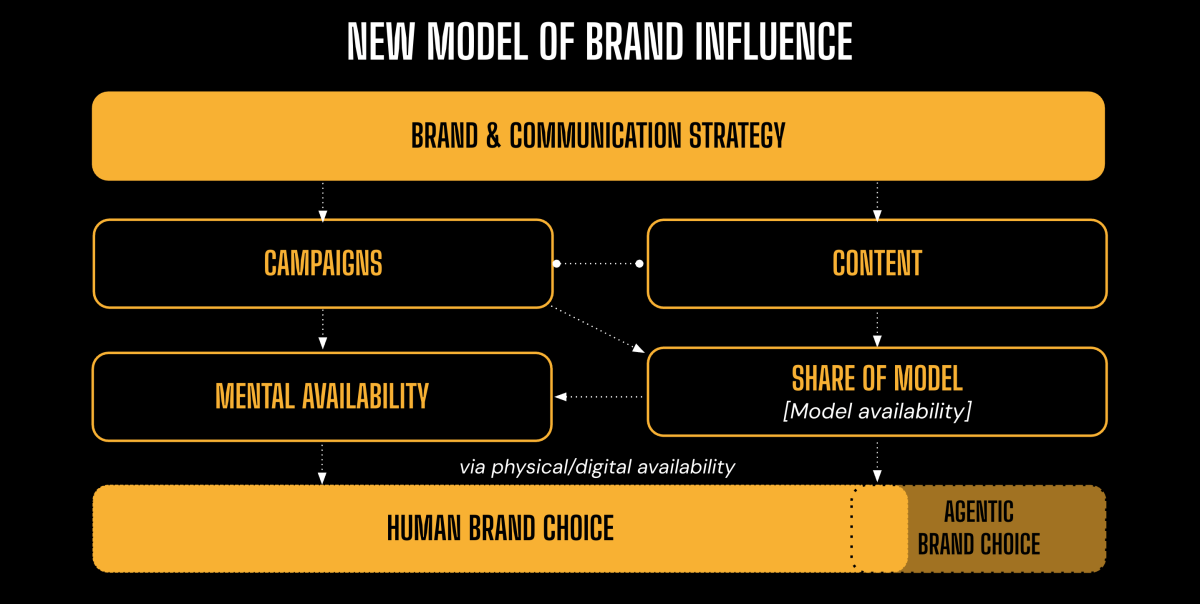
 ‘Brand’ in this world is far from being a static set of words in a strategy document. It’s a dynamic network that simultaneously builds and refreshes human memory structures while being constantly interpreted, reproduced and represented by machines.
Brand communication always needed to build mental availability; now it’s needed for model availability too. And when physical and digital availability are also strong, you have the conditions for brand choice – by both humans and agents.
 Tom Roach