This is a version of a pair of articles that were first published in Marketing Week in June and July 2023 that started life as a talk for the IPA & WARC at Cannes Lions Festival of Creativity, ‘The 3rd Age of Effectiveness’.
Part 1 – brand building
There are still people in adland who would love to turn back time to a pre-digital age. Who make bold claims like ‘digital can’t build brands’, or ‘no brand has ever been built solely with social media’.
Of course, no brand is ever built solely with advertising of any kind, it’s just one of many levers to be used in combination. And advertising is only ever a weak, not a strong force anyway. You don’t have to believe online advertising can build brands alone – just that it can make a meaningful contribution.
There’s also a less extreme feeling, a lingering doubt, that I think may be shared by a bigger chunk of adland, that the platforms dominating global advertising today aren’t yet, and perhaps never will be, as good as the previously dominant channels at helping build our brands.
But beware golden ages, they’re always fantasies. Nostalgia’s an elephant trap for marketers – it won’t build our brands any more than neophilia will. We should prioritise the use of the tools that work today, not ones that worked much better yesterday or those that will only start working tomorrow.
Full disclosure. This is a personal perspective and one that’s bound to be influenced by what I’m learning in my role as VP Brand Strategy at Jellyfish, a connected media, creative, data and tech company that builds brands by finding smart ways to combine these elements.
Before I come onto some of the evidence for brand building being perfectly and increasingly possible using the platforms we have today, I want to touch on ‘why now?’. Why are we at an inflection point where the technology is maturing and increasingly being used for brand building alongside its longstanding role assisting short-term sales?
Battle of the platforms
A fundamental factor is good old-fashioned market forces and the ongoing battle for market share of global ad spend by the platforms. Google and Meta built an unprecedented share of global advertising spend over the last two decades, initially from dominating companies’ lower-funnel budgets and by making direct response advertising vastly more accessible to millions of small companies than it had ever been before.
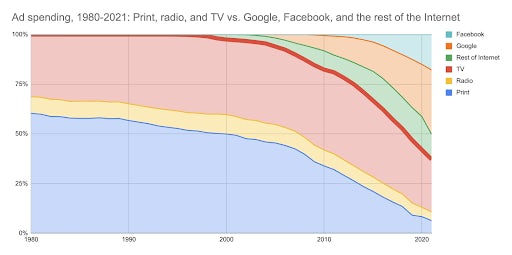
That level of growth could never continue, and they’re now being squeezed by both the newer social platforms and the huge growth of retail ad networks. So they’re now looking to both defend their existing massive shares of lower funnel budgets and also grow their share of upper funnel budgets. Everyone’s looking to match TikTok’s success in short form video. They’re all increasingly pushing their platforms’ brand-building capabilities to grow their share of that piece of the pie.
The rise of video
The rise of the smartphone fuelled the explosion in digital video that’s enabling all this. Video now accounts for the vast majority of global internet traffic, around 80% by some estimates.
And where there’s video there’s brand building. Video is to brand building what water is to life on earth. More video content means more attention, more emotional impact, and sometimes a more personal and attentive viewing experience than on bigger, more public screens. All of which means more of the long-term brand memory encoding that’s needed to contribute to sales tomorrow, not just sales today. AKA brand building.
Google’s main weapon against TV is naturally YouTube. More YouTube content is being watched on the main large screen in a household than ever (around 33% of YouTube viewing in the UK happens on TVs, according to BARB, and 45% in the US, according to YouTube data).
YouTube videos are being made with ever-higher production values, so it’s great content to put ads in and around. It’s probably the most powerful of the digital platforms for brand-building still, given the number of seconds of attention its ads command. But TikTok’s closing in, and is also helping to accelerate the growth in the video-creator economy.
Meta had to play catch-up when it came to video, with video still responsible for only around 15% of all content viewed on Facebook at the time of writing. I suspect the proportion of time spent on a given platform watching video content is probably a crude measure of its potential as a brand-building channel.
In the case of Google, innovation is making its traditional search business more upper-funnel friendly. Google’s Performance Max product generates AI-assisted video and other brand assets that are more polished and consistent with a brand’s visual identity and tone of voice than ever. Improvements in the impact of brand-building advertising can happen through better integration through the funnel, not just by creating more impact at the top.
And, just as the first platforms made direct-response advertising more accessible to millions of small businesses, some of the tools of brand-building advertising are now increasingly available to businesses of all sizes. My teenage son’s first Saturday job involved making TikToks for the local trainer store, which regularly got hundreds of thousands of views and occasionally millions, and built up a followership amongst most of the sneakerheads in the area. A role for video advertising previously completely off limits to a tiny local store.
A brand-building counter-revolution
All this is being underpinned by a greater understanding than ever of how brand-building really works. I don’t think it’s a coincidence that several of the most important books on brand growth (including Binet & Field’s seminal ‘The Long and the Short of It’) were published during advertising’s digital revolution. I suspect the rise of the digital platforms inspired an intellectual fightback by the established marketing world in defence of what works to build brands over the long term, against a new world that was putting short-term digital tactics first.
Changes to privacy laws and Apple’s subsequent updates to its operating system also led to a renewed interest in brand building.
Privacy regulations affected the ability of adtech to capture data on users and use cookies to track them across the internet and apps. Some of the links in the chain that allowed a clear sight of the ads an individual is served and the things they buy broke. This made brand advertising, which rarely demands that level of granular understanding of its impact on an individual, relatively more attractive than previously, including to businesses who wouldn’t have considered doing something so ‘unaccountable’ before.
This led to the digital measurement world looking less to attribution and more to measurement techniques such as econometrics and geo-experiments – both better able to capture the impact of brand activity.
The performance plateau
Increasing numbers of brands, having once had a more performance-driven approach, have also got to a point where their lower-funnel activity reaches saturation, they reach a performance plateau, and they then try a more balanced full-funnel strategy. I’ve written about this previously so won’t go over that here – but the sheer number of brands experiencing this feels like it must be a factor in why more and more brands are turning to digital for brand building, not just performance.
Econometrician Grace Kite and the Advertising Research Community (ARC) produce meta-analyses of the econometric modelling of the impact of media on everyday brands and campaigns, not just effectiveness awards winners (which are the basis of Binet and Field’s research). This work has been helpful in understanding the optimum balance between online and offline ad spend. ARC’s conclusion in 2021 was that on average the optimum percentage to spend online was 40% to 50%
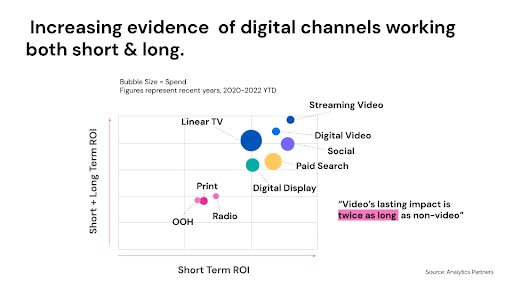
Various recent studies, including by ARC, have shown how many of the digital channels are equally capable of producing both short and long term effects, vital evidence to help end the view that digital advertising is just for triggering an immediate response.
According to econometrics company Analytics Partners, most digital channels are capable of contributing to the long as well as the short term. The importance of video for brand building is also evident in their analysis, the lasting impact of video channels typically being twice as long as non-video channels.
Brands built in digital
So what brands can we point to that have been built partly or solely using today’s platforms?
You have to be wary of placing too much emphasis on individual case studies, but Gymshark is a brand being ‘built in social’ with considerable creativity and marketing nous. Gymshark achieved profitability and unicorn status in a decade, and got there partly by growing a cult-like following in social media fuelled by influencer marketing. Too much has probably been written about Liquid Death already, but that brand’s mix of highly distinctive branding, impactful social-first communication, experiential and smart approach to distribution has proven to be a winning formula.
If we need more examples, there’s a fascinating and highly successful cohort of global SaaS brands such as Fiverr, Monday and Wix, which are often big YouTube advertisers, many of which continue to see success.
Are there bigger, more valuable brands and businesses out there that are less purely reliant on social or digital advertising? Yes. But it’s hard to imagine any of the world’s biggest brands not seeing digital advertising as an important part of their brand-building mix today, as well as of their sales activation mix.
Continued importance of brand equity
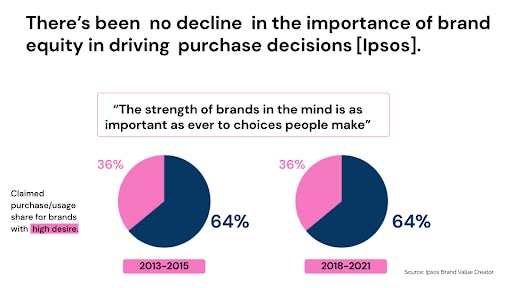
A discussion with Ipsos on the topic of ‘brand building in digital’ led to this question: given the massive shift in ad spend towards digital channels, if digital advertising were only about driving short-term sales, shouldn’t we have seen a big downward shift in the importance of brand equity as a driver of purchase decisions?
Well no, as it turns out. There’s actually been no decline in the importance of brand equity in the purchase decisions people make according to Ipsos’ ‘Brand Value Creator’, which suggests that “strength in the mind remains as important as ever as a driver of purchase decisions” – staying at the same level across its entire global database over the 2018-21 period as during 2013-15.
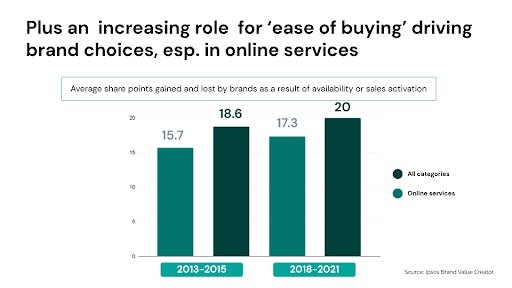
Ipsos data also suggests that ‘ease of buying’ as a factor in purchase decisions has grown over the same period, especially in online services categories, suggesting that whilst brands are still being built in the digital age, digital channels may also be creating greater opportunities to close the sale. Digital has been additive for marketing, not subtractive.
What marketers think
But what about the clients’ view of all this? What do marketers believe about brand-building in digital? Do they think digital has a lot of ground to catch up before it’s seen to be as useful as ‘traditional’ channels for brand building?
Actually Marketing Week’s ‘Language of Effectiveness’ survey of over 1,300 marketers suggests digital is far more mature for brand-building than others may believe. In fact a huge number, 86.7%, believe digital media is effective at brand-building, which is more than the 80.1% who believe offline media is effective at building brands.
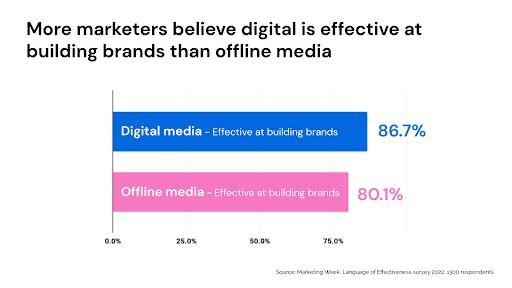
So marketers are far more optimistic than any remaining adland sceptics, and their perspective is much more in line with the econometrics data.
All of which suggests brand building is absolutely possible in today’s platforms, and that many brands are achieving it already.
The nostalgics may have had a point – maybe we just weren’t very good at using digital to build brands initially. But over time we’re learning how to use the new tools and are getting better at it.
But could we get even better? Almost certainly, especially when it comes to creativity. And we’ll look at that more closely now.
Part 2 – Creativity
Major issues do still exist in terms of creativity in digital advertising, including short-termism, a legacy from when its principal or even sole role was the narrow targeting of hot in-market prospects. That meant brands missing out on driving more sustainable long-term growth by reaching new audiences, and left many brands on the performance plateau. It meant too many ads that are ignorable or even irritating to everyone apart from those ready to buy right now.
Brand building relies on reaching people who are not currently in the market and so requires a different creative approach. As they’re mostly not interested in you, you have to try much harder to get their attention and make a lasting impression, so that when the time comes, the little seeds you’ve sown in their synapses have a chance of doing their work.
And this leads us to the biggest issue we face if we’re going to get better at using the platforms to their full potential to help build our brands.
The attention problem
Karen Nelson-Field’s work on attention gave us the alarming headline that 85% of 130,000 digital ad views she researched didn’t achieve the 2.5 seconds or more of active attention necessary to impact longer-lasting brand memories and build mental availability.

The theory is that ads under this threshold can basically only drive a click. Ads over it are able to influence future sales too. This is the essential difference between brand-building ads and direct-response ads. Karen Nelson-Field’s work suggests the more seconds of active attention an ad receives, the more days it can stay in the memory, and the longer it can work.
Another important finding from Nelson-Field is that a given platform has a set range or limit on the amount of attention people will pay to ads there – it’s the platform and format, not the creative, that makes the major contribution to the total number of attention seconds it will receive. Optimising your media plan for attention is becoming increasingly common.
But whilst platform and format choice determines the broad range of attention your ads can receive, it’s creativity that helps get you to the top of that range. “Attention elasticity forms the opportunity for ad creative,” says Nelson-Field. So good ads can get you somewhat more attention than bad ads on a given platform, albeit this will likely still be limited.
This is a challenging finding if, like me, you’d love to believe that the sheer force of human creativity can break through any boundaries and get everyone to watch every last second of everything you and the team have laboured over. The idealist in me still believes the finding must be wrong and wants every campaign to be an outlier; the realist in me has to admit this is extremely unlikely.
Whilst getting enough attention is a major challenge in digital advertising, it’s not a new one.
Ads of all kinds have always had surprisingly large drop-offs in attention. Data from measurement companies such as Lumen shows, for example, that magazine ads can have attention curves close to a YouTube non-skippable ad, and newspaper ads can have a steep retention curve akin to an in-feed Facebook ad. The difference is that we now have the data and are more aware of the drop-offs in digital ads than we’ve ever been before.
 And it’s not a new issue for creative people to be wrestling with either. You can see it in the famous quotes of many of the ad legends of the 60s:
- Bill Bernbach: “If your advertising goes unnoticed, everything else is academic.”
- Mary Wells Lawrence: “People are very sophisticated about advertising now. You have to entertain them. You have to present a product honestly and with a tremendous amount of pizazz and flair. But you can’t run the same ad over and over again. You have to change your approach constantly to keep on getting their attention.”
- John O’Toole: “[We’re] an uninvited guest in the living room of a prospect with the magical power to make you disappear instantly.”
O’Toole was talking about people flipping TV channels here, but could just as easily have been talking about ad skippability or scrollability today.
The issue of how to get and keep attention is one ad creators have always had. It’s not caused by ‘digital’ or by specific platforms, it’s caused by people not being as interested in ads as the stuff they’re actually there to see. And the solution is both simple and hard: creativity.
Platform best practices
But before applying that creativity you need to understand the dynamics of the platform you’re creating for. Why people are there, what they’re there to see, the ‘grammar’ of the stuff they like there. Only really knowing how things work on a platform, and knowing what the algorithms favour, can help you get more attention there and help you flatten the curve.

And this takes time to learn. We’ve had 70 years to learn how to make TV ads, but only four or so years to make TikToks. Of course we’ve not perfected this yet and of course we’re only going to get better at it.
All the research evidence says you need to learn the ‘rules’ of each platform and create bespoke ads for them to be able to maximise attention on them. Kantar found that campaigns with ads tailored to specific digital channels have 13% greater impact on brand equity overall versus using the same ads on each platform.

Similarly, Ipsos found that the same creative often doesn’t perform well across formats. In their research, strong performing TV commercials didn’t translate well into skippable and in-feed environments, and ads developed for skippable formats performed pretty well in-feed but badly in TV.
A common finding from these studies is that you have to apply a platform’s ‘best practice’. This often includes the story structures that work best to get and keep attention. YouTube’s advice is to use ‘emerging story arcs’ not ‘traditional story arcs’. YouTube ads using new story arcs get four times the average watch time before being skipped – 20 seconds compared to five – and ads with traditional arcs are twice as likely to be bottom performers. This is similar to TikTok’s advice, which says you should start with a bang to hook people’s attention, not the ‘slow build’ of a TV commercial.

In an analysis by Kantar of 11,000 ads, applying YouTube’s best practice principles (attention, branding, connection, direction) was found to contribute +17% in long-term brand contribution. Similarly, bespoke Snap ads get 1.4 times the attention of ads repurposed from other platforms and bespoke TikTok ads get three seconds more watch time and 25% more completed views.
So definitely don’t just put your TV ad on the platforms. And don’t put your Facebook or YouTube ads on TV. But also, you can’t just put ads for one digital platform onto another one, and expect them to work as well as something bespoke.
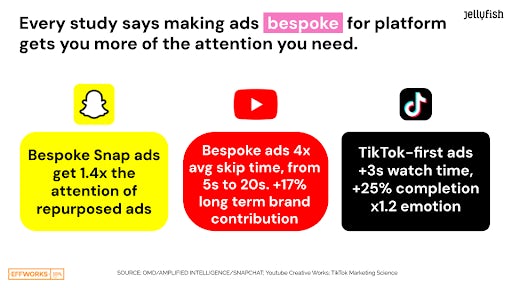
One of my favourite findings comes from Ipsos: “Challenge category conventions. Taking an unconventional creative approach produces 40% longer viewing time on average for skippable ads.”
It’s exactly the same principle they’ve been teaching from day one at creative agencies for decades: it’s pure ‘when the world zigs, zag’.
Emotional impact
Another principle that’s coming out of recent studies, but isn’t always mentioned in the basic platform best practice, is the importance of emotion in driving brand impact.
System1’s studies of ads on Meta and Pinterest show ads that create a strong emotional response are much more likely to also drive brand awareness or brand lift. High-emotion ads on Pinterest drove six times as much brand lift as low-emotion ads for example.
When you look across these principles, they’re actually principles that Bernbach, Ogilvy and Wells Lawrence would recognise.
You need to know what works on a given platform, make ads bespoke for them following their technical advice, and ensure they deliver the holy trinity of attention, branding and communication. But as well as A, B and C, you also need D and E: difference and Emotion. So:
- Get attention fast
- Integrate brand/product
- Use stories to communicate (and use new arcs)
- Difference works best
- Evoke intense emotion
None of these principles is ground-breaking, in fact they should be meat and drink to all creative advertising people.
And brands are learning. We’ve had years of people in the industry complaining that digital ads aren’t different, funny or surprising, but I’m seeing more evidence in my feeds of agencies and brands getting it right.
Tesco are clearly having fun and some success experimenting with TikTok, including with their #VoiceOfTheCheckout campaign.

Hilton Hotels’ 10-minute TikTok was genuinely great craft: a funny script that played with the grammar of the platform and a great performance from Paris. I doubt many people watched all 10 minutes, but then that’s not necessary for it to do its job.

And on top of this advice for paid ads, we now also have another really useful tactic. There’s a huge and growing army of creators who live or die by knowing what works best for their channels and their personal brands to retain viewer attention. And creator-led advertising is growing fast, reaching around $16bn in value globally last year.
Creators earn more attention
The best creators know how to make attention-grabbing thumbnails and opening shots; to deliver the promise of a video straight away; that music creates a feeling; that you need repeated emotional highs to keep people watching.
And when applied to brand creativity, their work can sometimes work even better than the professionals’. Platform-native creative made by creators on TikTok consistently outperforms repurposed or adapted ads in driving brand recall there, according to TikTok’s marketing science team. Influencer marketing can be easy to dismiss as hot people holding things. But when it’s creative people making things it becomes an entirely different proposition and much harder to dismiss.
Maybelline’s mascara TikTok was a joyfully silly PR stunt, with the quirky ‘is it real or fake’ intrigue of the Jacquemus handbags video from earlier in the year. You can argue about what it’s actually ‘saying’ about Maybelline. But if its job was to get attention for the brand in a distinctive way, it looks like a big success.

So this is the second creative opportunity: to break the attention curve and not just flatten it, with native content made by creators that can earn even more attention.
Which gives us two tactics: paid ads that are highly tailored to the platforms, and creator-made videos that are totally native to them.
All this has implications for budgets and consistency. You don’t want to stretch your communication too thinly across too many platforms, or end up doing one-off campaigns that don’t add up to a greater whole. You need to be as focused in your brand strategy as ever. You may have to use fewer platforms, but select them more deliberately. Some of these are media strategy questions, but plainly have an implication for creative: another argument for planning media and creative more closely together than has become the norm.
And once we’ve mastered the current crop of platforms, new ones will of course come along for us to get to grips with. And so the cycle continues.
 Tom Roach
2 replies on “Brand building in the platforms”
[…] successfully align images and messages to form a consistent brand requires content orchestration across channels, said Roach. Platforms reward volume and novelty, […]
LikeLike
[…] successfully align images and messages to form a consistent brand requires content orchestration across channels, said Roach. Platforms reward volume and novelty, […]
LikeLike